Angel Sergeev is a seasoned automotive journalist with over 15 years of experience covering the automotive industry. Born in Sofia, Bulgaria, he began his writing career in 2010 while pursuing a degree in Transportation Engineering.
His early work included contributions to the local edition of F1 Racing magazine (now GP Racing magazine) and roles at various automotive websites and magazines.
In 2013, Angel joined Motor1.com (formerly WorldCarFans), where he dedicated over a decade to delivering daily news and feature articles. His expertise spans a wide range of topics, including electric vehicles, classic cars, and industry topics. Angel’s commitment to automotive journalism is further demonstrated by his membership in the Bulgarian Car of the Year jury since 2013.
Honda brought the Prelude back, and the hype went wild. Then the specs and price dropped, and a lot of fans went, “Wait… that’s it?” The new Prelude uses a 2.0-liter two-motor hybrid very similar to the Civic Hybrid. It makes about 200 hp and 232 lb-ft, sends power to the front wheels, and uses an e-CVT. Early real-world numbers put the 0-60 mph closer to the 8-second range. That is not slow, but it is nowhere near the “hero coupe” people had in their heads when they heard the Prelude name again.
Then you look at the cost. Honda set the price at about $43,195, with one fully loaded trim and no manual. Some dealers already float markups that push cars well north of $50k. That sticker makes the Prelude more expensive than a lot of honest sports cars that feel quicker, sound better, and send power to the rear. It sits in a weird middle lane – good looks, sweet interior, strong mpg… but mild pace for the money.
For this list, the Prelude’s U.S. base price of $43,195 is the cutoff. Every car here uses a hybrid or plug-in hybrid setup, including a couple of mild hybrids where the electric side clearly helps performance. Each one either makes more power than the Prelude, runs a quicker 0-60, or both. All of them show up on the used market at or under Prelude money in normal listings, not unicorn auction results.
The 2026 Honda Prelude is back as a sleek hybrid sports coupe, blending classic style with modern tech ahead of its September debut.
On forums, this is the one that makes people say, “Hold up… the Prius is quicker than the Prelude?” The latest Prius Prime looks sharp and packs a punch. Its 2.0-liter engine and electric motor combo make 220 hp, which already beats the Prelude on paper. In independent testing, the Prime hits 0–60 in the high-6-second range, and in the real world, it feels eager off the line thanks to instant electric torque.
The wild part is how complete the package feels. Around town, the Prius Prime cruises on EV power for short trips. On a twisty road, it stays flat enough and sharp enough to keep an enthusiast awake, especially with decent tires. Used prices in the U.S. sit mostly in the high-20s to low-30s, so a buyer can spend less than Prelude money and get a plug-in hybrid that matches or beats it in a straight line. Toss on lowering springs and stickier rubber, and you basically get a stealth eco-hot-hatch that just happens to return stupidly good mpg.
The BMW 330e is what happens when BMW builds a plug-in hybrid and remembers that a 3 Series still needs to feel like a driver’s car. It pairs a 2.0-liter turbo four with an electric motor for up to 288 hp when the extra function kicks in. In that mode, it sprints to 60 mph in about the mid-5-second range, which puts a clean second or more between it and the Prelude.
Here’s the kicker – the 330e gives you real rear-wheel drive (or xDrive), a proper 8-speed automatic, and that classic BMW balance. The steering talks, the chassis rotates, and the car feels happy doing actual track-day stuff if you ask it to. On the used market, prices run from the mid-20s up to the low-30s for very nice, recent cars. For roughly the same money as a new Prelude, an enthusiast can hop into a plug-in 3 Series that pulls harder, drives better, and still covers daily commuting on mostly electric power. Add a mild tune and a set of good tires, and you’re flirting with old 340i performance while the Honda is still working up through its simulated “gears.”
Toyota builds a hybrid coupe with 200 hp. It also builds a plug-in compact SUV that just laughs at it. The RAV4 Prime cranks out 302 hp from a 2.5-liter engine and strong electric assist, with electric motors on both axles for e-AWD. In testing, it cracks 0–60 in about 5.7–5.8 seconds, which makes it one of the quickest Toyotas this side of the GR lineup.
On paper, it is a family crossover, but the way it launches makes it feel more like a tall hot hatch. It just goes when the driver plants the throttle, and the torque from the electric motors covers up any lag. Add a roomy cabin, big cargo space, and real EV range for daily use, and it checks a lot of boxes in one hit. Used prices have calmed down since the early crazy days, many U.S. listings now sit in the mid-30s, right under Prelude money. So for the price of a front-drive coupe that tries to fake sportiness with simulated shifts, an enthusiast can end up in a 300-hp AWD plug-in that rips off real 5-second 0–60s while hauling kids, bikes, and whatever else life throws at it.
The Lexus GS 450h is the perfect answer when someone posts, “I want something fast, comfy, reliable, and not boring.” Under the hood sits a 3.5-liter V6 plus electric drive for around 338-345 hp, and the car hits 60 mph in the mid-5-second range. Even with an e-CVT, the system blends power so smoothly that it just feels like a strong, torque-rich sedan that always has another shove in reserve.
In F Sport trim, the GS 450h turns into a legit sleeper. You get sharper steering, stiffer suspension, and bigger brakes, so it can hang with plenty of “real” sports sedans on a back road. The best part for enthusiasts is pricing. These cars took the usual luxury-sedan depreciation hit, which means you can find solid examples in the low- to mid-teens, with very nice later cars still topping out under Prelude MSRP. You basically trade coupe looks for four doors, rear-wheel drive, more power, and the kind of long-term durability Lexus nerds brag about.
Need something that can tow, haul kids, and still run away from the Prelude from a stoplight? The Porsche Cayenne S E-Hybrid is that one weird friend. It uses a supercharged V6 and an electric motor for 416 hp and a hefty wall of torque, and it cracks 0-60 in the mid-5-second range despite its size. All-wheel drive and a solid 8-speed automatic help it get out of the hole hard and stay composed on back roads.
From the driver’s seat, it feels like a big hot hatch with a high seating position. The steering has that Porsche weight and precision, the brakes shrug off abuse, and the chassis stays surprisingly flat if you find one with the right suspension package. The crazy part is the price. Early Cayenne S E-Hybrids already live in the high-teens to mid-20s in the U.S., with only the cleanest, lowest-mile examples poking near Prelude money. The catch is obvious: this is a complex German plug-in SUV. You have to budget for real-world upkeep, and hybrid battery work is not cheap. But if you play it smart, you get a 400-plus-hp Porsche family hauler that treats a Prelude like rolling scenery.
If the Cayenne is the fast hybrid family box, the Panamera S E-Hybrid is the big, weird Porsche hatch that actually lives pretty close to the “GT coupe” vibe Honda likes to talk about. It runs the same basic supercharged-V6-plus-electric setup as the Cayenne S E-Hybrid, with 416 hp on tap and a 0-60 time just over 5 seconds. Thanks to the lower center of gravity and more car-like stance, it feels a lot more like a proper grand tourer than an SUV.
On a freeway pull, a Panamera S E-Hybrid just walks away from a Prelude and never looks back. You get real Porsche tuning in the suspension and brakes, plus a cabin that mixes hatchback practicality with premium touches. Used prices make the car extra tempting. In the U.S., you can find these in the high-teens to mid-30s depending on mileage and spec, which easily undercuts a brand-new Prelude. The trade-off is exactly what you expect, just like the Cayenne – complex hybrid hardware, pricey parts, and the need to find a shop that knows these cars.
These sleeper sedans pack a serious punch and won’t drain your wallet.
Infiniti quietly built one of the nastiest sleeper hybrids of the last decade. The Q50 Hybrid runs a 3.5-liter V6 paired with an electric motor for 364 hp, and it rips to 60 mph in right around 5 seconds. That is serious pace even today. The gas engine loves to rev, the electric side fills in the low-end torque, and the whole car just lunges when the driver digs into the throttle.
Because Infiniti’s brand heat cooled off, the Q50 Hybrid sits in used-car no-man’s-land. That is great news for enthusiasts. In the U.S., you can find these things in the low-teens without much effort, and high-mile examples sometimes dip under $10k. For that money, you get rear- or all-wheel drive, a 7-speed automatic, and a chassis that responds well to the usual mods: better pads and fluid, decent coilovers, and proper summer tires. The steer-by-wire setup on certain trims divides people, and the infotainment feels ancient now, but if the goal is “make the Prelude look slow,” the Q50 Hybrid does it in a completely unfair fashion while leaving a lot of budget on the table for upgrades.
On paper, the Acura RLX Sport Hybrid looks like a mild-mannered dad sedan. Underneath, it is secretly running a detuned NSX-style drivetrain. Acura dropped a 3.5-liter V6 under the hood and backed it up with three electric motors for 377 hp, torque-vectoring SH-AWD, and a 7-speed dual-clutch gearbox. In instrumented testing, it hits 0–60 in just under 5 seconds, which absolutely buries the Prelude.
The rear electric motors do something a front-drive coupe simply cannot – they overdrive the outside rear wheel and help the big sedan rotate into a corner. It feels weird at first, then addictive. You get quiet cruising, luxury-car comfort, and then a weirdly agile feel when you switch into Sport mode and start leaning on it. On the used market, RLX Sport Hybrid prices float in the mid-20s for decent cars, maybe low-30s for super clean examples. That is often half of what some dealers will ask for marked-up Preludes. For an enthusiast who wants stealth performance, this thing ticks all the boxes – big V6 noise when you want it, hybrid torque fill, and a chassis that punches way above its “old guy Acura” image.
The Mercedes-AMG E 53 is technically a mild hybrid, but nobody argues with the results. Its 3.0-liter turbo inline-six works with a 48-volt EQ Boost system to make around 435 hp, and the car dashes to 60 mph in the low-4-second range when paired with 4Matic+ all-wheel drive. That is almost double the Prelude’s power and feels like a different sport altogether when you hit the throttle.
This thing is a highway missile that still plays nice in daily life. The interior feels like a proper luxury lounge, the seats support spirited driving, and the adaptive suspension can switch from comfy to firm with a button press. On the used market, early W213-gen E 53s now live solidly in the mid-30s to low-40s according to KBB. So for about the same money that buys a Prelude, an enthusiast can roll into an AMG with 430-plus hp, real performance pedigree, and a ton of tuning headroom. It is the classic “do-everything” car – school runs, road trips, track days, back-road blasts.
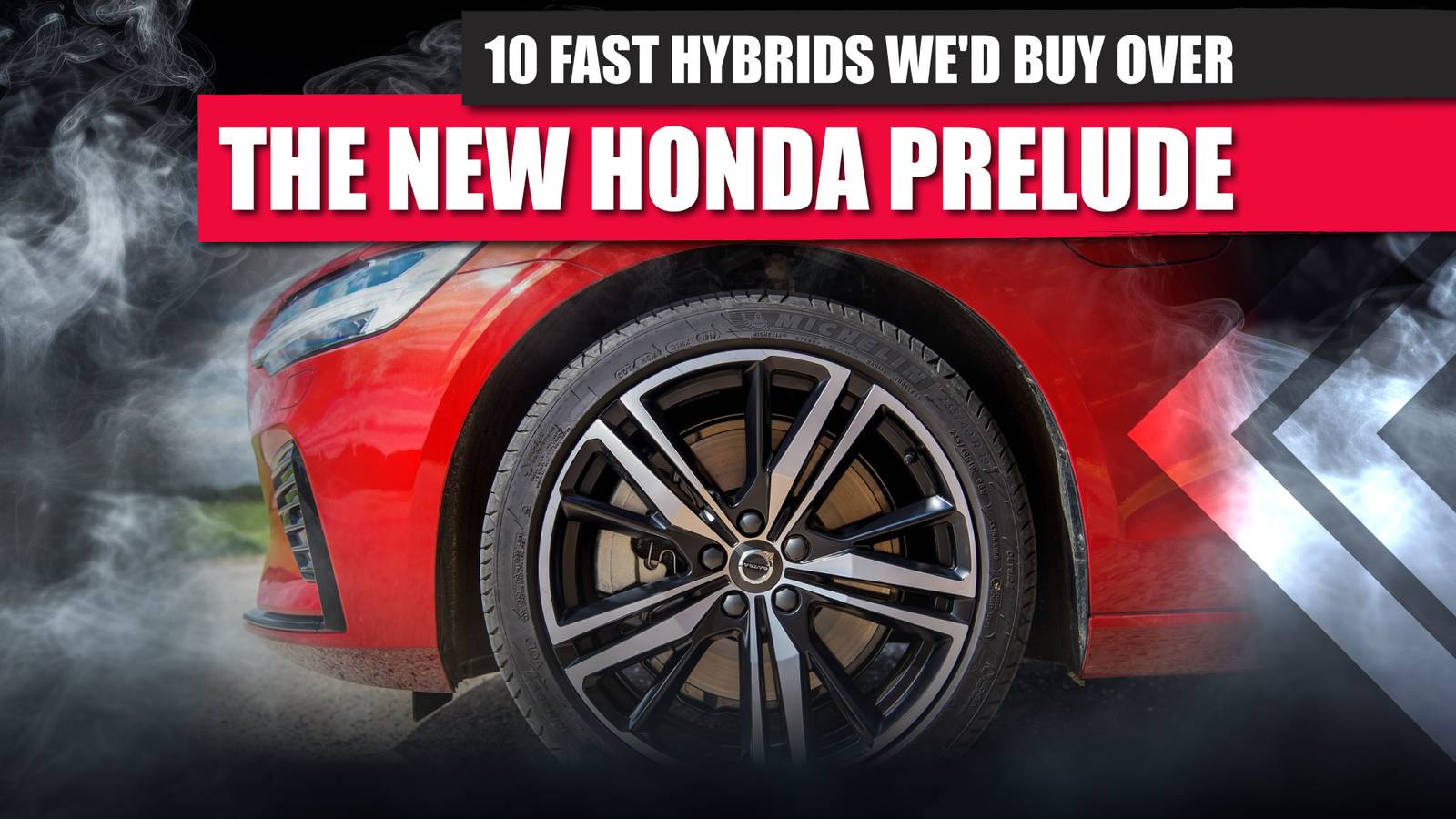
At the top of this list sits a car most people still sleep on – the Volvo S60 Recharge T8. The plug-in setup throws a turbocharged and sometimes supercharged four-cylinder at the front wheels and a strong electric motor at the rear. Together they pump out about 455 hp and over 520 lb-ft of torque, which shoves the S60 to 60 mph in roughly 4.1-4.4 seconds. That is serious “luxury rocket” territory.
The vibe is very different from some of the other heavy hitters here. The S60 looks clean and understated, the interior feels like a cool Scandinavian living room, and the car just destroys highway miles in silence when it runs in hybrid or EV mode. But when the driver drops the hammer, it hits harder than a lot of German sport sedans and makes the Prelude look like an econobox with a body kit. Used prices in the U.S. usually sit just under $40k for recent cars, which keeps it under Prelude MSRP while delivering more than twice the horsepower. For an enthusiast who wants a fast hybrid that flies under the radar and still feels special every day, the S60 Recharge T8 is a killer endpoint for this list.
We want to hear from you! Share your opinions in the thread below and remember to keep it respectful.
Your comment has not been saved
This thread is open for discussion.
Be the first to post your thoughts.