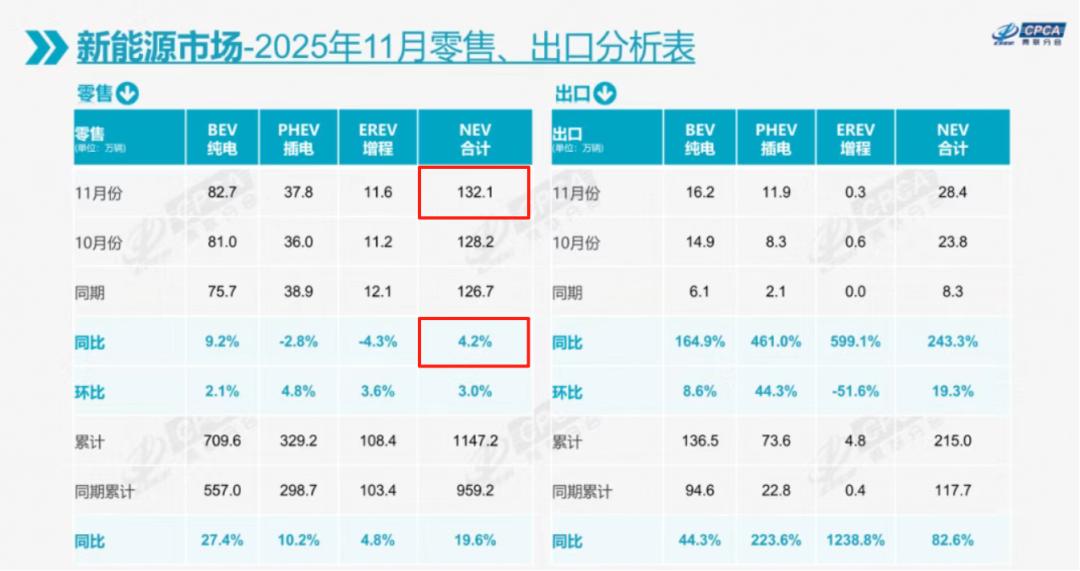
The latest data from the Passenger Car Association shows that in November, the retail sales volume of new energy passenger vehicles in the domestic market reached 1.321 million units, a year-on-year increase of 4.2%, and the retail penetration rate of the new energy market reached 59.3%.
Picture/Analysis of retail exports in the new energy market in November 2025. Source/Screenshot of New Energy Outlook from the Internet
However, behind the glorious data, the path is not all smooth.
In sharp contrast to the hot sales momentum are the frequent recall announcements that appear in the public eye. From January to November, many mainstream car companies successively filed recall plans with the regulatory authorities, involving a cumulative total of more than 2 million vehicles.
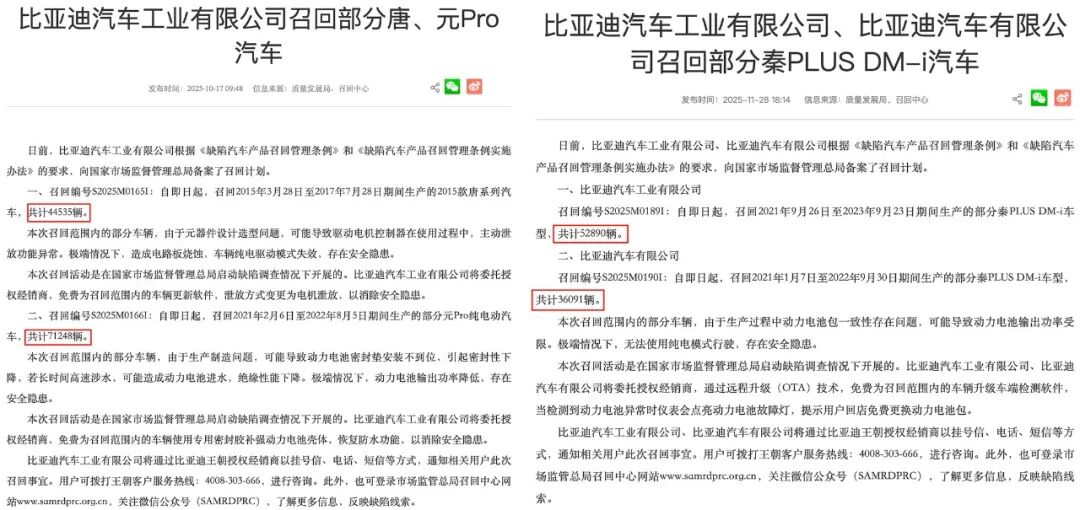
Taking BYD, the company with the highest new energy vehicle sales, as an example, although it sold more than 480,000 vehicles in November, nearly 90,000 units of its Qin PLUS DM-i model were recalled in two batches due to the “consistency issue of the power battery pack”.
On one hand, it has the best sales, and on the other hand, there are many recalls. This sharp contrast makes people wonder: In the second half of the new energy era, should car companies continue to pursue sales volume and expand scale, or should they focus more on improving quality and ensuring safety?
It should be emphasized that recall itself may be a “routine operation” in the automotive industry, but many car companies in China conduct recalls only after the intervention and investigation of the State Administration for Market Regulation, which is a last resort.
This obviously makes the so – called “customer first” concept touted by car companies an empty talk, and it is also what the industry really needs to pay attention to.
In the Chinese new energy vehicle market in 2025, “recall” has become an inescapable high – frequency word.
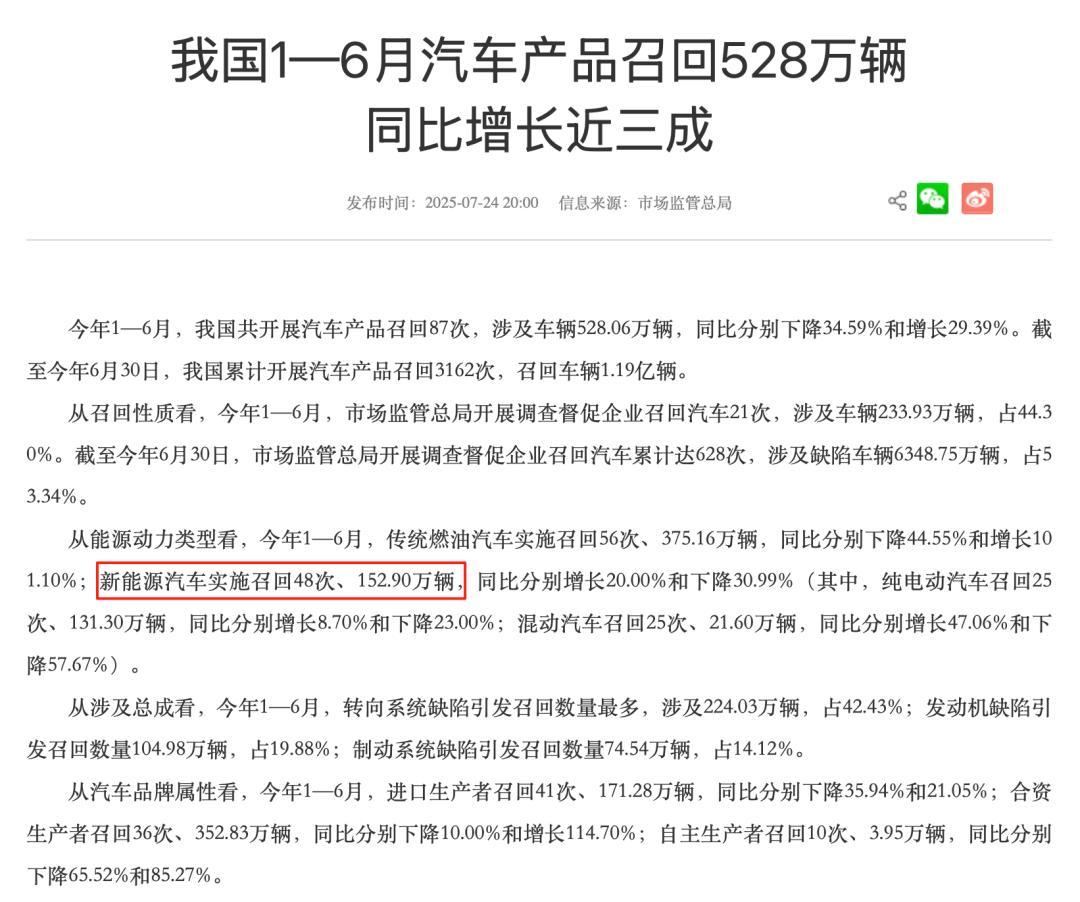
Data from the State Administration for Market Regulation shows that in the first half of this year, new energy vehicles were recalled 48 times, a year – on – year increase of 20%, with a total of 1.529 million vehicles recalled.
Picture/Automobile recall situation in H1 2025. Source/Screenshot of New Energy Outlook from the Internet
In the second half of the year, this trend did not slow down. More than 10 car companies, including BYD, XPeng, Xiaomi, BMW, and Toyota, successively launched recall plans. The reasons for the recalls were concentrated in core areas such as battery system defects, electronic control failures, and safety configuration hazards.
Specifically for brands, as the sales champion, BYD became the focus on the recall list in 2025. Within just two months from October to November, BYD initiated multiple recalls due to reasons such as “improper installation of the power battery gasket” and “consistency issues with the power battery pack”, involving a cumulative total of more than 200,000 vehicles.
Picture/BYD recall situation from October to November 2025. Source/Screenshot of New Energy Outlook from the Internet
“I bought a BYD because I thought highly of its high sales volume. I thought a car that many people bought should be reliable. But after seeing its frequent and large – scale recall announcements, to be honest, I’m really disappointed.”
“Although my car is not in the recall batch, I’m still very scared. I’m always worried that there may be safety hazards in the vehicle, and I dare not drive it on the road easily. After all, I use this car not only for commuting to work but also for picking up my kids every day.” Many BYD owners said so.
Besides BYD, other car companies are also facing recall pressure.
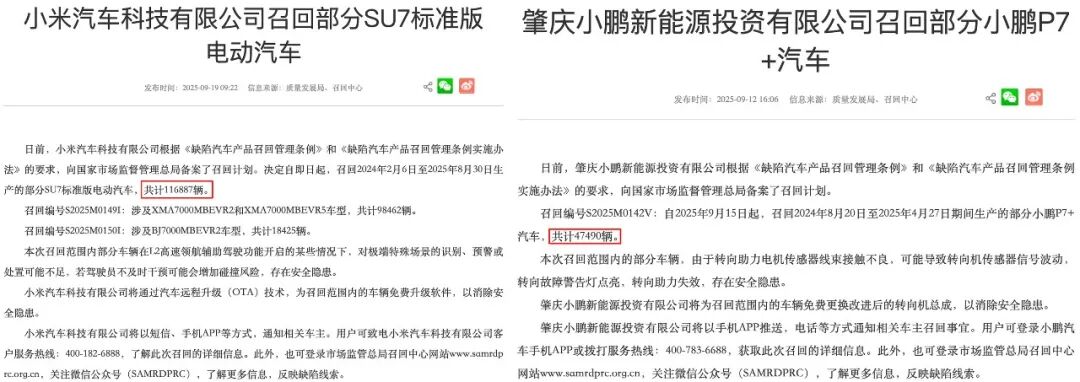
In September, XPeng announced that it would recall 47,490 XPeng P7+ vehicles due to poor contact in the steering assist motor sensor wiring harness. In the same month, Xiaomi Auto recalled 116,887 Xiaomi SU7 standard – edition vehicles due to safety hazards in the assisted driving system.
Picture/XPeng – Xiaomi recall situation in 2025. Source/Screenshot of New Energy Outlook from the Internet
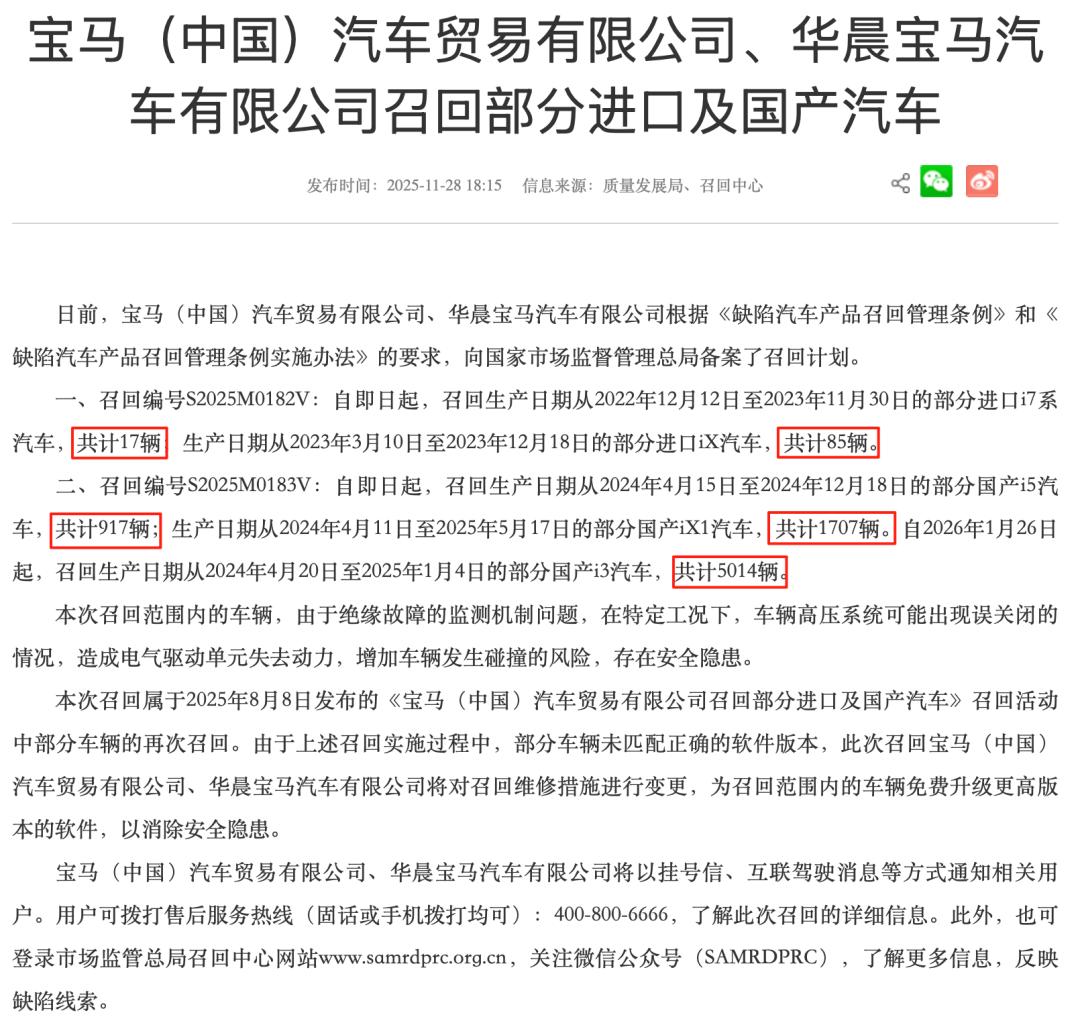
In November, BMW announced the recall of 7,638 domestically produced i5, iX1, and i3 models due to problems with the detection mechanism of insulation faults. Under specific working conditions, the vehicle’s high – voltage system may shut down incorrectly, causing the electric drive unit to lose power.
Picture/BMW recall situation in 2025. Source/Screenshot of New Energy Outlook from the Internet
Facing such a dense stream of recall information, the attitudes of many consumers have begun to change subtly. On major automotive forums and social media, discussions about “whether to buy a new energy vehicle” have heated up again.
“Every time I see a recall news, I’m glad I haven’t bought one yet.” Ms. Lin, a consumer waiting to make a purchase, said frankly. “It’s a good thing that technology is evolving rapidly, but consumers shouldn’t always be the ones to test for safety issues.”
Mr. Fang, another new energy vehicle owner, expressed a different view. “Recall at least shows that the manufacturer is actively solving problems. What’s really scary are those car companies that hide problems instead of reporting them.”
In fact, the recall notice is just the beginning. What really tests the sincerity of car companies is the subsequent solutions.
“After seeing the recall information, I asked the customer service on the APP and found out that my car was within the recall scope.” Mr. Jin, an owner of a BYD Qin PLUS DM – i, said. Although the customer service said that he could go to the store for inspection even if he didn’t receive an upgrade reminder, he always felt that the solution given by the car company only addressed the symptoms rather than the root cause.
Mr. Jin’s concerns are not unfounded. According to the recall plan announced by BYD, regarding the battery pack consistency issue, battery detection software will first be installed on the vehicle through OTA upgrade. After the dashboard lights up the fault light to indicate a battery abnormality, the user will then return to the store to replace the battery pack. This “detect first, then handle” model seems more like a “passive response” in the eyes of many owners.
Picture/BYD’s solution. Source/Screenshot of New Energy Outlook from the Internet
“Why do we have to wait until the fault light comes on to solve the problem? Why can’t we replace it in advance?” Mr. Tang, another owner who received the recall notice, complained. “It’s like being told that there’s a risk of gas leakage at home, but instead of fixing it immediately, they just install an alarm for you first.”
Similar uneasiness is widespread among the recalled vehicle owners.
The owners of the Xiaomi SU7 standard – edition received a software upgrade plan. The official said that the safety hazards in the assisted driving system could be remotely repaired through OTA.
Picture/Xiaomi’s solution. Source/Screenshot of New Energy Outlook from the Internet
“Can a safety – related assisted driving problem be completely solved just by a software upgrade? Could there also be problems with the hardware? The official didn’t give a clear answer to these questions.”
“It’s a good thing that car companies recall vehicles after detecting problems. But I’m really confused about a recall plan that only involves OTA remote repair. Should this be called a recall or an upgrade?” Many consumers said bluntly on social platforms.
It’s worth noting that consumers who are troubled by vehicle quality problems are far more than just those on the recall list.
On major automotive complaint platforms, a large number of new energy vehicle owners whose vehicles are not in the recall batches are experiencing problems such as false range claims, brake failures, and slow – running infotainment systems.
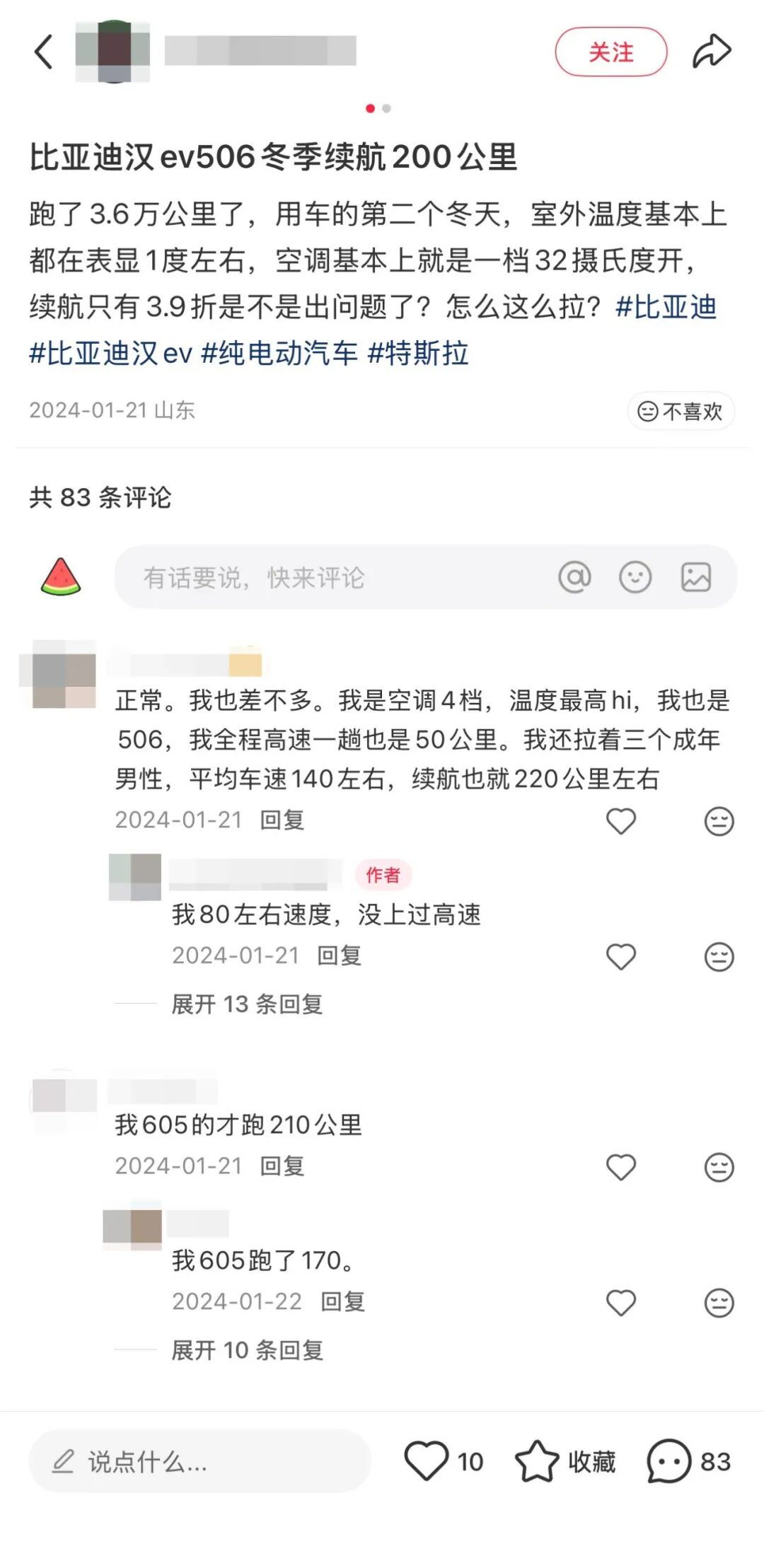
Mr. Zhao in Beijing bought a BYD Han EV at the end of 2023. The official – advertised CLTC range is 605 kilometers. “Even under the most ideal circumstances, I’ve only driven 350 kilometers. In winter, the actual range after a full charge is only about 230 kilometers.”
Picture/An exchange between a BYD Han EV owner and fellow car owners about winter range issues. Source/Screenshot of New Energy Outlook from the Internet
Mr. Zhao has repeatedly reported the serious false range claim problem to the customer service and the service center, but he always gets a standardized response: The range is affected by various factors such as driving habits, temperature, air – conditioning use, and road conditions. Your vehicle has been detected and has no faults, which is within the normal range.
“They always shift the blame to personal usage factors. But cars of other brands can easily reach more than 70% of the CLTC range. Instead of checking the battery when the vehicle has problems, they shift the blame. It really ruins my good impression of the brand.”
Compared with Mr. Zhao, Ms. Li’s situation is not much better. She drives a Leapmotor C10. The central control screen of her car has gone black three times within half a year after she picked it up. “The after – sales service said that it might be a problem with the infotainment system module. Finally, they compensated me with 10,000 Leapmotor APP points. But what I need is a complete solution to the problem. I won’t buy a Leapmotor for my next car.”
In the new energy market in 2025, the era of wild growth is long gone. In the competition for the existing market, consumers’ trust has become the key for car companies to stay in the game.
“Our family probably won’t buy a BYD again.” When saying this, Mr. Zhao’s tone was calm but full of disappointment. As one of the earliest supporters of BYD’s new energy vehicles, he has bought two models, the Tang and the Han, and was once the most loyal fan of this brand.
However, the serious false range claim of the vehicle and the subsequent tortuous and inefficient problem – solving process have finally exhausted all of Mr. Zhao’s enthusiasm. “Sentiment can’t replace practicality. A sense of security and peace of mind are what really matter. After being disappointed so many times, you just get scared.”
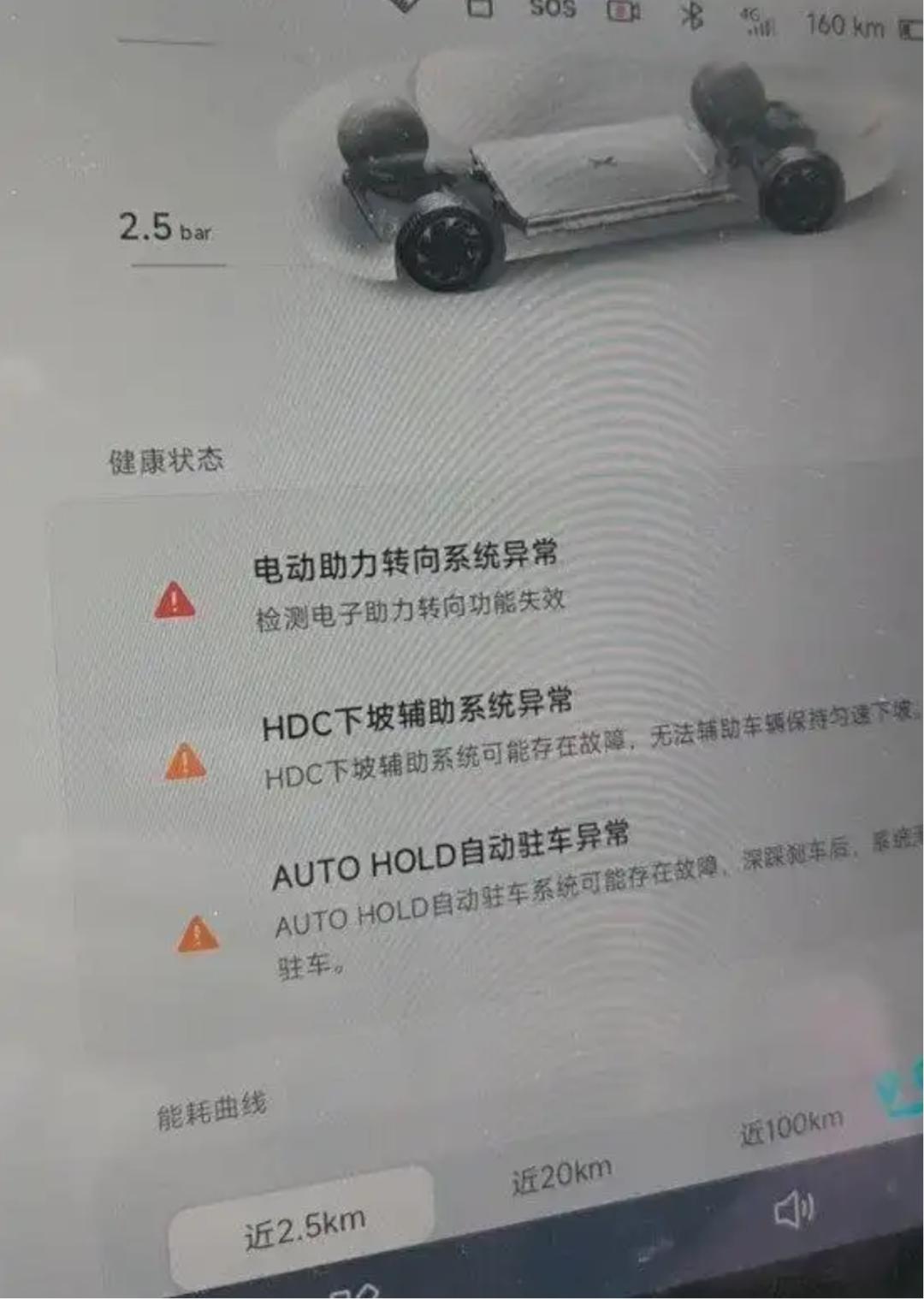
A similar breakdown of trust is also happening to other brands. Ms. Sun in Hangzhou was one of the first owners of the XPeng P7. She originally planned to choose XPeng again for her next car. But since this year, the frequent steering system problems of the P7+ have completely changed her mind.
Picture/Steering assist abnormality problem of XPeng cars. Source/Screenshot of New Energy Outlook from the Internet
When she changed her car last week, she chose NIO, which has better service. “Although the problem didn’t happen to my car, I’m still worried. What really breaks my heart is that I heard that XPeng initially tried to deal with the steering hazard by a simple method like applying sealant. No matter how fancy the intelligent features are, if the basics like the chassis and steering are not up to standard, it’s all empty talk.”
In contact with many consumers, it’s not difficult to find that when choosing a car nowadays, consumers no longer just look at parameters and sales volume. The real word – of – mouth on forums and the attitude towards recall events are all important references for them. One act of shirking responsibility for a quality problem or one perfunctory recall plan is enough to erase the brand image that a car company has built with millions of dollars in advertising fees.
“We’ll directly put brands that frequently appear on the recall list and have a lot of negative reviews on complaint platforms into the ‘blacklist’ and never consider them when buying a car.”
Recall itself may not be a bad thing. It can even be seen as a sign of the industry’s maturity. However, there is a fundamental difference between an active recall and a recall after the problem can no longer be concealed.
Take Tesla, the benchmark for
该文观点仅代表作者本人,36氪平台仅提供信息存储空间服务。
36kr Europe (eu.36kr.com) delivers global business and markets news, data, analysis, and video to the world, dedicated to building value and providing business service for companies’ global expansion.
© 2024 36kr.com. All rights reserved.


Related Article