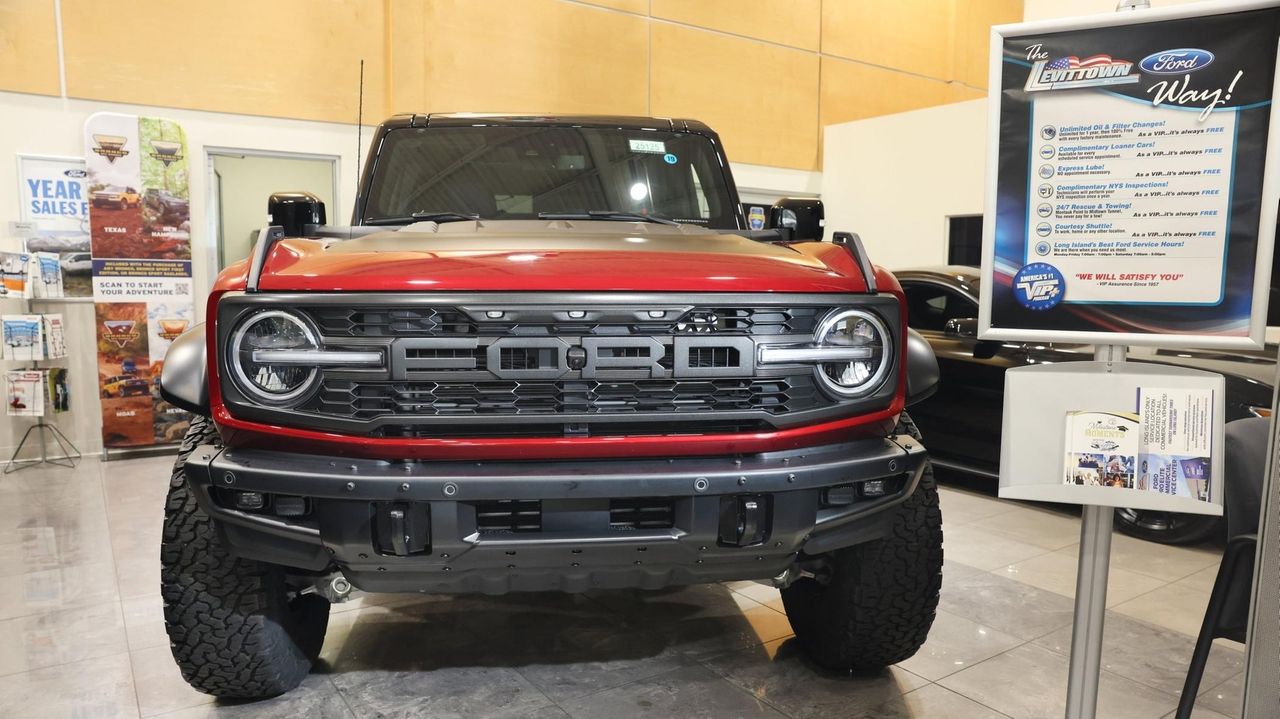
A Ford Bronco on display at Levittown Ford, where popular trucks and SUVs continue to sell briskly even as higher prices, interest rates and insurance costs push many Long Island buyers to rethink budgets and financing options. Credit: Debbie Egan-Chin
The car-buying market — new and used — has shifted so dramatically in just a few years that anyone who last shopped before the pandemic could be stunned by how different the landscape looks today.
Whether you’re leasing, buying new or looking for a used car, 2026 brings a tougher market where small decisions can cost thousands of dollars.
For Long Islanders, the stakes are real: prices are higher across the board, financing is tougher and the cost of owning a vehicle — from insurance to repairs — is soaring. With households already strained by housing and everyday expenses, experts say buyers need to brace for sticker shock, rethink budgets and shop more strategically than ever.
Here’s what shoppers can expect — and how Long Islanders can avoid getting blindsided at the dealership.
The main thing is that cars are a lot more expensive now.
Stay in the know on jobs, retail and all things business across Long Island.
By clicking Sign up, you agree to our privacy policy.
“If you’re buying a new car today, you’re going to pay more than you ever have,” said Ivan Drury, director of insights for Edmunds.
The average new-car transaction price is about $50,000, according to Kelley Blue Book, with the cost driven by consumers gravitating toward larger vehicles and pricier trims. Luxury sales inflate the average — Drury said 12% of all car sales are of vehicles costing at least $70,000 — but he noted the bottom end has shifted, too.
$50,000
Average new-car transaction price in the U.S.
“Virtually nothing is sold below $20,000,” Drury said. “Consumers are pushed to the outer limits of affordability.”
He said anyone returning to the market after years away will find a “vastly different” landscape, especially online, where buyers can click through pricey options: ventilated seats, bigger screens, all-wheel drive.
“People can go crazy checking all the boxes,” Drury said. “Typically people are spending about 30% above where a vehicle starts.”
Consumers are pushed to the outer limits of affordability.
— Ivan Drury, director of insights for Edmunds.
A mid-priced SUV can easily balloon in price. Mazda lists the 2026 CX-90 with an MSRP of $38,800 — but “as-shown” pricing is $57,965. A base 2025 Nissan Pathfinder starts at $36,400; loaded versions stretch well into the $50,000s.
“That’s where they get you,” Drury said. “They package it very intelligently.”
Brian Moody, executive editor of Kelley Blue Book, said average transaction prices have jumped roughly 25% since 2020. Electric vehicles also drive up the average, with new EVs at about $58,000.
But not every car is out of reach.
“There are plenty of new cars under $30,000,” Moody said, including the Toyota Corolla hybrid, Kia K4 and Nissan Kicks.
$26,035
Average used-car transaction price
Jeff Bartlett, managing editor for the autos group at Consumer Reports, warns that average prices may make buyers assume they need to stretch.
“Don’t let that scare you into buying a Mercedes when you’re on a Chevy budget,” he said.
For some Long Island buyers, leasing still feels like a way to limit long-term risk in an increasingly expensive market.
Gerrit De Vos of Massapequa Park recently signed a three-year lease for a new Acura MDX after turning in his previous vehicle. He said leasing still appeals because it limits long-term commitment, even as costs rise.
“If you do a three-year lease, you’re not committing to anything long-term,” De Vos said.
His new lease runs about $570 a month, which he described as a “marginal increase” from his prior payment.
Sohrab Wahab, sales manager at Levittown Ford, with a 2026 Ford Mustang Mach-E on the showroom floor. Credit: Debbie Egan-Chin
It’s not just sticker prices that have changed, but the financing, said Sohrab Wahab, sales manager at Levittown Ford, where popular models include F-150 trucks, Explorers and Broncos.
“Bronco and Bronco Sports, those sell like hot cakes,” said Wahab. “But people pay more attention to the price and other costs that have changed significantly since the pandemic.”
Wahab said shoppers returning to the market after leasing vehicles five or more years ago are often surprised to find incentives, interest rates and payment structures dramatically different.
“People now are payment conscious, payments are higher,” he said. “People don’t make more money but they pay more money. People are hesitant to put money down. They’re concerned about payments going up.”
According to Edmunds, the average monthly payment for a new car in November 2025 was $772, with an APR of 6.6%, and the average for a used car was $569. It depends on variables like the price of the car and the APR. Some dealers offer eye-popping deals like 0% APR for 60 months.
Bartlett of Consumer Reports said that financing for new cars, at less than 7%, is better than that for used cars, which averages about 10%.
“You’re much better saving a few percentage points on financing than a $500 rebate,” said Bartlett. “It’s important to know that those interest rates are the best case scenario, meaning a perfect credit score, which most people don’t have.”
People don’t make more money, but they pay more money.
— Sohrab Wahab, sales manager at Levittown Ford.
He suggested that car buyers check with their banks or credit unions on financing deals and then see if the dealer can beat it.
Deals are slimmer than they used to be. The average incentive package in November 2025 was equal to 6.7% of the average transaction price, according to Cox Automotive, which is part of Kelley Blue Book. This is down from 7.9% a year ago.
Zach Shefska, CEO and co-founder of CarEdge, an online marketplace for cars, said that incentives have dropped significantly since pre-pandemic, when they averaged 10%. He said one in five owners of new cars are now facing $1,000 monthly payments.
Sticker shock is pushing many shoppers toward used cars, which are cheaper but not as cheap as they once were.
Edmunds says the average used car transaction price in November 2025 was $26,035, up 1.4% year-over-year. Prices vary widely: roughly $30,600 for a 3-year-old vehicle, versus $12,461 for one that’s 9 years old.
Adrian Smith, manager of Power Motors East, a used car dealership in Massapequa Park, said that pandemic-era shortages of new vehicles pushed up lease prices and forced more drivers to buy out their own vehicles instead of trading them in — shrinking the pool of used cars for dealers like him.
10–15 million
Vehicles removed from global supply during pandemic-era disruptions
“I used to have endless inventory,” Smith said. “It’s very hard to stock.”
He said SUVs remain in demand for Long Island winters and long commutes, and luxury trims still attract buyers drawn to extras. He often steers them to 3-year-old models to save 20% to 30%.
Manufacturing slowdowns removed 10–15 million new vehicles from circulation, said Shefska of CarEdge, and the effects linger. Used prices have softened from pandemic peaks but remain elevated.
Supply chain disruptions that began during the pandemic continue to impact the market, exacerbated by tariffs on key imports including semiconductors and auto parts. Ford paused manufacturing last year because of an aluminum shortage resulting from a fire at a production plant, and Volkswagen closed a factory in Germany because of U.S. tariffs.
Moody of Kelley Blue Book said used supply is improving — with 2.3 million used cars on sale nationwide in December — and that deals can be found on older luxury car, obscure brands and electric vehicles, the last of which depreciate quickly.
“A 2- or 3-year-old EV can be around $23,000,” Moody said.
Bartlett said Carvana and CarMax can simplify buying, but buyers should factor in delivery costs of up to $2,000 — and always calculate taxes and fees.
“The difference between sticker price and what you’re paying is thousands,” he said.
Insurance and repairs have become major costs for car owners — especially in New York.
“Insurance rates have gone up across the board,” said Rick Braile, agent and owner of Bay Harbour Insurance in Patchogue. Auto insurance premiums jumped 92% from 2015 to 2025, according to federal data.
These two ancillary costs — insurance and repair — are closely related. Moody of Kelley Blue Book said that when you see prices on auto parts going up, which are being driven by tariffs, supply chain issues and labor shortages at body shops, that means that insurance is going to go up.
“Consumers are getting hit from kind of every direction,” said Bartlett of Consumer Reports. “It’s all of these other costs that go into the expense of owning a car.”
Those pressures feed each other, said Moody — when parts cost more, insurers pay more to fix cars, and premiums rise.
Consumers are getting hit from kind of every direction.
— Jeff Bartlett, Consumer Reports
New York is among the most expensive states for auto insurance. Experian says statewide full coverage averages roughly $3,300 a year, though premiums swing widely based on driver age, driving record and location. Experian said the cheapest full coverage car insurance carriers in New York are AAA Insurance, Plymouth Rock, Progressive and Geico.
The cost of auto insurance varies by location, and drivers on Long Island and in the New York City area face even higher bills compared to the state average. Bankrate estimates full coverage averaging about $3,700 in Melville, and topping $4,700 in Valley Stream. Brooklyn averages $6,779, the state’s highest. Fairport is the least expensive, averaging $1,774 per year.
Braile and others say these costs push many buyers toward practical brands like Toyota — cheaper to insure, maintain and repair.
Madison Ford of Bethpage is nearing the end of a three-year lease on her Jeep Cherokee and plans to lease again. But she said rising insurance costs have become one of the biggest and most frustrating parts of the car-buying equation.
“Insurance is ridiculous,” Ford said. “It continues to rise and there’s really nothing you can do about it, because you need to insure the car.”
New electric vehicles — including Teslas — remain more expensive than gas-powered cars, but rapid depreciation is creating bargains in the used market, analysts say. Credit: AP/Damian Dovarganes
Smith of Power Motors East said that electric vehicles are harder to sell than gas cars. For those who prefer EVs, the market has changed considerably just in the last few months.
$58,000
Average price of a new electric vehicle (2025)
New EVs are more expensive than non-electric cars, averaging $58,124 last September. That’s when the federal EV tax credit of $7,500 expired at the behest of President Donald Trump. Going forward, EVs face an uncertain future. Ford recently announced that it was discontinuing its money-losing EV truck, the F-150 Lightning, which cost $54,780 last year.
Drury of Edmunds said that 2026 is a good time to buy used electric vehicles because of depreciation. He said the value of EVs will plummet in the wake of the expired tax credits. “You’re buying yesterday’s technology,” said Drury, who added, “I would buy one in a heartbeat.” He said consumers who don’t want Tesla can buy Ford or Kia EVs.
Shefska of CarEdge said that fewer than 10% of car buyers are interested in electric vehicles. But he doesn’t think EV prices will crash because there will be more demand as automakers like Ford discontinue them.
Moody of Kelley Blue Book downplayed the notion that consumers aren’t interested in EVs.
“People love to say things like no one wants an electric car and that’s simply not true,” said Moody. “We sold plenty of Teslas before there was a taxpayer incentive; my guess is we’ll sell plenty more.”
Sources: Newsday reporting; interviews with industry experts
Tracking weekend storm, deep freeze … Push to save 9/11 health funding … Dangerous Roads: Scourge of speeding … LI Volunteers: Beading Hearts
Get more on these and other NewsdayTV stories
Tracking weekend storm, deep freeze … Push to save 9/11 health funding … Dangerous Roads: Scourge of speeding … LI Volunteers: Beading Hearts
Get more on these and other NewsdayTV stories
The Newsday app makes it easier to access content without having to log in.
Unlimited Digital AccessOnly 25¢for 6 months
Privacy Policy | Terms of service | Subscription terms | Your ad choices | Cookie Settings | California Privacy Rights | About Us | Contact Newsday | Reprints & permissions | Advertise with Newsday | Help
Copyright ©2026 Newsday. All rights reserved.