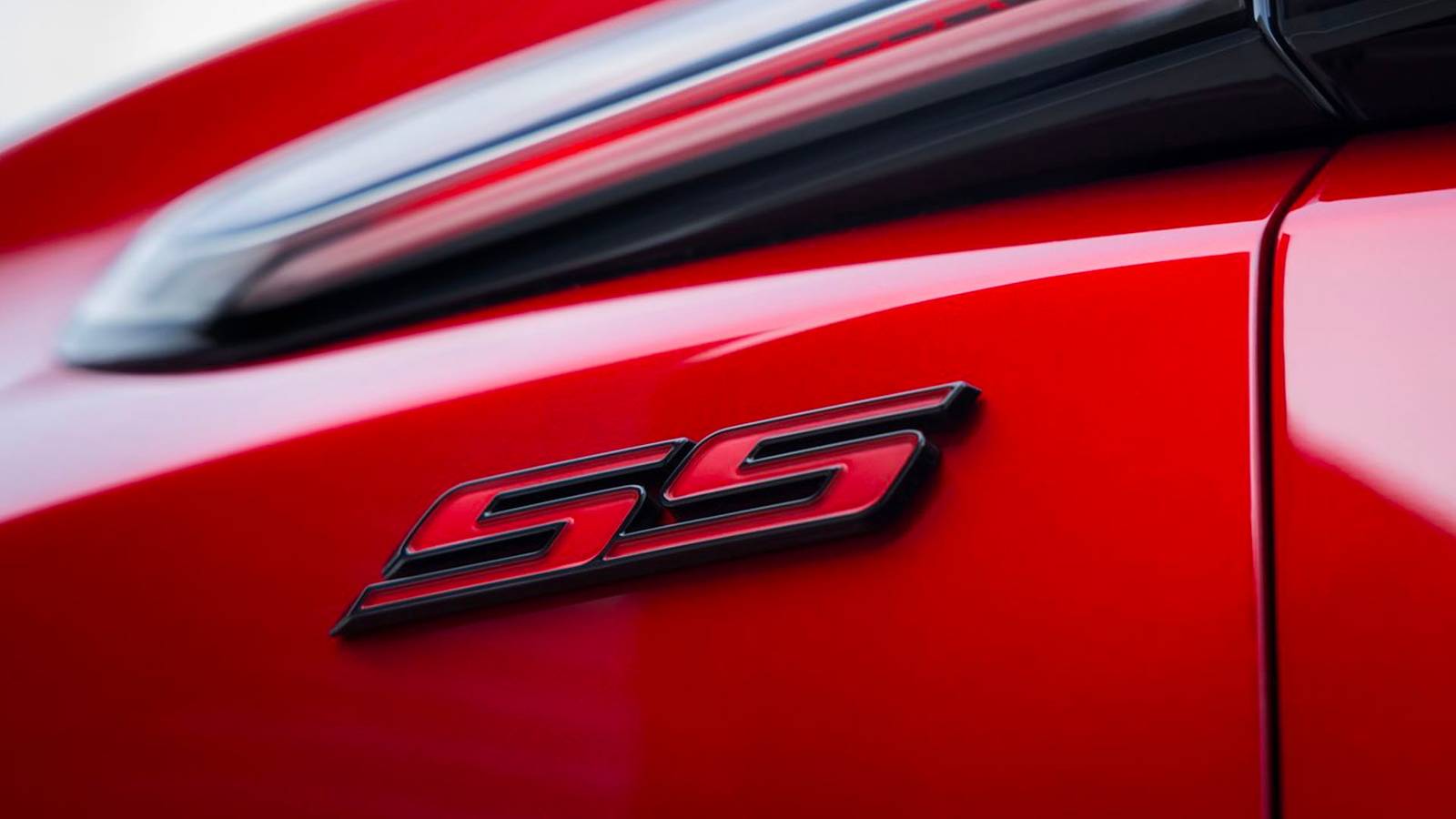
2025 Chevrolet Blazer EV SS Badge
The Chevrolet Corvette C8 isn’t only one of the best sports cars on the market today, but it’s also surprisingly affordable given the performance it offers. With a starting price of under $70k, it’s essentially a mid-engined supercar with a 0-60 mph of 2.9 seconds. But Chevrolet’s model range consists of a vehicle that undercuts it in cost while offering even more power. Owning the accolade of being the quickest “SS” model Chevrolet has ever produced, this model out-muscles its 6.2-liter V8 of the Corvette Stingray.
The Corvette Stingray sticks to its mid-engine layout and rear-wheel drive for an engaging driving experience, but this Chevy takes a different approach to performance. It prioritizes raw power and modern engineering, making it an intriguing alternative for buyers. The Corvette is still quicker to 60 mph and has a higher top speed. But if bragging about horsepower is your thing, then this all-wheel-drive Chevy will trump any Stingray owner for a starting price of just $62,095.
The Corvette C9 is a good value supercar, but there is a worthy mid-engined machine that costs almost half the price.
2025 Chevrolet Blazer EV SS Front Three Quarter Dynamic
Model
Chevrolet Blazer EV SS
Chevrolet C8 Corvette Stingray
Power
557 hp
490-495 hp
Torque
648 lb-ft
465-470 lb-ft
0-60 MPH
3.4 Seconds
2.9 Seconds (Z51 Package)
Top Speed
130 mph
184 mph
Price
$62,095
$68,300
(Source: Chevrolet)
For $62,095, the Chevrolet Blazer EV SS packs 557 hp, making it not only the most powerful SS model Chevrolet has ever built but also both stronger and cheaper than the C8 Corvette Stingray. The Stingray starts at $68,300 with 490 hp, meaning the Blazer EV SS offers 67 more horsepower while costing $6,205 less.
2025 Chevrolet Blazer EV SS Interior
Even when you upgrade the Corvette Stingray with the $6,345 Z51 Performance Package, output rises only slightly to 495 hp – still 62 hp shy of the Blazer EV SS. However, raw numbers only tell part of the story. With the Z51 pack, the Corvette remains a far more focused performance machine. Chevrolet claims a 0-60 mph time of 2.9 seconds and a top speed of 184 mph, which firmly outpaces the electric SUV.
Weight is the defining difference between the two. Thanks to its Ultium-based battery pack, the Blazer EV SS tips the scales at roughly 5,300 lbs, while the Corvette comes in dramatically lighter at 3,647 lbs. That 1,650-lb gap completely reshapes real-world performance. Despite its horsepower advantage, the Blazer EV SS hits 0-60 mph in 3.4 seconds and tops out at 130 mph – quick for a family-friendly electric crossover, but not enough to challenge a mid-engine sports car.
2025 Chevrolet Blazer EV SS Front Three Quarter Static
Still, judged in isolation, the Blazer EV SS is impressive. It’s the first electric SS, the fastest SS Chevrolet has ever made, and it delivers legitimate muscle in a segment not usually associated with high-performance badges.
General Motors Ultium EV Platform
Manufacturer
Chevrolet
Model
Blazer EV SS
Motor
Dual Permanent magnet motor
Battery
102 kWh Lithium-Ion
Horsepower
557 hp
Torque
648 lb-ft
Max Range
303 Miles
(Source: Chevrolet)
The standard Chevrolet Blazer EV rides on GM’s BEV3 architecture, offering a wide range of configurations – from front-wheel drive to all-wheel drive, and from single-motor to dual-motor setups depending on the trim. Most versions use an 85-kWh battery pack, making them suitable for everyday driving rather than outright performance.
The Blazer EV SS, however, is a very different machine. This range-topper is engineered specifically for drivers who want genuine performance credentials from their electric SUV. Chevrolet equips the SS with a larger 102-kWh lithium-ion battery and a dual permanent-magnet motor AWD system as standard, giving it the hardware to justify the Super Sport badge.
2025 Chevrolet Blazer EV SS Rear Three Quarter Static
With both motors unleashed, the Blazer EV SS produces 557 hp and 648 lb-ft of torque, delivered through a single-speed direct-drive transmission that powers all four wheels. Thanks to the BEV3 platform, the SS also unlocks Wide Open Watts (WOW) mode, which sharpens throttle response, maximizes battery output, and allows the SUV to sprint from 0-60 mph in 3.4 seconds, making it the quickest SS model Chevrolet has ever built.
Range is equally respectable. According to the EPA, the Blazer EV SS can travel up to 303 miles on a full charge. When plugged into a high-speed DC fast charger, it supports up to 190 kW, allowing it to add roughly 78 miles of range in just 10 minutes. To keep everything under control, Chevrolet also equips the SS with front Brembo brakes and a sport-tuned chassis, enhancing grip, stability, and stopping power.
With a 2.9-second 0-60 mph time, the Corvette C8 is one ridiculously quick sports car – but these two Japanese cars easily keep up.
The Chevrolet Corvette C8 Stingray starts at $68,300 for the base 1LT trim. For that price, the Stingray uses the LT2 6.2-liter V8, which makes 490 hp and 465 lb-ft of torque. The 8-speed twin-clutch transmission is standard and sends power to the rear wheels.
The optional Z51 performance package improves the power and torque output of the engine by 5 hp and 5 lb-ft. The package includes upgrading to performance suspension, 4-piston Brembo brakes, Michelin Pilot Sport 4S tires, performance exhaust, new rear axle ratio, improved cooling system, an electronic limited slip differential, and front and rear spoilers.
Inside, the Corvette Stingray surrounds the driver with a cockpit that feels straight out of a modern fighter jet. A two-spoke flat-bottom steering wheel, a fully digital instrument cluster, and a dramatic, driver-centric layout create an immersive performance environment. One of the C8’s most distinctive touches is its vertical row of climate controls running along the center console – an unconventional design that clearly prioritizes the driver over everyone else.
Mid-engine sports cars rarely score points for practicality, yet Chevrolet managed to engineer the C8 with surprising everyday usability. Thanks to smart packaging, the Stingray offers a sizable 12.6-cu-ft rear trunk tucked behind the engine – large enough for luggage, golf bags, or even track-day gear. On top of that, the C8 includes a decently sized frunk, giving owners both front and rear cargo options. For a mid-engine exotic, the Corvette stands among the most practical sports cars on the market.
Meanwhile, the 557-hp Blazer EV SS delivers serious electric muscle and was clearly built with performance enthusiasts in mind. But when placed side-by-side with the Corvette, the difference is clear: in pure acceleration and top-end speed, the Stingray remains on an entirely different level – its mid-engine layout and lightweight construction give it a superiority the Blazer EV SS simply can’t match.
Sources: Chevrolet.
We want to hear from you! Share your opinions in the thread below and remember to keep it respectful.
Your comment has not been saved
This thread is open for discussion.
Be the first to post your thoughts.