Cyclists have long helped out their motoring cousins. The nation’s earliest paved roads, including in Seattle, were done by and for bicyclists, and Henry Ford’s first car, the Quadricycle, was basically a four-wheeled Frankenstein bike with a two-cylinder engine.
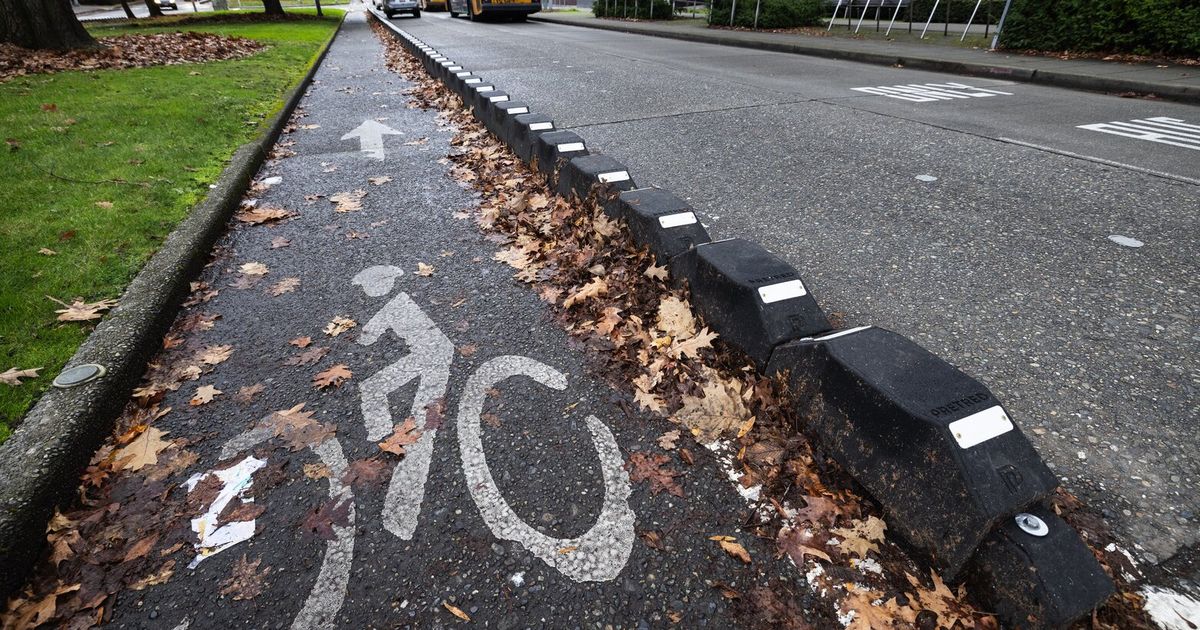
Now cars are giving back, with a new type of bike lane barrier being tested in Seattle that’s made from recycled car tires. Each segment of the zipper-like barrier, which are a couple of feet long and 12 inches tall, is made from a full car’s worth of four recycled tires and weighs about 100 pounds.
“The vast majority of tires are burned or incinerated, and they call that recycling,” said Toni Olson, director of marketing for Pretred, the Colorado-based company that makes the barriers, which stretch along about a half-mile of Northeast Campus Parkway near the University of Washington. “We’re an environmentally friendly, innovative company and we’re looking for ways to reuse waste.”
Pretred began buying used tires and turning them into roadway barriers in 2022, but the production of bikeway barriers is new for the company, which primarily makes heavy-duty barriers for construction zones and crowd control.
“Seattle is our first pilot project and we’re super excited about it,” Olson said of the U-District bikeway completed last month.
The type of barrier may be novel, but the work to upgrade the city’s bike network isn’t. The Seattle Department of Transportation has been systematically adding stronger barriers to existing bikeways since 2022, when it began its Even Better Bike Lanes program with an upgrade to Northeast 40th Street beneath the University Bridge.
The goal is to replace “paint and post” protected bike lanes, which are guarded against traffic with just paint and plastic bollards, as the name suggests. They don’t offer much protection but remain the most common type of barrier for Seattle’s protected bike lanes due to availability and ease of installation. By design, the flexible plastic posts are easily surmounted by emergency vehicles.
That flexibility has a downside: The posts are easily broken and require continued maintenance and replacement. In 2024, over 700 of these posts were replaced by SDOT crews.
That’s why SDOT is casting about for suitable replacements. The agency has been swapping out the plastic posts with a variety of barriers, including short concrete curbs, low concrete walls called “Toronto barriers,” and small plastic humps called “armadillos” that look a bit like their namesake mammal.
Using this variety, in 2025 SDOT upgraded more than 5 miles of existing protected bikeways, including 2 miles on Ravenna Boulevard, a mile on East Union Street, a mile on South Columbian Way, and more than a mile downtown on Fourth Avenue.
Mariam Ali, an SDOT spokesperson, said the city has identified another 5 miles of protected bikeways to upgrade in 2026 and 2027, in every corner of the city from Renton Avenue South to Gilman Avenue West.
The work will continue into the 2030s, thanks to the $1.55 billion transportation levy passed last year by city voters. It included $133.5 million for bikeways, part of which is dedicated to upgrading 30% of the city’s existing protected bike lanes over the course of the eight-year levy.
Seattle cyclists shouldn’t get used to one type of barrier, Ali suggested. Like with the new recycled rubber barriers, the city is in testing mode, trying to find the most cost-effective and durable retrofit to make its miles of bikeways safer and more appealing to people who normally wouldn’t opt for two wheels.
The barriers also must be easily maintained, and serve different situations. For instance, the short armadillos don’t offer the same protection as the 18-inch tall Toronto barriers, but they may be the only option for a bikeway on a narrow street or where emergency curbside access is important.
Lee Lambert, executive director of Cascade Bicycle Club, said he’s supportive of just about any type of strong barrier because they “make bike lanes more accessible to less confident riders.”
Lambert praised the Colorado company’s barriers, in particular, for their affordability and sustainability.
While they cost the same as equivalent concrete barriers, they’re lighter and easier to install. Still, SDOT’s Ali said there was a “learning curve in how to pin them properly into the asphalt.”
As for sustainability, Olson said her company adds a binding agent to the recycled rubber to ensure it doesn’t leach toxins and other harmful chemicals, something she said was certified by an independent third party. “The binding helps keep all the nasties, if you will, intact,” she said.
In the end, Lambert said a good bike lane barrier is one that keeps riders safe and drivers aware. He pointed to the new bike lanes on Beacon Avenue South, protected by low, concrete curb ramps, as an example of how protected bikeways can slow traffic down and make the entire street safer, not just for cyclists.
Beyond the safety of people, Pretred’s barriers have the added benefit of not doing as much damage to a vehicle that crashes into them, without sacrificing safety of the people on bikes.
“Most people drive every day and don’t hit concrete. If they do, they probably didn’t want to and won’t do it again,” Lambert said. “The rubber provides instant feedback to the driver.”
Olson agreed.
“If a car hits one of those,” she said, “they’re going to know it and they’re going to correct.”
That clearly happened to the U-District barriers. Below the bridge where Eastlake Avenue and Roosevelt Way join, a few sections of rubber barrier are out of place, the work of a machine much bigger than a bicycle. How quickly, and easily, they’re put back in place will help the city decide if it should order more Colorado barriers or not.
Until then, bicyclists are enjoying the new protection, Olson said.
“The engineer who developed the product for us went out to see how the installation is going,” she said. “The bikers who were going by were saying, ‘Thank you!’ They just felt so much safer.”
The opinions expressed in reader comments are those of the author only and do not reflect the opinions of The Seattle Times.
Related Article