Explore the hottest hotel openings, exclusive experiences and our expertly curated destination guides.
The latest from the world of fine dining, reviews of rare spirits and delicious cocktail recipes.
Discover the latest supercars, pioneering yacht builds and boundary-pushing private jets.
Explore the worlds of haute horology and fine jewelry, as well as carefully selected style guides.
Explore the finest properties on the market, standout interior styling and architectural wonders.
From science-backed retreats to traditional spas, relax into the world of high-end wellness.
Be inspired by our conversations with Leaders in Luxury, and explore the world of Art and Tech.
Elite Collections is a trusted distinction of excellence, recognizing the world’s finest suites, restaurants and jets.
The Oscar-winning special effects supervisor lifts the hood on 007 filming secrets as Assouline revs up a landmark new book.
Words
Ben Oliver
Share
The next James Bond film won’t reach cinemas until 2028, seven years after the release of Die Another Day. It will be the longest hiatus in a franchise which now spans 25 films and more than 60 years.
But rather than drum their fingers impatiently, the spy’s large and famously obsessive fan base can entertain themselves with Assouline’s trilogy of Bond books. The French luxury publishing house has just released the third — James Bond Cars — which joins its earlier volumes on 007’s style and destinations. All three can be purchased individually, or together in limited-edition brushed aluminium ‘coffret’ slipcase inspired by the technical look of Q Branch’s gadgets.
This latest is curated and introduced by Oscar-winning special effects supervisor Chris Corbould OBE, whose career includes the special effects on Star Wars, the Dark Knight trilogy, and Inception. But the Londoner is best-known for Bond, having worked on 15 films with four different 007s over 34 years. The book assembles a remarkable selection of over 300 rarely seen images, including behind-the-scenes shots of the cars (and an eclectic array of other transportation) used by Bond and his adversaries, and original design sketches and technical drawings from Eon Productions’ special effects skunkworks. Corbould’s expert commentary provides the context and is fascinating, funny and honest. He spoke to Elite Traveler in advance of the James Bond Cars book launch.
You’ve created special effects for some of the biggest movie franchises. How does working on Bond compare?
Since I was a kid, I’ve always had a passion for the cars in the Bond films, and because they have gadgets and are doing weird and wonderful things, Bond’s cars come under my special effects remit. It’s just a lot of fun, but you’re also working on a prestigious franchise where the budget is big enough for you to do the best possible job. In Die Another Day there’s a chase on ice between the Aston Martin Vanquish and the Jaguar XKR. The cars needed four-wheel drive but neither carmaker offered it as an option, so the underneath of those cars were built from scratch in-house to our own bespoke design. As a special effects guy, it doesn’t get much better than that.
What you create is far more than just a prop or transportation. Are James Bond cars almost as important to the franchise as the man himself?
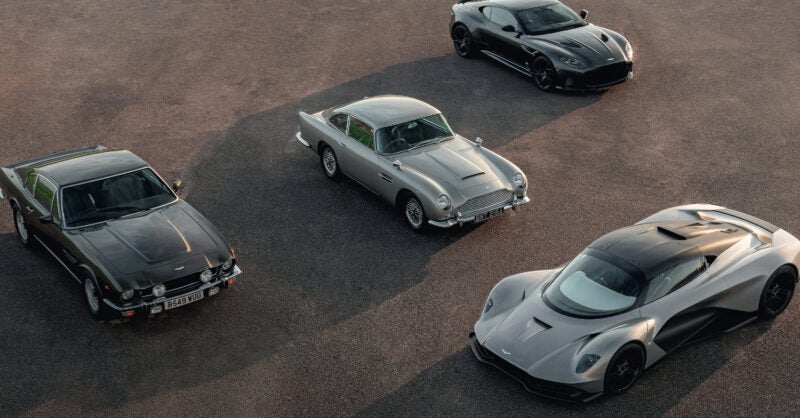
I think so, and particularly in the case of the Aston Martin DB5. It’s not just a car: it’s a character in the film. There was a lot of debate on Skyfall between the director Sam Mendes and the producers Barbara Broccoli and Michael Wilson about whether the helicopter which was circling Bond’s ancestral home in Scotland should destroy the DB5 parked outside. Some felt like killing the car would be like killing Bond. We obviously did blow it up in the end, but then in Spectre you see it being rebuilt in Q’s workshop, because that’s what you can do on a Bond film.
Clearly the budgets are huge, and in the past the stunts have bordered on the camp, but do you ever reign back the gadgets and the effects to keep the focus on the human side of the story?
Yes, we do. I was delighted when the DB5 went into full combat mode in No Time to Die because in recent films it just had cameo roles, maybe with Bond driving off in it at the end. So, we dreamt up all sorts of new gadgets to go into it, like a drone coming out of the rear number plate, either as a weapon or for surveillance, and at one stage we had it escaping by driving off a cliff and a Union Jack parachute coming out. But we took it all down a notch because it was such an emotional scene between Daniel Craig and Léa Seydoux in the car when they’re surrounded and the guys come forward to shoot the windows out. We all felt that we didn’t really want to overpower that with some weird and wonderful special effects, so we pared it right back.
What’s your personal favourite of all the James Bond cars you’ve worked on?
I have a soft spot for the Aston Martin V8 Vantage that we first used in The Living Daylights with Timothy Dalton, and I’ve now been around long enough to see it come back with a cameo in No Time to Die. I oversaw the cars out in Austria on The Living Daylights, and I fell in love with the sound and the look of the V8 then. It’s such a stylish car, but not as instantly recognisable as the DB5. It was our job to take them across a frozen lake to the set every day and, between us, we had a great time. On the ice there’s nothing to hit, so we could donut them to our heart’s content and not worry about breaking them.
Of all the car-related special effects you’ve done for Bond over five decades, what was the most challenging?
It’s in the book, but it’s not actually a car. The producers weren’t happy with the motorcycle chase in GoldenEye, so I recommended replacing it with a tank. The whole sequence came out of that one conversation, but it then became my job to find the tanks. Not easy! But I sourced a couple of Russian T54 tanks in England which we modified and then, weirdly, re-exported to St Petersburg for filming. I got a call late one night from a very panicked truck driver saying they wouldn’t let one of the tanks onto the ferry because it could still fire a shell. So, we welded a solid billet of steel into the barrel, and I had to drag a guy out of the Birmingham Gun Barrel Proof House to give us a certificate to say that it was now deactivated and wouldn’t sink the boat.
Bond memorabilia can be hugely valuable now, especially the props made by you, or by your forebears in production or special effects design, such as Sir Ken Adam and John Stears. Do you ever think about the likely future value of a car or gadget as you’re making it?
One of my few regrets is that I should have kept more of the gadgets that we made by hand as mementos over the years. But when you’re working on the films, your head is down just trying to make everything and hit deadlines, so you don’t think about the objects’ collectability and their monetary value. The Bond films have always tried to do as many real special effects as we possibly can. It was the same working with Christopher Nolan. He’s a huge Bond fan and has the same mantra that if you can get the effect in-camera and on the day rather than doing it digitally later, then you should. So, we make a lot of stuff, but it’s only when you get to the end and everything’s handed over to the Bond archive that you wish you had been able to keep a few bits and pieces. Of course, you sign a contract to say that everything that you make is owned by Eon Productions, but if I had been able to hang onto some of it, I’d easily be a multimillionaire by now.
$150, mytheresa.com
Words
Ben Oliver
Share
© 2025 Elite Traveler. All rights reserved
© 2025 Elite Traveler. All rights reserved