News
Reviews
Buyer's Guide
What's My Car Worth?
Events
Ask MOTORTREND
See All 31 Photos31
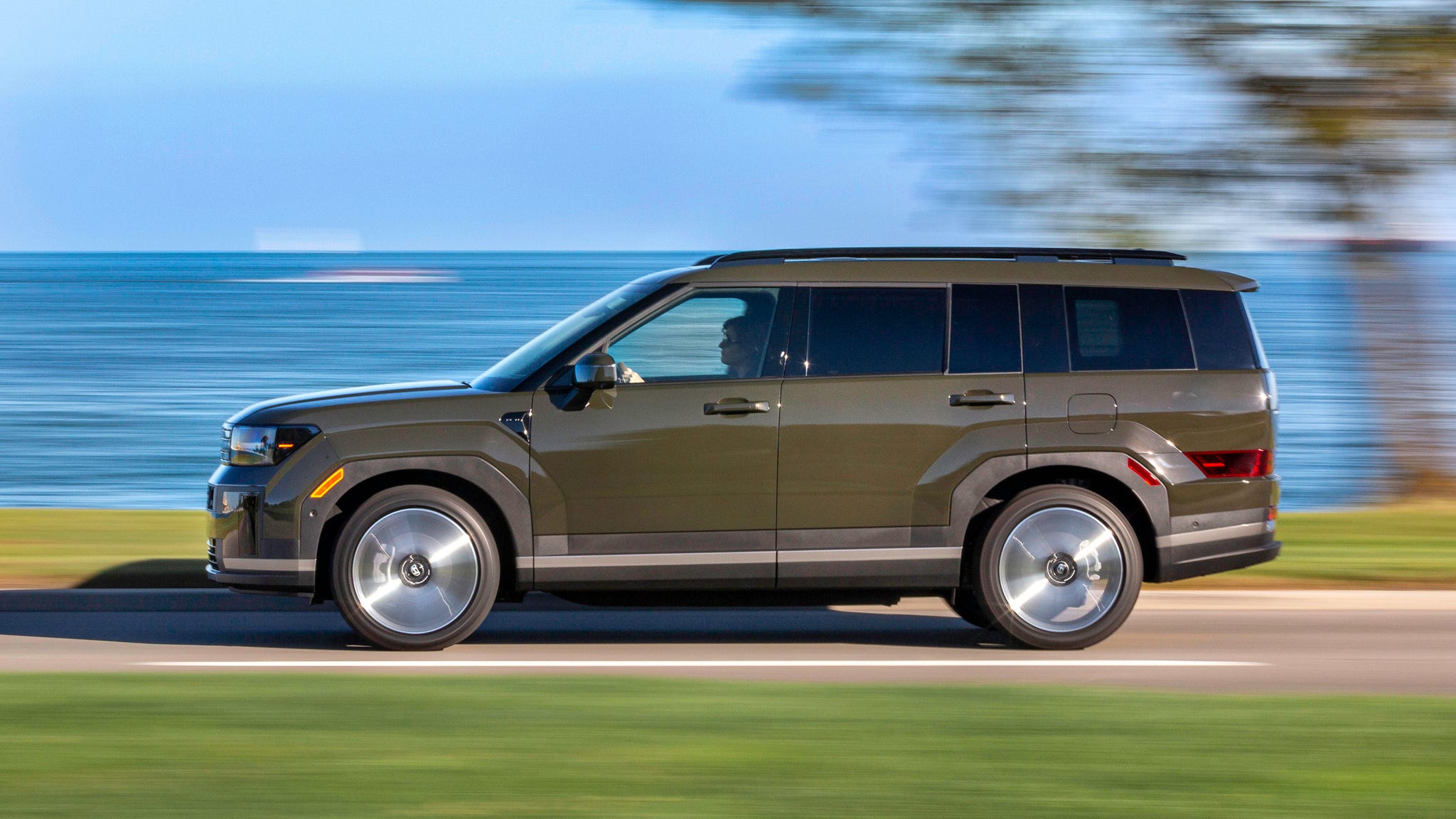
A couple months ago, the average new vehicle transaction price crested $50,000 for the first time. If that seems like a lot of money to you—and it likely does for the majority of Americans—you’ve probably wondered why new cars are so expensive and what exactly $50,000 buys these days. Here’s one answer to those questions: MotorTrend’s newest yearlong test vehicle, a 2025 Hyundai Santa Fe Hybrid Limited AWD, rings in just under the average with a sticker price of $48,325.
That buys you a midsize SUV that’s both sensible and indulgent. Hyundai’s smallest three-row model feels perfectly sized for a family of four, and its parsimonious hybrid powertrain covers 34 miles on a single gallon of gas, per the EPA combined rating. Our Limited model, which sits just below the top Calligraphy trim, spoils passengers with its upscale finishes and long list of creature comforts. In other words, our Santa Fe feels like the kind of vehicle someone might buy as a reward for long days in the digital coal mines while using its practicality to rationalize their purchase. Early impressions suggest Hyundai dialed in the perfect amounts of practicality, luxury, and value. Every time we’ve driven it so far, we walk away with the sense that it gives you a lot for your money. Not many vehicles manage to do that these days.
See All 31 Photos31
The Santa Fe makes a loud visual statement, too, thanks to the 2024 redesign that traded generic curves for arrow-straight lines, flat sides, and H-themed flourishes sprinkled pretty much everywhere, from the headlights to the dashboard to the four dots of Morse code on the steering wheel. Whether you agree with what that statement says is a matter of personal opinion, as the exterior styling has drawn both praise and criticism from our staffers. Some editors love its utilitarian boxiness while others find the details and proportions fussy.
We’re at least in agreement that the Santa Fe’s cabin is a home run. Finished in Pecan Brown with faux wood trim and real leather on the seats, our test vehicle is a seriously nice place to spend time. Part of its appeal is simply a matter of size. While Hyundai calls the Santa Fe a compact SUV, there’s nothing small about it. The fifth-generation model stretched the wheelbase 1.9 inches and made the third-row bench standard. Our long-termer comfortably seats seven or stashes up to 40.5 cubic feet of cargo behind the second row, and as long as you’re not trying to do both of those things at the same time, it fits right in with suburban living. It’s large enough for a weeklong road trip with the family and tidy enough to easily thread through the Costco parking lot at 11 a.m. on a Saturday.
See All 31 Photos31
Back to that original question: What does $50,000 buy in 2025? We should start by pointing out that our long-termer is positioned well above the starting price of $35,795 for a front-wheel-drive Santa Fe SE with the gas engine. From there it takes $4,000 to jump to the entry SEL Hybrid (there’s a new SE Hybrid for 2026 that shrinks the hybrid premium to just $1,300). Splurging on the Limited’s luxuries adds $6,400, and all-wheel drive costs another $1,800. Hyundai could probably get away with charging for the Rockwood Green paint and Pecan Brown interior, but this handsome combination is gratis, as is the optional second-row bench seat in our Santa Fe. Our test vehicle’s sole extra-cost option is $240 worth of carpeted floormats.
See All 31 Photos31
The long list of luxuries includes heated and cooled front seats, heated seats for the outboard second-row passengers, a heated steering wheel, and a dual-pane sunroof. A phalanx of cameras, radars, and ultrasonic sensors feed a 360-degree monitor, adaptive cruise control, parking assistants, blind-spot monitors, collision avoidance systems, and Highway Driving Assist, which keeps the vehicle centered in its lane as long as you keep a hand on the wheel. The dash is dominated by two 12.3-inch displays integrated into one curved housing, and a panel full of touch-activated climate controls. There’s a head-up display, wireless Apple CarPlay and Android Auto, a wireless phone charger, a 12-speaker Bose audio system, six USB ports, and a 110-volt household outlet, all of which are sure to be used over the course of the next year. We’re less certain that’s true for our Santa Fe’s one oddball feature, a compartment ahead of the front passenger that can sterilize cell phones, sunglasses, and wallets with UV-C light.
See All 31 Photos31
The Hybrid sandwiches an electric motor between its 1.6-liter turbocharged inline-four and six-speed automatic transmission for a total system output of 231 horsepower. Compared to the standard 2.5-liter turbo inline-four, the Hybrid trades away 46 hp but gains a remarkable 11 mpg in the EPA’s combined metric. Thanks to a 17.7-gallon gas tank, it’s rated for a bladder-busting 602 miles of range (on paper at least), but the real-world fuel economy has been our biggest disappointment to date. We’re averaging 26.2 mpg at the moment.
There is no Normal mode in the Santa Fe with the SUV defaulting to Eco mode on startup. In what seems like a natural consequence of those decisions, the powertrain can be sluggish when you’re trying to jump off the line. Once it’s underway or with Sport mode selected, however, the 4,496-pound Santa Fe Hybrid has a nice pep in its step. It is certainly much swifter than its 19.1 pounds per horsepower weight-to-power ratio implies It did 0–60 mph in 7.6 seconds, stopped from 60 mph in 115 feet, and cornered averaging 0.83 g in MotorTrend testing. Those are legitimately impressive numbers for the class.
See All 31 Photos31
On public roads, the Santa Fe is smooth, calm, and quiet. It’s graceful in switching the engine on and off, and the braking force builds naturally. The steering is accurate, and the ride quality is comfortable. It’s all so well dialed in that you never really think about the driving experience. Considering this is a family crossover, not a sports car, that’s what most buyers are looking for.
Our 2025 Hyundai Santa Fe Hybrid Limited AWD has made a strong first impression with our staff, but the hard part of a MotorTrend yearlong test is just beginning. Can the small three-row SUV live up to our big expectations when it comes to durability and reliability? Will the fuel economy rebound and crest the 30-mpg threshold? Will we be as impressed with it on day 365 as we were on day 1? The answers to those and other questions will determine whether we still think the Santa Fe is worth its nearly $50K price tag a year from now.
See All 31 Photos31
2025 Hyundai Santa Fe Hybrid Limited AWD Specifications
BASE PRICE
$47,995
PRICE AS TESTED
$48,235
OPTIONS
Carpeted floor mats, $240; second-row bench seat, $0
VEHICLE LAYOUT
Front-engine, front-motor, AWD, 7-pass, 4-door hybrid SUV
POWERTRAIN
1.6L turbo direct-injected DOHC 16-valve I-4, 178 hp @ 5,500 rpm, 195 lb-ft @ 1,500 rpm; Permanent-magnet motor, 59 hp, 195 lb-ft
TOTAL POWER
231 hp
TOTAL TORQUE
271 lb-ft
TRANSMISSION
6-speed automatic
BATTERY
1.5-kWh lithium-ion
CURB WEIGHT (F/R DIST)
4,496 lb (54/46%)
WHEELBASE
110.8 in
LENGTH x WIDTH x HEIGHT
190.2 x 74.8 x 67.7 in
TIRES
Pirelli Scorpion MS; 255/45R20 105V XL M+S
EPA FUEL ECONOMY, CITY / HWY / COMBINED
35/34/34 mpg
EPA RANGE
602 mi
MotorTrend Test Results
0-60 MPH
7.6 sec
QUARTER MILE
15.8 sec @ 89.2 mph
BRAKING, 60-0 MPH
115 ft
LATERAL ACCELERATION
0.83 g
FIGURE-EIGHT LAP
27.8 sec @ 0.62 g (avg)
Ownership Experience
SERVICE LIFE
2 mo/4,884 mi
REAL-WORLD FUEL ECONOMY
26.2 mpg
ENERGY COST PER MILE
$0.12
DAYS OUT OF SERVICE
0
MAINTENANCE AND WEAR
None
DAMAGE
None
RECALLS
None
I fell in love with car magazines during sixth-grade silent reading time and soon realized that the editors were being paid to drive a never-ending parade of new cars and write stories about their experiences. Could any job be better? The answer was obvious to 11-year-old me. By the time I reached high school, becoming an automotive journalist wasn’t just a distant dream, it was a goal. I joined the school newspaper and weaseled my way into media days at the Detroit auto show. With a new driver’s license in my wallet, I cold-called MotorTrend’s Detroit editor, who graciously agreed to an informational interview and then gave me the advice that set me on the path to where I am today. Get an engineering degree and learn to write, he said, and everything else would fall into place. I left nothing to chance and majored in both mechanical engineering and journalism at Michigan State, where a J-school prof warned I’d become a “one-note writer” if I kept turning in stories about cars for every assignment. That sounded just fine by me, so I talked my way into GM’s Lansing Grand River Assembly plant for my next story. My child-like obsession with cars started to pay off soon after. In 2007, I won an essay contest to fly to the Frankfurt auto show and drive the Saturn Astra with some of the same writers I had been reading since sixth grade. Winning that contest launched my career. I wrote for Jalopnik and Edmunds, interned at Automobile, finished school, and turned down an engineering job with Honda for full-time employment with Automobile. In the years since, I’ve written for Car and Driver, The New York Times, and now, coming full circle, MotorTrend. It has been a dream. A big chunk of this job is exactly what it looks like: playing with cars. I’m happiest when the work involves affordable sporty hatchbacks, expensive sports cars, manual transmissions, or any technology that requires I learn something to understand how it works, but I’m not picky. If it moves under its own power, I’ll drive it.
Read More
Load More
Join Newsletter
Subscribe to our newsletters to get the latest in car news and have editor curated stories sent directly to your inbox.
Explore Offerings
A Part of Hearst Digital Media
©2025 Hearst Autos, Inc. All Rights Reserved.
Report Issue
Cookie Choices
Follow us
Related Article