WASHINGTON, D.C. — President Donald Trump is proposing drastically scaling back mile-per-gallon standards for new cars and light-duty trucks put in place by former President Joe Biden and rewriting how those standards are developed, reducing pressure on automakers to produce and sell electric vehicles and potentially giving a boost to gasoline-powered ones.
He says the plan will save Americans up to $109 billion over the next six years and that Biden’s rules would have forced car prices to rise by at least $1,000.
“They were anti-economy (standards),” Trump said on Wednesday, Dec. 3, of the earlier rules put in place by the Biden administration, which had the effect of promoting electric vehicle sales and which Trump campaigned against. “They were horrible, what they were doing to costs, and they actually made the cars much worse.”
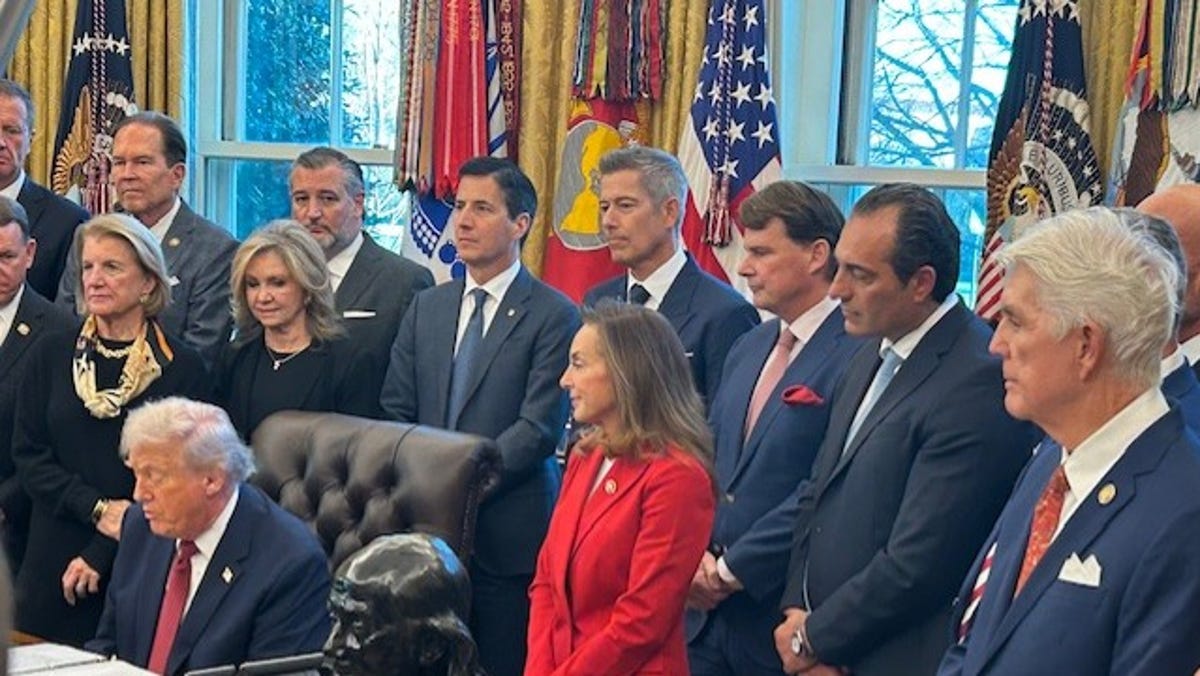
“People were brainwashed,” Trump said of the effort to promote production of electric vehicles or EVs under Biden in a ceremony at the Oval Office, where he was surrounded by auto executives, auto dealers and members of Congress. “People were paying too much for a car that didn’t work as well and now they’re going to have a great car that is going to be environmentally friendly but it’s going to cost you a lot less.”
Environmentalists denounced the proposal, which still must undergo a public comment period before being finalized. “In one stroke Trump is worsening three of our nation’s most vexing problems: the thirst for oil, high gas pump costs and global warming,” said Dan Becker, director of the Center for Biological Diversity’s Safe Climate Transport Campaign and a longstanding proponent of stronger emission standards.
The proposal, made by the National Highway Traffic Safety Administration (NHTSA) would significantly reduce fuel economy standards − which are measured as the miles per gallon of gasoline an automaker’s new cars and light-duty trucks get on average − across the U.S. fleet, going back to model year 2022, with compliance data not yet finalized for that model year, and going forward.
For each successive year, the percentage increase in fuel economy would be smaller than that proposed by the Biden administration. For model year 2026, for example, the fleetwide average was expected to be 35.8 mpg; under Trump’s new rules, it would be 30.4 mph.
By 2031, the gap would increase substantially, from 50.4 mpg on average under the Biden rules to 34.5 mpg under Trump’s.
Trump not only said Biden’s rules amounted to “an insane electric vehicle mandate,” suggesting they only could be met by forcing Americans to buy EVs and companies to produce them, but added cryptically that his Environmental Protection Agency (EPA) could get rid of tailpipe emission standards it has previously mandated under the Clean Air Act. Such a move, if it were to happen, would be an enormous change in how greenhouse gas emissions from autos − considered one of the largest sources of climate change − are regulated.
With Trump and Transportation Secretary Sean Duffy flanked in the Oval Office by various dignitaries, including the leaders from the Detroit Three automakers, Trump asked Ford Motor CEO Jim Farley to step forward and comment on it.
“Today is a victory of common sense and affordability,” Farley said. “Eighty percent of the vehicles we sell here, we make in our country, and we never left, unlike many of our competitors. This CAFE (Corporate Average Fuel Economy) standard, that is aligned with customer demand, is the right move. We believe that people should be able to make a choice as you said Mr. President.”
Farley went on to say, “We will invest more in affordable vehicles. This allows us to invest in affordable vehicles made in the US, which we will take the lead on and it will allow us to make vehicles more affordable.”
Stellantis, which makes Chrysler, Dodge, Jeep, Ram and Fiat brands, was represented at the White House by its CEO Antonio Filosa, who also praised the proposal. “It’s a great day for us at Stellantis because it’s the day when we see CAFE standards reconciled with real customer demands.”
GM CEO Mary Barra did not attend due to a previous commitment but John Urbanic, plant manager at GM’s Orion Assembly plant, was on hand. He told Trump, “We support your leadership for this issue that is so important to the auto industry.” General Motors spokeswoman Liz Winter noted that as part of a $4 billion investment GM is making in U.S. manufacturing, GM is transitioning Orion from building EVs to instead build gasoline-powered pickups and SUVs.
In a statement, Winter said GM supports the move because GM has long advocated for one national standard.
“GM supports the goals of NHTSA’s proposed CAFE rule and its intention to better align fuel economy standards with market realities. We have long advocated for one national standard that upholds customer choice and provides the auto industry long-term stability,” Winter wrote. “As we review the proposal, we remain committed to offering the best and broadest portfolio of electric and gas-powered vehicles on the market.”
In a statement to the Detroit Free Press, the wider auto industry also applauded the move to ease the CAFE standards.
“We’ve been clear and consistent: The current CAFE rules finalized under the previous administration are extremely challenging for automakers to achieve given the current marketplace for (electric vehicles),” John Bozzella, CEO of Alliance for Automotive Innovation — a group that represents most automakers — said in a statement. “What’s good for consumers and the auto industry? A stable regulatory environment and balanced, reasonable, achievable standards that continue to reduce emissions and improve fuel economy.”
Bozzella added that the new policies will preserve consumer choice and keep the U.S. auto industry globally competitive.
Likewise, the National Auto Dealers Association said in a statement that it has advocated for regulations that protect consumer choice and vehicle affordability for decades. It said car dealers support CAFE standards that are feasible and in line with customer demand for affordable, fuel-efficient cars.
“The comprehensive reset of CAFE standards proposed today represents a milestone in that effort, and we commend the Trump administration for its leadership on the issue,” the NADA said in a statement. “If finalized, these regulations would craft standards that can be met with a range of technologies. This would enable manufacturers to produce vehicles suited to a wide spectrum of consumers with varying budgets and fuel preferences.”
But as noted, environmentalists were outraged. The League of Conservation Voters said a rollback will hurt the environment and consumers’ pocketbooks.
“The Trump administration is continuing their attacks on clean energy and families’ budgets by rolling back standards that save each family hundreds of dollars each year at the pump and make our environment healthier for our communities and future generations,” said Darrien Davis, government affairs advocate on climate change and clean energy for the group.
“Slashing fuel economy standards will increase costs for drivers and threaten the progress made in reducing dangerous air pollution and preventing adverse health outcomes for children, older adults and communities who live near busy roads,” he said.
More: Report: White House to propose less stringent fuel economy standards
The proposal, if it is finalized in the months to come as expected, abandons standards put in place under the Biden administration about 18 months ago. The Biden administration had said those standards would save some 70 billion gallons of gasoline through 2050, save Americans more than $23 billion in fuel costs, and prevent more than 710 million metric tons of carbon dioxide emissions by 2050, if they remained in place.
The announcement by Trump, meanwhile, continues his aggressive effort to unwind tougher mile-per-gallon standards for the U.S. fleet of cars and trucks that stretch back to 2011 and former President Barack Obama’s first term.
More: AI, other data centers are coming to Michigan — and they need a lot of energy and water
Those standards − which Trump moved to freeze in place during his first term as president and which Biden tried to pump up significantly in an effort to encourage the production and sale of zero-emission electric vehicles, or EVs − have become a political football, rising or retreating with each successive presidential administration.
In turn, those changes have scrambled automakers’ multibillion-dollar plans to try to meet them with new models and set off lawsuits by environmentalists, consumers and the states.
The latest round, which began after Trump took office in January of this year after campaigning vigorously on a promise to drop Biden’s “EV mandate,” is expected to be no different.
In June 2024 during Biden’s administration, NHTSA finalized its most recent rule under the law passed by Congress 50 years ago that requires it to set average fuel economy, or mile-per-gallon standards, at the “maximum feasible level.” That rule called for a fleetwide U.S. average across all new light-duty cars and trucks sold to be 47.3 mpg for model year 2027, rising to 50.4 mpg in model year 2031.
Significantly, that rule by the Biden administration was developed concurrently with one previously finalized by the EPA in March 2024 under the Clean Air Act that called for two-thirds of all new vehicles sold in the U.S. by 2032 to emit no greenhouse gases that contribute to climate change, effectively requiring a steep increase in the number of EVs produced and sold.
On the campaign trail especially in Michigan and other Midwestern swing states, Trump used the threat of that “EV mandate” to great effect, telling voters − and UAW members − that it would end in American auto companies losing business and jobs to Chinese producers better able to make and sell EVs and forcing consumers to buy vehicles they did not want at a higher upfront cost.
Once in office, Trump immediately followed through on his promise to roll back the so-called mandate, signing an executive order reversing an earlier one signed by Biden promoting EV adoption. In March of this year, new EPA director Lee Zeldin said the earlier Clean Air Act rule would be reconsidered, and Trump in June signed a congressional resolution reversing a waiver to California and other states to enact tougher standards on vehicle emissions, which is provided for in the Clean Air Act and is being challenged in court.
In passing a wide-ranging measure of tax and spending reductions, Trump and the Republican Congress also followed through on getting rid of a tax credit that encouraged the sale of American-assembled EVs by Sept. 30 of this year; it also dropped the penalties for automakers violating fuel standards under the law to zero, effectively making − for now − Trump’s own proposed standards without any teeth, enforcement-wise.
Duffy, Trump’s transportation secretary, also said NHTSA would reconsider the fuel economy standards immediately after Trump took office in January and, in June, his department issued an interpretive rule “of the factors the agency is prohibited by law from considering when setting maximum feasible fuel economy standards” for vehicles of all kinds, saying that included any reliance on “non-gas-powered” cars and trucks, meaning EVs. It was the inclusion of EVs, however, which allowed for higher mpg standards to be set across the fleetwide average, since they use significantly less, if any, gasoline.
As proposed by NHTSA, the new rules would also make other changes to the ways in which fuel economy standards are set and enforced, including by getting rid of rules that allow automakers to bank and trade compliance credits. Duffy, speaking at the White House, said the old rules were based on a “lie.”
“These CAFE standards used (factors) which were contrary to the law,” Duffy said, developing a standard “which the car companies will take you was completely unattainable.”
“All the nonsense is being taken out of the cars,” added Trump.
Staff reporters Liam Rappleye and Jackie Charniga contributed.
Contact Todd Spangler: tspangler@freepress.com. Follow him on X @tsspangler.
This story has been updated with new information.
Related Article