Sign in with
Forget Password?
Learn more
share this!
2
Tweet
Share
Email
December 16, 2025
by Shibaura Institute of Technology
edited by Sadie Harley, reviewed by Robert Egan
scientific editor
associate editor
This article has been reviewed according to Science X’s editorial process and policies. Editors have highlighted the following attributes while ensuring the content’s credibility:
fact-checked
trusted source
proofread
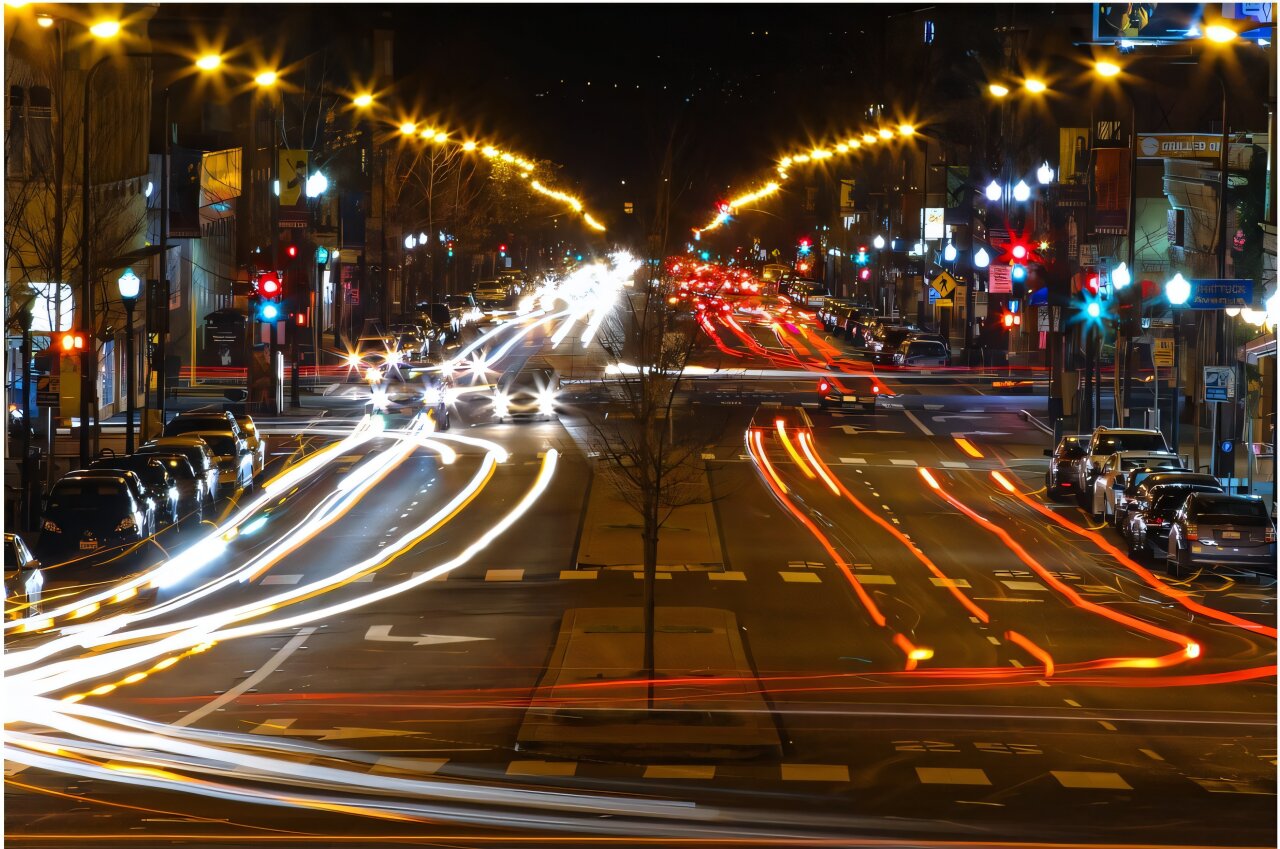
Road accidents often stem from failing to notice vehicles. A study published in the journal IEEE Open Journal of Intelligent Transportation Systems introduces a method for detecting distant vehicles with over twice the accuracy of existing systems.
Instead of using road markings, it analyzes the motion of nearby vehicles to estimate the road’s trajectory and vanishing point, capturing distant road areas.
By enlarging distant regions, the system can more accurately detect faraway vehicles, thereby enhancing safety by providing distant-vehicle information to drivers and pedestrians.
Intersections are among the most unpredictable spots on city roads. Drivers may struggle to notice approaching vehicles, and pedestrians often misjudge when it is safe to cross.
In Japan, nearly half of all road accidents occur at intersections, highlighting an urgent need for smarter systems that can improve visibility and safety.
Now, a team of researchers led by Professor Chinthaka Premachandra from the Advanced Electronic Engineering Course, the School of Engineering and the Graduate School of Engineering and Science at the Shibaura Institute of Technology (SIT), Tokyo, Japan, and Eigo Ito from the Department of Electronic Engineering, School of Engineering, SIT, Japan, has developed a new technique for accurately identifying distant vehicles.
Most current vehicle detection methods depend on deep learning algorithms that require powerful computing systems. However, these methods often struggle when vehicles appear small or unclear in the distance. The newly developed method takes a simpler, more practical approach—it examines the movement of nearby vehicles to predict where the road extends far ahead.
“Most detection systems work well for vehicles close to the camera, but their accuracy drops sharply for those farther away,” explains Prof. Premachandra. “We wanted to overcome this limitation with a lightweight approach that doesn’t require large datasets or complex neural networks.”
The system analyzes continuous video footage of the road and tracks the motion of nearby vehicles from frame to frame. By mapping these movements—called trajectories—it estimates the road’s vanishing point, or the area where the road appears to narrow toward the horizon. Once this region is identified, the system digitally enlarges it, making distant vehicles more visible.
Next, the system uses a mathematical model known as a Gaussian Mixture Model to detect moving vehicles in the magnified image. This process helps identify even tiny, faraway vehicles that might otherwise go unnoticed—all while using a standard camera and modest computing power.
In tests conducted under both day and night conditions, the method achieved more than twice the detection accuracy of conventional systems. It even outperformed some deep learning-based techniques while running smoothly at 30 frames per second on small, low-cost devices, such as the Raspberry Pi and Jetson Nano.
“Detecting faraway vehicles earlier can significantly reduce intersection-related accidents,” says Prof. Premachandra. “Imagine a system that warns pedestrians before they step onto the crosswalk or alerts drivers to vehicles still hundreds of meters away—it could make daily commuting much safer.”
Prof. Premachandra believes that this innovation could form the foundation of next-generation guidance systems that communicate real-time traffic information to both drivers and pedestrians. For example, cameras installed at intersections could detect vehicles approaching from a distance in all directions and issue alerts to drivers and pedestrians near the intersection via connected devices or traffic signals.
Beyond safety, the technology could contribute to the development of intelligent transportation systems (ITS)—which are networks that integrate vehicles, sensors, and infrastructure to create safer and more efficient roads. Because the system operates without heavy computational resources, it can be easily deployed in urban and rural areas alike.
While the initial results are promising, Prof. Premachandra notes that further improvements are planned. The team aims to test the system under different weather conditions, such as fog, rain, and snow, since these conditions often obscure visibility. They also intend to expand the system’s capability to classify different vehicle types and integrate it into broader ITS frameworks.
“Our goal is to make roads safer for everyone,” says Prof. Premachandra. “Even a few extra seconds of early warning can make the difference between a safe journey and a serious accident.”
By combining smart observation with simple computation, this study demonstrates that innovation in traffic safety doesn’t always require complex artificial intelligence—sometimes, it just takes a sharper look at the road ahead.
More information: Chinthaka Premachandra et al, Recognizing Distant Vehicles on GMM by Extracting Far Road Area Based on Analyzing Trajectories of Nearby Vehicles, IEEE Open Journal of Intelligent Transportation Systems (2025). DOI: 10.1109/ojits.2025.3614862
Explore further
Facebook
Twitter
Email
Feedback to editors
Dec 16, 2025
0
Dec 15, 2025
0
Dec 14, 2025
0
Dec 12, 2025
0
Dec 12, 2025
0
8 minutes ago
17 hours ago
17 hours ago
17 hours ago
17 hours ago
18 hours ago
18 hours ago
20 hours ago
21 hours ago
22 hours ago
Mar 24, 2025
Dec 3, 2025
Oct 7, 2024
Apr 21, 2020
Sep 9, 2025
Mar 12, 2024
17 hours ago
21 hours ago
23 hours ago
23 hours ago
Dec 15, 2025
Dec 15, 2025
A camera-based technique detects distant vehicles with over twice the accuracy of existing systems by analyzing the motion of nearby vehicles to estimate the road’s vanishing point and digitally enlarging distant regions. This approach improves detection even on low-cost devices, enhancing intersection safety and supporting intelligent transportation systems without heavy computational demands.
This summary was automatically generated using LLM. Full disclaimer
Use this form if you have come across a typo, inaccuracy or would like to send an edit request for the content on this page. For general inquiries, please use our contact form. For general feedback, use the public comments section below (please adhere to guidelines).
Please select the most appropriate category to facilitate processing of your request
Thank you for taking time to provide your feedback to the editors.
Your feedback is important to us. However, we do not guarantee individual replies due to the high volume of messages.
Your email address is used only to let the recipient know who sent the email. Neither your address nor the recipient’s address will be used for any other purpose. The information you enter will appear in your e-mail message and is not retained by Tech Xplore in any form.
Daily science news on research developments and the latest scientific innovations
Medical research advances and health news
The most comprehensive sci-tech news coverage on the web
This site uses cookies to assist with navigation, analyse your use of our services, collect data for ads personalisation and provide content from third parties. By using our site, you acknowledge that you have read and understand our Privacy Policy and Terms of Use.