Sharing tools are disabled until you accept Social Networking Cookies. Update cookie preferences
If the dialog doesn't appear, ad-blockers are often the cause; try disabling yours or see our Social Features Support.
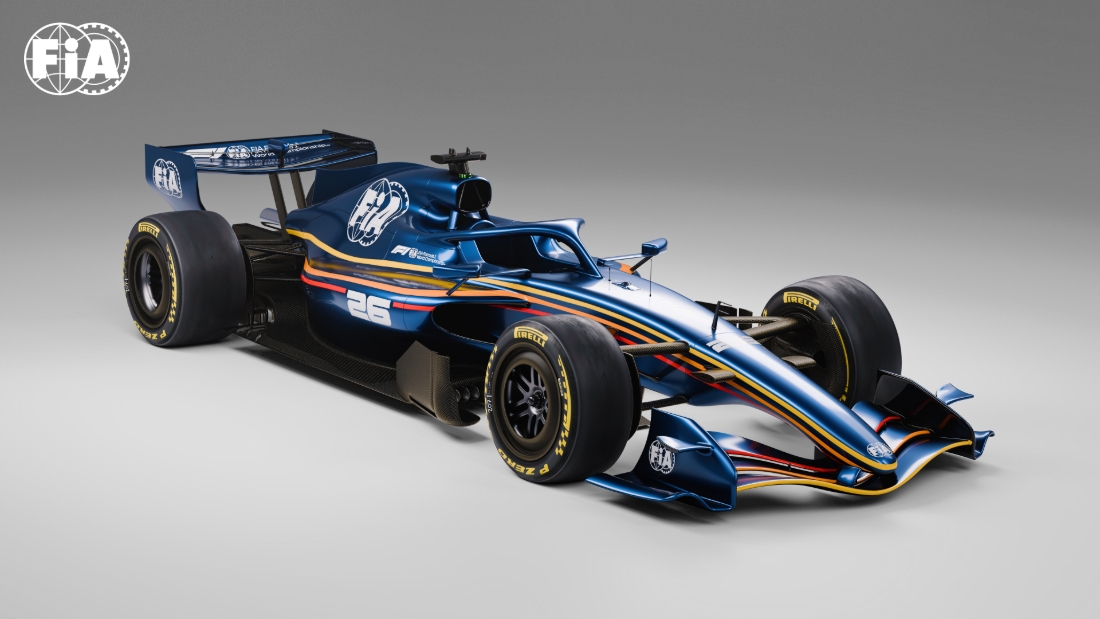
Formula 1 and the FIA have finalized new terminology that is required for the 2026 cars, amid a radical change in regulations.
The 2026 rules will provide more electrical energy being available as part of the power unit – close to a 50:50 split with the internal combustion engine – while active aerodynamics also come into use. There are new overtaking aids and configurations, that have all been tested with fan focus groups – comprising new, existing and core followers of the sport – to simplify the terms that will describe the incoming technology.
Replacing DRS, the new overtaking aid will simply be known as "Overtake," and will allow drivers that are within as second of the car in front to be able to deploy additional energy to help them in a wheel-to-wheel battle. That is separate to the "Boost" function that cars will have, when drivers use the energy recovery system (ERS) to deploy energy as and when they need it.
The active aerodynamics are perhaps the biggest change from a car perspective, with two separate modes simply called "Straight Mode" and "Corner Mode."
Corner Mode is effectively the car in its normal, full-downforce state, allowing maximum performance from the aerodynamics through corners.
In Straight Mode, the front and rear wing flaps open up to reduce drag, providing an increase in top speed for less energy. This configuration is only available to cars in designated areas on each circuit, that will be defined by straights with a minimum length.
The 2026 regulations will also include further attempts to improve the impact of dirty air on a following car, with the FIA having made gains compared to 2021 in the previous ruleset. According to team geometry, 2021 cars had an estimated 67% of the lead car’s aerodynamic performance available to them when following within 20 meters, a total that dropped to 55% at 10m.
The baseline target from F1 in 2022 was to achieve 95% performance at 20m and 85% at 10m, but data over the past three years suggests the average has been 80% and 65% respectively. In 2026, the baseline target is for 90% at 20m, and 80% at 10m, with the FIA hoping to have addressed some loopholes that could be exploited in the previous regulations.
“The very early days of 2022, everyone was saying how closely they can follow and everyone was really happy, and nowadays it is quite difficult, I would say,” said the FIA’s single seater director Nikolas Tombazis. “So in that respect, I would say we didn't manage to keep that parameter as well under control as we would have liked.
“The main areas [that were exploited] were the front wing endplate. The front wing endplate was originally planned to be a very in-washing device. And gradually in all the ruling to do with how the profiles go around and join into the endplate, that was not tight enough, and it led to profiles being quite out-washing in that area and creating a lot of out-wash.
“The other area where they exploited a lot was the drums design of the front wheel and all the 'furniture' on the inside of the front wheel. I would also say the edges of the floor were in that category. All the designs on the floor edges … These I think were the main areas of, let's say, performance deterioration from the intent of the rules.
“The out-wash, we obviously believe [has been addressed for 2026], but let's have this discussion in two years, and hopefully we will tell you it was OK and we will all be smiling.”
formula 1
fia
2026 regulations
active aerodynamics
overtake aid
energy recovery system
nikolas tombazis
car performance
Formula 1
Sharing tools are disabled until you accept Social Networking Cookies. Update cookie preferences
If the dialog doesn't appear, ad-blockers are often the cause; try disabling yours or see our Social Features Support.
While studying Sports Journalism at the University of Central Lancashire, Chris managed to talk his way into working at the British Grand Prix in 2008 and was retained for three years before joining ESPN F1 as Assistant Editor. After three further years at ESPN, a spell as F1 Editor at Crash Media Group was followed by the major task of launching F1i.com’s English-language website and running it as Editor. Present at every race since the start of 2014, he has continued building his freelance portfolio, working with international titles. As well as writing for RACER, his broadcast work includes television appearances on F1 TV and as a presenter and reporter on North America's live radio coverage on SiriusXM.
Read Chris Medland's articles
Comments are disabled until you accept Social Networking Cookies. Update cookie preferences
If the dialog doesn't appear, ad-blockers are often the cause; try disabling yours or see our Social Features Support.
All contents copyright © 2025, Racer Media & Marketing, Inc. or Racer Network, LLC. All rights reserved. This material may not be published, broadcast, rewritten or redistributed in any form without prior authorization. Your use of this website constitutes acceptance of our Privacy Policy and Terms & Conditions. Contact us at 2525 Main St, Ste 430, Irvine, CA 92614, 949.417.6700 for more information.