Notifications can be managed in browser preferences.
Please refresh the page or navigate to another page on the site to be automatically logged inPlease refresh your browser to be logged in
Swipe for next article
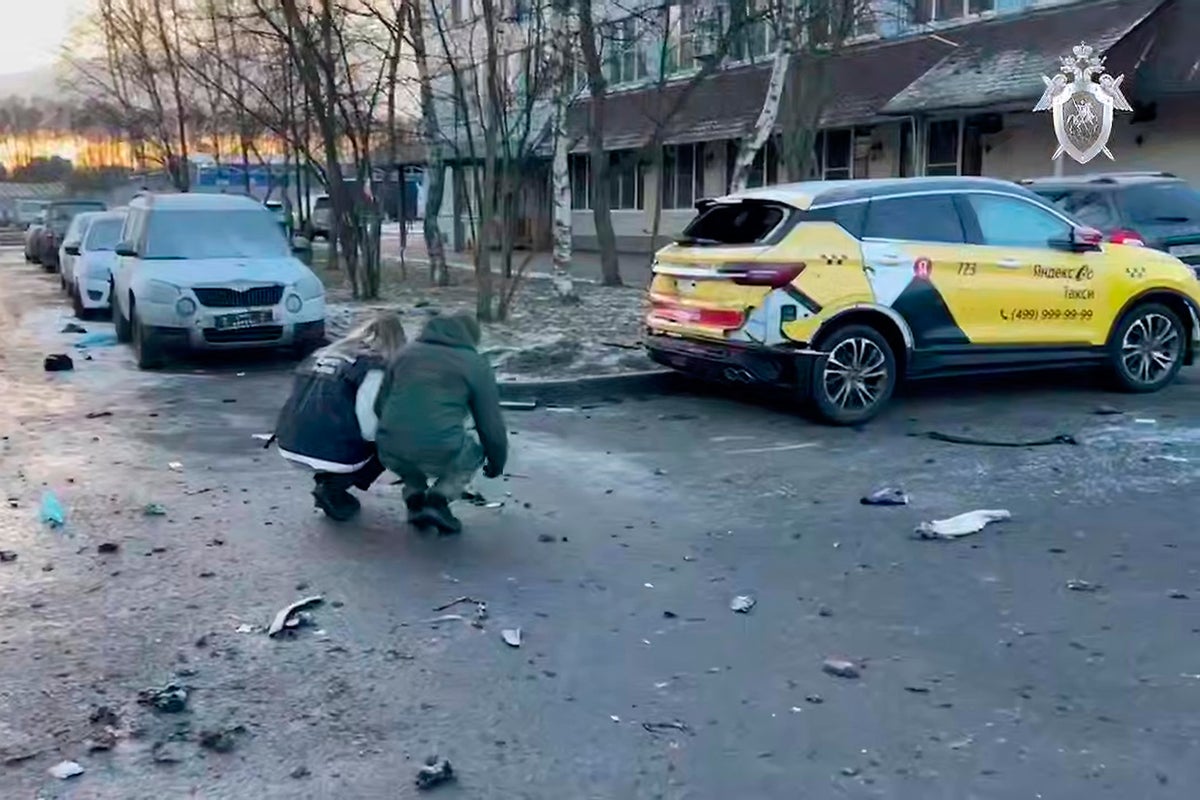
Fresh blast rocks site in Moscow where Russian general was killed on Monday
Removed from bookmarks
I would like to be emailed about offers, events and updates from The Independent. Read our Privacy notice
At least three people have died in an explosion in southern Moscow at the site where a Russian general was killed earlier this week.
Russian authorities said two police officers were among those found dead after the fresh blast in the capital. The other was thought to have been a bystander.
Earlier, Ukraine’s military said its forces had pulled out of the embattled eastern town of Siversk near Bakhmut.
“The invaders were able to advance due to a significant numerical advantage and constant pressure from small assault groups in difficult weather conditions,” Ukraine‘s General Staff said.
Siversk had a pre-war population of 10,000, and its capture by Russia puts a dent in the “fortress belt” of major Donbas towns still held by Ukraine.
Russia has continued to push forwards – albeit slowly – in Ukraine after rejecting a Christmas truce, and launching a massive drone and missile attack early on Tuesday.
Pope Leo criticised Vladimir Putin‘s decision to turn down a ceasefire.
“I will make an appeal one more time to people of good will to respect at least Christmas Day as a day of peace,” he said.
Russia is reportedly planning to establish a nuclear power plant on the moon within the next decade.
This ambitious project aims to supply energy for its lunar space programme and a joint research station with China, as global powers intensify their efforts in lunar exploration.
Historically, Russia has held a prominent position in space, notably with Yuri Gagarin’s pioneering journey in 1961.
The Zaporizhzhia nuclear power plant has been a critical issue in the US- brokered peace talks between Ukraine and Russia.
Here is everything you need to know about the power plant:
The Zaporizhzhia nuclear power plant is located on the banks of the Kakhovka water reservoir in southeastern Ukraine.
Construction started on the site in 1979 and the first reactor was turned on in 1984.
The 1986 Chernobyl nuclear disaster led to a moratorium on the construction of new nuclear power units in Ukraine, and construction work on reactor number 6 was paused. However increasing demand for electricity meant that the ban was later eased.
By 1995, all six Soviet-designed pressurised water reactor (PWR) units were in operation – with a combined power output of nearly 6,000 MW.
Zaporizhzhia is capable of providing one-fifth of Ukraine’s electricity and almost 47 per cent of electricity generated by Ukrainian nuclear power plants.
It has been operated by Ukraine’s national nuclear energy generating company NNEGC Energoatom, though it is unclear what will happen now that Russian troops have seized the site.
The city is home to around 750,000 people and is the sixth largest in Ukraine.
Russian forces have captured Zarichne in eastern Ukraine, according to the country’s defence ministry.
The village is in Donetsk Oblast, near the Luhansk border.
We will bring you more details as we hear them.
Ukraine has unveiled the latest 20-point peace proposal brokered by the US to bring an end to the war with Russia.
Ukrainian and US delegations reached a consensus on several critical issues in the latest round of talks in Miami.
However, Volodymyr Zelensky said sensitive issues around territorial control in the country’s eastern industrial heartland, along with the management of the Zaporizhzhia Nuclear Power Plant (ZNPP), remain unresolved.
The Russian Federal Security Service (FSB) said on Wednesday it thwarted “a terrorist attack” at Transneft’s oil facility in Russia’s Tyumen region, Interfax reported.
“When apprehended, the suspect resisted arrest and was neutralised by return fire,” the agency said, citing FSB.
In case you missed this editorial from the weekend, here is The Independent View:
The Ukrainians have responded to the cautiousness of their European allies with a show of fighting spirit. After European leaders signed off a €90bn loan – as we commented yesterday, “just enough” to hold Vladimir Putin’s forces at bay but not enough to push them back – Ukraine has struck an alleged Russian shadow-fleet oil tanker off Libya, 2,000km from the battlefield.
Ukrainian drones also hit a Russian patrol ship and an offshore drilling platform in the Caspian Sea, hundreds of kilometres away.
The icy ground crackling under their feet, members of an elite Ukrainian drone-hunting team set up for a long night.
Antennas and sensors are clipped to a light stand. Monitors and controls are pulled from hard cases, and a game-changing new weapon is readied for deployment.
The Sting, shaped like a flying thermos, is one of Ukraine’s new homegrown interceptors.
Read more here:
Three people were killed including a four-year-old child, Ukraine officials said, in a large-scale Russian drone attack on the country just two days before Christmas.
The latest barrage, involving more than 650 drones and three dozen missiles, comes as hopes of securing a US-brokered ceasefire before 25 December fade.
The Russian assault struck homes and the power grid in 13 regions of Ukraine, causing widespread outages in bitterly cold sub-zero temperatures.
Read more:
Ukraine’s military said its forces were keeping up pressure on Pokrovsk and would continue trying to sever logistics for Russian troops inside.
Fighting is still raging around the former eastern logistics hub, where Ukrainian forces said this month they had fended off an unusually large Russian mechanised attack.
The Ukrainian military’s Operation Task Force East unit, which reports regularly on its defence of Pokrovsk, said yesterday that Ukrainian forces remained in control of the northern part of the largely destroyed city.
Writing on Facebook, it said Ukrainian servicemen were blocking attempts by Russian forces to advance. In the nearby town of Myrnohrad, the unit said Ukrainian forces were holding defensive lines and eliminating Russian forces on the outskirts.
Ukraine’s General Staff said Russian forces had launched 29 attacks in the Pokrovsk sector in an attempt to advance near a string of villages.
Join thought-provoking conversations, follow other Independent readers and see their replies
Please refresh the page or navigate to another page on the site to be automatically logged inPlease refresh your browser to be logged in
Related Article