Home » Blog » Blog » Driver dies in New Year’s Eve two-vehicle rollover crash on East Loop 820 in Fort Worth
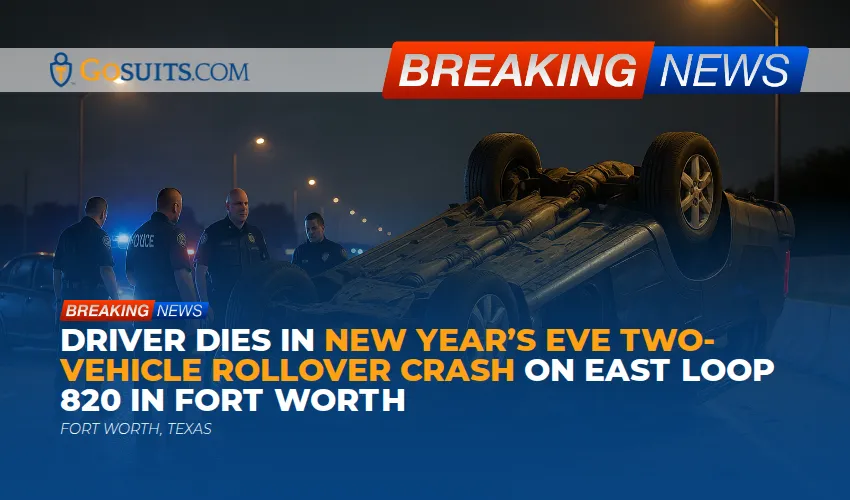
A late afternoon traffic collision on New Year’s Eve led to a fatal rollover crash on East Loop 820 North in east Fort Worth. Authorities indicated two vehicles collided near the 600 block of East Loop 820 North, close to the Trinity Boulevard area. One vehicle overturned, and the driver of the overturned vehicle was pronounced deceased at the scene. This occurred just before 5:45 p.m., during a time of day when northbound traffic often thickens ahead of evening celebrations and holiday gatherings.
While complete investigative details have not yet been released, what is clear is that this was a two-vehicle crash with a rollover component that proved deadly. Rollover crashes are among the most dangerous roadway events; the risk of serious injury or ejection rises sharply if occupants are unrestrained, and roof deformation and multiple impacts can compound trauma [1].
The crash occurred in the northbound lanes of East Loop 820 North, near Trinity Boulevard in east Fort Worth, shortly before 5:45 p.m. on December 31, 2025. That stretch of Loop 820 serves commuters traveling between the Trinity Boulevard industrial corridor, residential communities east of the Trinity River, and connections toward Interstate 30, State Highway 10, and access routes into Hurst and Euless. Evening and holiday traffic can create heavier volumes and spur lane changes, merging, or sudden slowdowns that increase crash risk.
Fort Worth Police Department East Division officers responded and confirmed the fatality. In collisions involving a rollover and a death, it is typical for investigators to secure the scene, document vehicle positions, examine roadway evidence such as skid or yaw marks, and gather witness statements. In Texas, crash reporting and investigation for serious crashes follow statutory procedures, including documentation of contributing factors and whether safety restraints were used [6].
Investigators may also look for nearby cameras that could have captured pre-impact movement or the rollover sequence, such as traffic signal cameras, commercial security cameras facing the highway, or dash cameras from other drivers. If a commercial vehicle is involved, additional data sources like electronic control module (ECM) downloads or telematics may be relevant. At this time, authorities have only shared the essential facts that two vehicles collided and one overturned with a fatal result.
East Loop 820 borders a mix of industrial sites, warehouse distribution hubs, and neighborhoods that funnel daily commuter and freight traffic along the loop. The Trinity Boulevard corridor parallels the river and rail lines, and the area can have frequent large-truck activity entering and exiting side streets. While this report does not indicate a commercial carrier was involved, the local mix of vehicle types and the loop’s speed environment are important context for investigators and safety planners.
Holiday timing can also matter. On New Year’s Eve, more vehicles are on the move in the late afternoon and evening, and roadway dynamics may involve increased lane changes and variable speeds. Whether those dynamics played any role here remains to be determined by the ongoing investigation.
When a fatal crash occurs in Fort Worth, several agencies may become involved. Patrol officers and crash investigators manage the scene and initial documentation. If a death is confirmed, the Tarrant County Medical Examiner’s Office is notified to determine the cause and manner of death and to handle next-of-kin notifications according to established protocols. Families often have questions about when and how they can receive the decedent’s remains and whether an autopsy is performed. In Texas, medical examiner offices follow state law regarding examinations, toxicology, and official determinations. The Tarrant County Medical Examiner’s Office provides information on autopsy and report requests to the public through county channels [3].
In parallel, a formal crash report is created. In Texas, crash reports for serious incidents are typically filed and made available for purchase through the Texas Department of Transportation’s Crash Records Information System after processing. These documents can help families understand basic facts such as crash location, involved vehicles, and reported contributing factors [2].
Texas law centralizes most crash report access through the state. After processing, eligible parties can obtain a certified copy of the crash report from the Texas Department of Transportation. TxDOT’s system is the primary portal for certified crash reports and related records for crashes across Texas, including Fort Worth [2].
Fort Worth residents sometimes also submit public information requests through the City of Fort Worth for supplemental materials such as 911 audio, CAD notes, or officer incident narratives, when available. The city’s open records process explains how to request public records maintained by the police department or other city offices [4].
The Tarrant County Medical Examiner’s Office provides autopsy reports, toxicology, and related documents to authorized requestors in accordance with law and county policy. Families seeking information about the examination, release of remains, or obtaining official reports should refer to the county’s medical examiner webpage for procedures, identification requirements, and any applicable fees [3].
Official records serve several purposes. They clarify key facts, help with insurance claims, and may be essential if the family pursues civil claims related to the crash. Because a rollover crash can involve complex dynamics, these records provide a starting point for understanding what occurred.
Texas law provides two separate civil pathways after a fatal crash: a wrongful death claim and a survival action. Though they often proceed together, they serve different purposes.
Under Texas Civil Practice and Remedies Code Chapter 71, certain family members may bring a wrongful death action when a death is caused by the wrongful act, neglect, carelessness, unskillfulness, or default of another. Eligible beneficiaries generally include the spouse, children, and parents of the deceased, and the action seeks damages for losses they suffered due to the death, such as loss of companionship and support [5].
The survival statute allows the decedent’s estate to bring the claims the decedent could have brought had they survived, including pain and suffering, medical expenses before death, and certain other damages. This action proceeds on behalf of the estate and is distinct from the wrongful death claim [5].
Texas generally imposes a two-year limitations period for wrongful death and personal injury claims, subject to specific exceptions. Missing this deadline can bar claims, making early attention to timelines critical [7].
Texas follows proportionate responsibility. If multiple drivers contributed to a collision, fault is apportioned by percentage. A claimant who is more than 50 percent responsible cannot recover, and any recovery is reduced by their percentage of responsibility if 50 percent or less. These rules shape negotiations and case assessment in two-vehicle collisions [8].
Insurance coverage questions arise quickly after a fatal crash, particularly in a two-vehicle collision on a high-speed loop. Several coverage types may be involved.
Insurance carriers move fast after a serious crash, often seeking statements or authorizations. It is generally prudent to consult with a qualified attorney before giving recorded statements or signing medical authorizations. Statements made early can be used later in ways that are difficult to anticipate.
Rollover events often produce wide debris fields and complex impact patterns. Preserving evidence early makes a significant difference when analyzing liability and causation. Consider the following categories:
When multiple vehicles are involved, timely preservation requests and spoliation letters can help prevent loss of critical evidence. The precise approach depends on the facts, which develop as investigators release more detail.
Rollovers are disproportionately deadly. Even though they represent a smaller share of total crashes, they account for a large portion of fatalities due to the potential for ejection, roof intrusion, and multiple impacts. NHTSA has identified several broad contributing mechanisms, including tripping on soft shoulders or curbs, high speed combined with abrupt maneuvers, and loss of control on curves. Proper restraint use dramatically reduces the risk of fatal ejection [1].
On urban loops like 820, lateral movements, lane changes, and interacting traffic streams can create sudden conflicts. If a vehicle leaves the travel lane and encounters a soft edge, a curb, or a median grade change, the tripping mechanism can initiate a rollover. Investigators often consider vehicle type and center of gravity, tire condition, and whether a secondary collision precipitated the roll. None of these specifics have been released for this crash, but they are part of standard rollover analysis [1].
Families often ask how long it takes to understand what happened and what a civil process might look like. Official crash reports typically take days to a few weeks to post in state systems. Medical examiner reports can take longer, especially when toxicology is required. Insurance investigations proceed on their own timelines, which may not align with a family’s need for answers.
On the civil side, complex two-vehicle collisions with a rollover component require careful analysis. Negotiations can begin once the core facts and insurance coverages are clear. The two-year limitations period in Texas applies in most fatal crash cases, so tracking the date is important even while agencies finalize reports [7]. For a practical discussion of timing considerations, see how long does it take to settle a wrongful death lawsuit.
In the aftermath of a fatal crash, there are a few concrete steps that can protect rights and prevent the loss of key information. The goal here is clarity, not pressure.
Acting within the first days and weeks is critical because video is overwritten, vehicles are salvaged, and memories fade. Timely action preserves options.
Our hearts go out to everyone affected by this tragedy on East Loop 820. On New Year’s Eve, a moment that should have been about community and celebration turned into unimaginable loss. This commentary is for educational and general informational purposes.
From a civil injury perspective, a two-vehicle collision that results in a rollover raises several familiar questions. How did the impact occur in the moments before the roll, and where did the primary contact happen within the lane geometry near Trinity Boulevard. Were there abrupt maneuvers, lane changes, or a tripping mechanism at the pavement edge. Are there third-party videos that captured the traffic flow just before 5:45 p.m. These are the types of fact questions investigators and reconstruction professionals work through in a rollover crash.
It is also important to understand how insurance companies and, where applicable, corporations managing vehicles, approach these cases. Adjusters move quickly to gather statements and shape liability narratives early. They may ask for recorded statements, broad medical authorizations, or early releases that are not in a family’s long-term interest. Without clear knowledge of Texas wrongful death and survival statutes, proportionate responsibility rules, and coverage layers, people can unintentionally give up leverage or even jeopardize claims.
That is why many families choose to obtain a free consultation before speaking with insurers or signing documents. A consultation helps people understand timelines, beneficiaries under Texas law, potential coverage sources, and the kinds of evidence that matter most in a case involving a rollover crash. Even when the path forward is not yet clear, answering these practical questions early can offer a measure of control in a very difficult time.
This article is provided solely for general informational and educational purposes. It is not intended as legal advice and should not be relied upon as such, particularly by individuals affected by the incident discussed. Reading this article does not create, nor is it intended to create, an attorney–client relationship.
An attorney–client relationship with our firm can only be established through the execution of a written contingency fee agreement signed by both the client and the law firm. If you are a victim of this incident, you should not interpret the information herein as legal advice. Instead, we strongly encourage you to contact an attorney of your choice to obtain a proper consultation tailored to your specific situation.
Some or all of the information found on this site maybe generated by AI. Images of the scene of the incident are not real images and are created by AI. We do not guarantee the accuracy of the research and infromation found here. You agree to indemnify, defend, and hold Gosuits and the affliated companies harmless for damages or losses caused by you or another party due to any access to or use of the Services on this website or any information contained therein whether authorized or unauthorized. We will not be liable for any information or access caused by unauthorized disclosure of your information by any third party. You agree to notify us in writing immediately if you suspect any unauthorized use of or access of your information from this website by a third party.
We rely on the information found on the net and do not always have first hand knowledge of the matters. If you find any information here inaccurate or offensive contact us and we will have it immediately removed.
By using this website you are agreeing to these terms and conditions along with our terms and conditions on our disclaimer page. https://gosuits.com/terms-use-disclaimer/
If you would like this article removed, please call 800-972-4355 and ask for Sean Chalaki, who will assist you with your request.
Your email address will not be published.
About the Author
Limited time to file your claim. Don’t wait!
We’re here to help you get the compensation you deserve.
Almost There!
One Last Thing!
The content of this website has been prepared by Gosuits.com, for informational purposes only and should not be construed as legal advice from a lawyer. The material posted on this website is not intended to create, and receipt of it does not constitute, a lawyer-client relationship, and readers should not act upon it without seeking professional counsel. The chat system is an automated system that provides general information and not legal advice. You should not rely on any of the information, nor should you ever disclose private information to anyone in the chat system. Our office will never ask you for your private information until you have retain our firm with a written contract. Until there is an established written contract there is no attorney-client relationship. The knowledge base section of this website is not to be used as legal advice or legal resources. This website contains attorney advertising. Prior results do not guarantee a similar outcome. Disclaimers.
Gosuits Personal Injury & Accident Lawyers – Dallas: 3234 Commander Dr. Suite 800 Carrollton, Texas 75006
Gosuits Personal Injury & Accident Lawyers – Irvine: 2082 Michelson Dr. Suite 315 Irvine, CA 92612
Gosuits Personal Injury & Accident Lawyers – Los Angeles: 11900 W Olympic Blvd suite 640, Los Angeles, CA 90064
Gosuits Personal Injury & Accident Lawyers – Chicago: 8 S Michigan Ave suite 935, Chicago, IL 60603
* Best Lawyers Ones to Watch 2025 – Sean Chalaki
* Best Lawyers Ones to Watch 2022 – Sean Chalaki
* Rising Stars 2016 – Sean Chalaki
* Attorney at Law Magazine 2016 – Sean Chalaki
* The National Trial Lawyers 2015 – Sean Chalaki
Copyright © 2026 Gosuits.com. All Rights Reserved | Privacy Policy | Terms and Conditions
We’ve got your answer ready!
Just let us know where to send it by filling out this form.
Almost There!
Disclaimer: The response you’re receiving is generated by artificial intelligence based on your inputs and available data. While we strive for accuracy and usefulness, the content may include errors or omissions and is provided “as is” for informational purposes only. It does not constitute legal, medical, financial, or other professional advice. You are responsible for verifying the information before acting on it. We disclaim any liability for decisions made or actions taken in reliance on this content.