Tesla Cybercab test fleet expands in Austin and Bay Area
Tesla Germany’s “Giga Train’s” improved service gets rave reviews
Tesla stands to gain from Elon Musk’s rekindled friendship with President Trump
Tesla FSD earns high praise in South Korea’s real-world autonomous driving test
Tesla claims nearly 20% market share as Norway sets new car sales record
Tesla Cybercab test fleet expands in Austin and Bay Area
Tesla Germany’s “Giga Train’s” improved service gets rave reviews
Tesla stands to gain from Elon Musk’s rekindled friendship with President Trump
Tesla FSD earns high praise in South Korea’s real-world autonomous driving test
Tesla claims nearly 20% market share as Norway sets new car sales record
Starlink achieves major milestones in 2025 progress report
Starlink passes 9 million active customers just weeks after hitting 8 million
SpaceX shades airline for seeking contract with Amazon’s Starlink rival
Tesla hints at Starlink integration with recent patent
SpaceX IPO is coming, CEO Elon Musk confirms
Tesla stands to gain from Elon Musk’s rekindled friendship with President Trump
Tesla CEO Elon Musk drops massive bomb about Cybercab
Tesla analyst breaks down delivery report: ‘A step in the right direction’
Starlink achieves major milestones in 2025 progress report
Elon Musk: Tesla Model Y is world’s best-selling car for 3rd year in a row
Tesla captured roughly one in five new cars in Norway, highlighting its dominance in the world’s most EV-friendly market.
Published
on
By
Norway shattered its all-time new car sales record in 2025, and Tesla emerged as the clear winner. A year-end rush ahead of higher EV taxes pushed registrations to nearly 180,000 vehicles, with electric cars accounting for 96% of sales.
Tesla captured roughly one in five new cars in Norway, highlighting its dominance in the world’s most EV-friendly market.
Norway’s EV rush
As noted in a CarUp report, Norway’s electric vehicle sales in 2025 surged, thanks in part to buyers rushing ahead of a post–new year VAT increase of roughly 50,000 kronor on many new electric cars. This ended up pulling demand forward and setting a national record with almost 180,000 registrations in 2025.
The result was unprecedented. From the vehicles that were sold in 2025, 96% of new cars sold were fully electric. And from this number, Tesla and its Model Y made their dominance felt. This was highlighted by Geir Inge Stokke, director of OFV, who noted that Tesla was able to achieve its stellar results despite its small vehicle lineup.
“Taking almost 20% market share during a year with record-high new car sales is remarkable in itself. When a brand also achieves such volumes with so few models, it says a lot about both demand and Tesla’s impact on the Norwegian market,” Stokke stated.
Tesla domination
🇳🇴Norway finishes record-breaking 2025 with 95.9% of the 179,550 new vehicles registered being EVs.
Total vehicle registrations jumped 40% YoY.@Tesla remained the Top Car Brand for the 5th year in a row with 34,385 vehicles registered — one in every five new cars on the road… pic.twitter.com/HFoA7pTLmW— Brian Basson (@BassonBrain) January 5, 2026
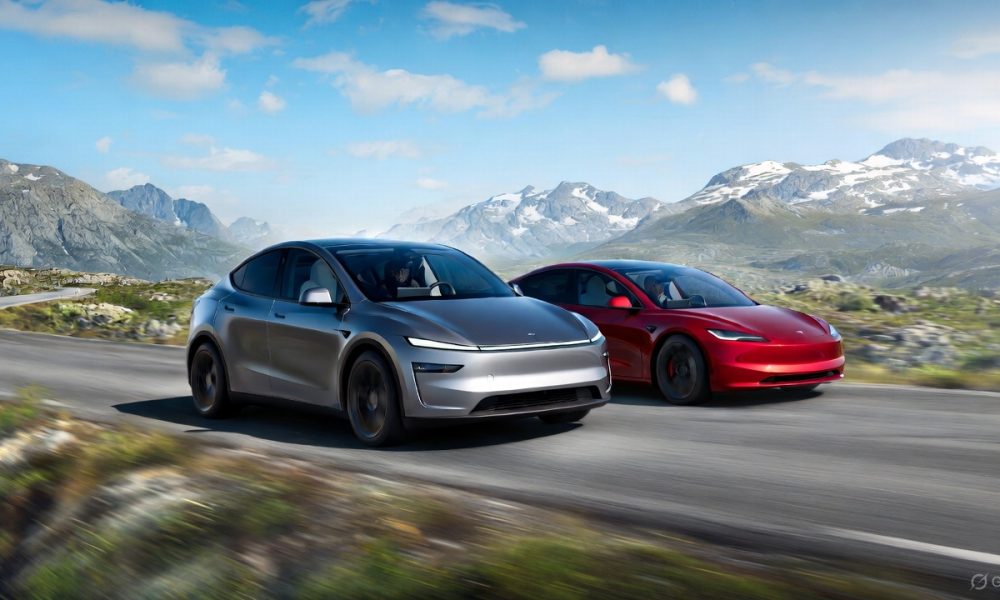
Tesla led all brands in Norway with 34,285 registrations, which is equal to a 19.1% market share. These results place Tesla well ahead of Volkswagen and Volvo, which held a 13.3% and 7.8% market share in 2025, respectively.
On the model chart, Tesla’s strength was even clearer. The Tesla Model Y topped all vehicles with 27,621 registrations, accounting for 15.4% of the entire market. The Tesla Model 3 also ranked among the top five, accounting for 3.7% of Norway’s entire auto sales in 2025.
Other strong performers included Volkswagen’s ID.4 and ID.7, Toyota’s bZ4X, which commanded 4.9%, 3.9%, and 4.1% of Norway’s total sales in 2025, respectively.
Simon is an experienced automotive reporter with a passion for electric cars and clean energy. Fascinated by the world envisioned by Elon Musk, he hopes to make it to Mars (at least as a tourist) someday. For stories or tips–or even to just say a simple hello–send a message to his email, simon@teslarati.com or his handle on X, @ResidentSponge.
In total, the Robotaxi fleet is comprised of 139 total vehicles in both Austin and the Bay Area. The vast majority of these units are Model Y cars, but the Cybercab is the most recent addition to the fleet.
Published
on
By
Tesla has expanded its fleet of Cybercab test units in both Austin and the Bay Area of California, as the vehicle is heading toward the first production stages, hopefully early this year.
As the first few units were spotted in Austin late last year, Tesla is now operating seven total Cybercab units in testing, three of which were spotted over the weekend in Texas. Bay Area testing just started on January 3, with both units also being added to the fleet on Saturday and Sunday.
In total, there are seven Cybercabs now operating, according to Robotaxi Tracker, each with different license plates that have been observed over the course of the last several weeks; the first unit was spotted in Austin on December 18.
The future should look like the future, indeed.
The Cybercab really changes the look of the roads, but without the shock factor of the Cybertruck. It’s a pretty good balance, imo.pic.twitter.com/PM0KbjzhxR
— TESLARATI (@Teslarati) December 22, 2025
The expansion of the Cybercab test fleet is a slow but steady process that Tesla is taking to get the car on public roads ahead of its initial production stages.
CEO Elon Musk said last week that Tesla has already started some test production phases of the vehicle at Gigafactory Texas, which is located outside of Austin.
Tesla Cybercab tests are going on overdrive with production-ready units
However, it will likely be some time before Tesla actually adds it to the fleet for rides that are available to the public. Tesla plans to build it without a steering wheel or pedals, so the company will have to reach Level 5 autonomy at that point before customers can hail rides and take it to their destination.
In total, the Robotaxi fleet is comprised of 139 total vehicles in both Austin and the Bay Area. The vast majority of these units are Model Y cars, but the Cybercab is the most recent addition to the fleet.
As per recent reports, Tesla’s free “train”Giga Train” service will increase its daily trips to six starting this week.
Published
on
By
Tesla has expanded its employee shuttle service from Berlin Ostbahnhof East Station to the Gigafactory Berlin-Brandenburg. As per recent reports, Tesla’s free “train”Giga Train” service has increased its daily trips to six starting this week.
The service has so far received positive reviews from the facility’s employees, some of whom noted that the upgraded shuttle train has reduced their travel time by a notable margin.
Giga Berlin’s expanded shuttle service
As noted in a rbb24 report, Giga Berlin’s free shuttle train now operates six times daily, up from one previously. The service also goes directly to the Model Y production facility without stopping at other stations. Tesla employee Dené Schunck described the service to rbb24 in a comment: “The shuttle goes directly to the factory site, without any transfers, which reduces the commute time for our employees by almost half,” Schunck stated.
Operated by Ostdeutsche Eisenbahngesellschaft (Odeg) after switching from Niederbarnimer Eisenbahn (NEB), Giga Berlin’s shuttle train, which also stops at Ostkreuz and Erkner, remains free for all riders, including non-Tesla employees. It has been fully funded by Tesla Germany since September 2023.
Employees praised the changes: One Giga Berlin worker stated that it “definitely makes the journey easier” because employees “used to need two hours for the round trip from Berlin, but now it’s significantly faster.”
Tesla Germany’s previous comments
In late 2025, reports emerged stating that Tesla Germany will be expanding its shuttle train service by adding direct rail trips from Berlin Ostbahnhof to Giga Berlin-Brandenburg. In a comment, Tesla Germany stated that the updated service would mirror the shift changes for the Model Y factory’s employees.
“The service includes six daily trips, which also cover our shift times. The trains will run between Berlin Ostbahnhof (with a stop at Ostkreuz) and Erkner station to the Gigafactory,” Tesla Germany noted.
At the time, Tesla Germany also stated that despite construction being done at Fangschleuse and Köpenick stations, the route of the Giga Train has been optimized to maintain a predictable 35-minute travel time. This should provide Tesla Germany’s employees with a convenient way to travel to and from Giga Berlin.
“He’s 80% super genius and 20% he makes mistakes, but he’s a good guy. He’s a well-meaning person.”
Published
on
By
Tesla CEO Elon Musk and President Donald Trump are back in each other’s good graces, and after a lengthy period where the two were at odds, the pair seemed to make up back in September.
The two were spotted at dinner at Trump’s Mar-a-Lago estate in West Palm Beach over the weekend, which was followed by a press conference on Air Force One, where the President called Musk, “great.”
He continued:
“He’s 80% super genius and 20% he makes mistakes, but he’s a good guy. He’s a well-meaning person.”
Musk previously had a position in Trump’s White House, as he was in charge of reducing government spending and waste by leading the Department of Government Efficiency (DOGE). Musk stepped back from his role in the government last year to focus on Tesla and SpaceX, as well as other projects.
Trump tonight on @elonmusk: “Elon’s great. He’s 80% super genius and 20% he makes mistakes, but he’s a good guy. He’s a well meaning person.” pic.twitter.com/QUprw06bie
— Sawyer Merritt (@SawyerMerritt) January 5, 2026
However, Musk, back in Trump’s good graces, stands to get some assistance for Tesla from the White House moving forward, especially as he and the President are back to being friends and allies.
Tesla has been the subject of several National Highway Traffic Safety Administration (NHTSA) probes, including ones that dive into Autopilot and Full Self-Driving and incidents involving the two.
Trump has already initiated a more relaxed environment for autonomous vehicle oversight. Last January, he proposed a voluntary framework system for self-driving vehicles, which reduced barriers for companies involved with autonomy.
In April, he relaxed crash reporting and exemptions for autonomous vehicles, creating a clearer pathway for companies to innovate and easing compliance burdens.
In September, Transportation Secretary Sean P. Duffy led efforts to update FMVSS, eliminating redundant human-driver requirements. This aimed to create a single national standard, boosting deployment and eliminating much of the bureaucracy that stalls innovation.
Some of the moves that were mentioned previously will assist Tesla in rolling out its Robotaxi network across the country, and although it currently has to go through the process on a state-level, things could become easier for Tesla and other companies exploring self-driving vehicles.
Musk could have a direct line to Trump that would help create fewer regulatory barriers for the companies involved in developing autonomous vehicles, which would directly benefit Tesla, but also its competitors like Waymo.
It is no secret that the President is focused on domesticating manufacturing, AI efforts, and everything in between. This is enforced by the tariffs the White House enforced last year, which have prioritized U.S.-based companies.
This could shield Tesla from potential foreign competitors, especially ones like BYD, which have been formidable opponents.
Overall, these gains stem from a more aligned political environment, where Musk’s influence could prioritize deregulation over enforcement; this leads to more innovation and relaxed regulations, but there are some risks. However, outcomes are dependent on the depth of President Trump and Musk’s reconciliation.
Long-term benefits to Tesla would require concrete policy actions.
Copyright © TESLARATI. All rights reserved.