
An Immigration and Customs Enforcement agent shot and killed a 37-year-old woman in Minneapolis, sparking protests as the Trump administration claimed self-defense and local and state authorities said the agent acted recklessly.
The Jan. 7 fatal shooting, which occurred less than a mile from where George Floyd was killed by a police officer in 2020, has spurred questions around the use of force by federal agents, especially as the Trump administration expands its deportation efforts.
Video circulating online shows multiple law enforcement officers approaching Renee Nicole Good’s SUV, which was stopped in the middle of a street, where demonstrators had gathered that morning to protest heightened immigration enforcement.
Visual analysis: Minneapolis ICE shooting video shows when agent fired
Footage shows one officer attempting to open the driver’s side door, as someone is heard saying, “Get out of the (expletive) car.” Good briefly reverses before driving forward, beginning to turn right, away from the agents. As the vehicle moves ahead, another officer standing near the front driver’s side draws his gun and fires three times at close range.
At the moment the shots were fired, the wheels of Good’s vehicle are turned to the right, angled away from the agents. It is unclear whether the officer was struck by the SUV, as President Donald Trump has said. The agent can be seen on his feet and walking away immediately after the shooting.
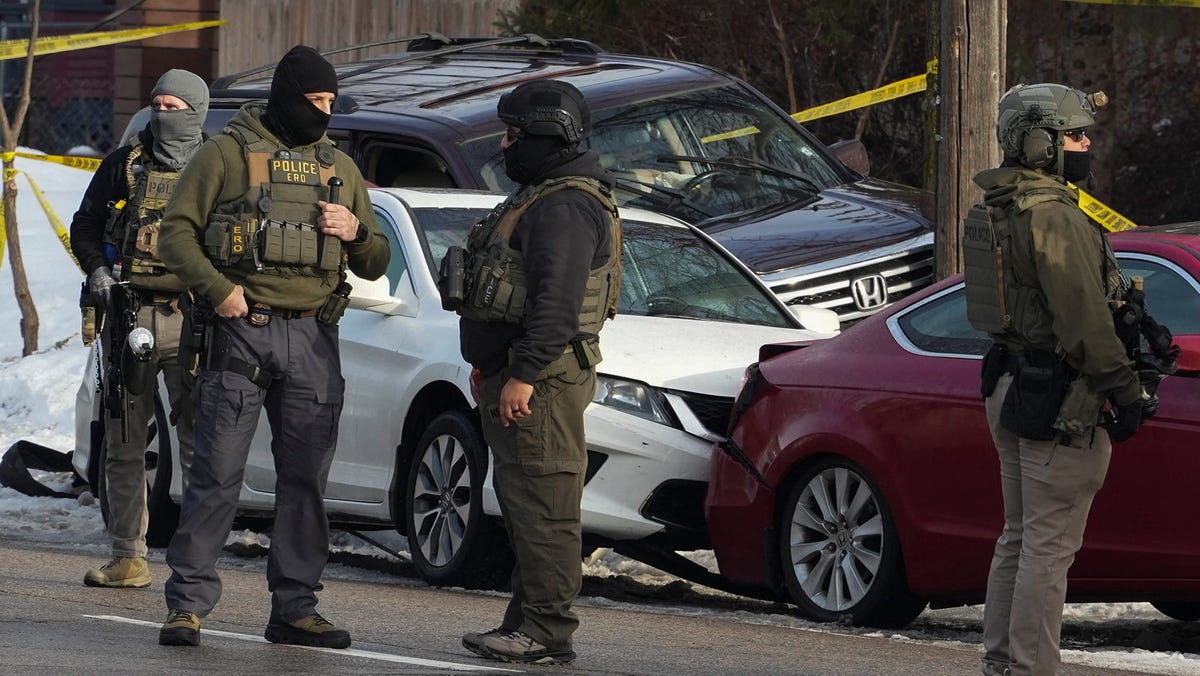
Following the gunfire, the vehicle headed down the road and crashed into a line of parked cars, videos show. Good was pronounced dead at a local hospital. Federal officials said the agent was treated at a hospital and later released.
Diane Goldstein, a former police lieutenant and executive director of the nonprofit Law Enforcement Action Partnership, reviewed footage of the shooting and described the agent’s tactics as “aggressive.”
“Law enforcement policy should always be about using the least amount of force and preserving people’s lives,” Goldstein told USA TODAY. She added that the footage suggests “a lack of supervision, a lack of training and a lack of understanding of what other tactics are available to deescalate these types of situations.”
Aggressive enforcement tactics can make officers less safe rather than more, she previously told USA TODAY.
Experts pointed to the Department of Homeland Security’s policies, which state that agents should minimize risk and “avoid placing themselves into positions in which they have no alternative to using deadly force.”
“It clearly looks like she was driving away,” said Geoffrey Alpert, a professor of criminology at the University of South Carolina who specializes in the use of deadly force. “She turned her wheel and looked like she was trying to escape.”
The Trump administration has defended the agent’s actions, describing the incident as an “act of domestic terrorism” and claiming the woman “weaponized her vehicle.” Noem said the agent “used his training to save his own life and that of his colleagues.”
Local and state officials in Minneapolis disputed the government’s description of the shooting, calling it “propaganda” and saying video shows the agent “recklessly using power that resulted in somebody dying.”
Law enforcement agencies have long regarded vehicles as deadly weapons.
But in recent decades, high-profile incidents have led local police departments and federal agencies to warn against firing at moving vehicles, saying it should be a last resort. Many agencies have banned the practice in most instances.
Justice Department policy says officers cannot fire at a moving vehicle unless there’s “no other objectively reasonable means of defense appear to exist, which includes moving out of the path of the vehicle.”
ICE’s parent agency, the Department of Homeland Security, says firing at a driver is “prohibited” unless there’s a “reasonable belief that the subject of such force poses an imminent threat of death or serious bodily injury,” according to a use-of-force policy from 2023.
Both agencies bar officers from using deadly force against drivers “solely to disable moving vehicles.”
Similar policies are in place across dozens of local police agencies nationwide, including in New York City, home of the nation’s largest police force, which banned the practice of shooting at moving vehicles in the 1960s, Alpert said.
Among the main reasons firing at cars is prohibited is that doing so can cause major public safety hazards.
“They end up being 4,000- or 5,000-pound unguided missiles,” Alpert said. “That’s what happened in Minneapolis. Fortunately, there were no kids playing on the sidewalk and no one was in the car that (Good) rammed” into.
Federal agents are generally immune from state prosecution for actions taken in their official capacity, said John Banzhaf, an emeritus professor at George Washington University Law School.
He said agents can be prosecuted on the federal level, but charges are rare.
The reason is that prosecutors face a high bar to win a conviction. To do so, they must prove the officer knew his conduct was unlawful or knowingly acted beyond the constitutional limits of his authority, Banzhaf said.
What’s more, the court must take into consideration that the officer had to make a “split-second” decision, Banzhaf said. The court must also consider agents’ backgrounds when weighing whether the actions they took were reasonable.
At a news conference, Noem said the agent who opened fire had “previously been dragged by an anti-ICE rioter who had rammed him with a car.” Noem said the incident occurred in June and left the agent with injuries.
“That might make him – or at least it would so be argued – more wary, more concerned, more likely to react than an ordinary individual or even another ICE agent,” Banzhaf said.
More likely, Banzhaf added, would be a civil case in which the burden of proof is much lower than in a criminal prosecution.
Multiple criminal justice experts said more questions need to be answered before making a firm judgment on whether the agent’s use of force was justified.
“There are a lot of things that appear in the video, but we need a thorough and transparent investigation to determine if what was done was reasonable,” Alpert said. “That’s going to take a long time to do.”
The FBI said it has launched an investigation into the incident. The Minnesota Bureau of Criminal Apprehension initially said it was partnering with the FBI, but on Jan. 7 the agency said the FBI had revoked its access to case materials and evidence. Noem said the state didn’t have jurisdiction.
Some of the lingering questions include why ICE was there in the first place. DHS said agents were conducting “targeted operations” when the shooting occurred, but has not provided further details. Also unclear is what exactly led the officer to open fire.
“The imminent threat is really difficult to tell,” Alpert said.
“The shooting officer, he’s in front of the car: Why is he there? Why hasn’t he moved? What’s he doing?” Alpert added. “I assume he’s going to say he was in fear for his life and that’s why he shot because that’s what policy says. But was that a reasonable belief when she’s turning away?”
Christopher Cann is a national breaking news reporter for USA TODAY. Contact him via email at ccann@usatoday.com.
Related Article