By providing your information, you agree to our Terms of Use and our Privacy Policy. We use vendors that may also process your information to help provide our services. This site is protected by reCAPTCHA Enterprise and the Google Privacy Policy and Terms of Service apply.
Curating Life’s Luxuries Since 1976
Subscribe for full access to Robb Report. Includes the digital edition.
Sign up for our newsletter and go inside a world of luxury.
By providing your information, you agree to our Terms of Use and our Privacy Policy. We use vendors that may also process your information to help provide our services. This site is protected by reCAPTCHA Enterprise and the Google Privacy Policy and Terms of Service apply.
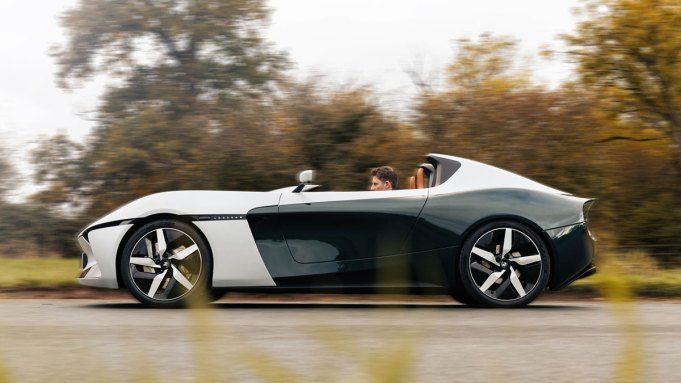
Revealing its new Speedster to a gathering of early investors and reservation-holders in London’s hip district of Brixton not long ago, new British electric sports car brand Longbow has kept its promises. Back in April of 2025, the company said its first demonstrator would be ready before the end of the year. At the end of October, a third of the time traditional OEMs require, it came to light. And what debuted was the production vehicle too, rather than mere concept eye candy. “Unlike others, we’re not about delivering mannequins that aren’t alive,” said cofounder Daniel Davey. “This car is very much alive.”
Longbow is a company that is gathering pace. Focused on minimizing mass—its mantra is “the speed of lightness”—the marque promises to make featherweight sports cars (weighing less than 2,200 pounds) amid a sea of heavyweights. Just about 1,970 pounds is the target for the Speedster. For an EV with an anticipated 275-mile range, that’s remarkable. For context, the late Colin “add lightness” Chapman’s old firm, Lotus, makes an Emira with an internal-combustion engine—so no need for the black mass of batteries—that starts from around 3,200 pounds.
We don’t yet have details of the electric motor or battery, but we do know they’re off-the-shelf items, rather than made in-house. It’s as sensible as Lotus using Toyota or Mercedes-AMG engines, and speeds up development no end. Longbow’s glittering auto-industry experience helps. Davey and fellow cofounder Mark Tapscott are both ex-Tesla and Lucid players (Davey was Tesla employee number 650). The third cofounder, Jenny Keisu, is a seasoned entrepreneur and investor.
The trio have assembled an expert team in Britain, calling on the best of motorsport and sports-car specialism, with advisors including former McLaren Automotive CEO Mike Flewitt, Dan Balmer (ex-Aston Martin and Lotus) and Michael van der Sande (he launched Tesla in Europe, relaunched Alpine, and led JLR’s SVO division). In total, 70 people helped to create this first Speedster, and their names are celebrated on a brass plaque inside the car.
The plan is to make 150 examples of the Longbow Speedster, each one costing £84,995 (approximately $111,500). A higher-volume hard-top alternative called the Roadster (not that electric Roadster, as this one actually exists) will then be offered in a series of special editions to Longbow’s first customers, known as Guild members. Pricing on those is even more compelling, starting from £64,995 ($85,200).
Beyond that, Davey’s plan is to make 2,000 Roasters, “moving on to 10,000 electric cars a year.” That’s a similar volume to Lamborghini, which will surely mean expansion into higher-volume sectors, such as a Porsche 911 rival or a GT. But why not? After all, Tesla started with its own Roadster, before pivoting into the giant it is today. It can be done.
Yet that’s all to come. Establishing the featherweight electric vehicle—or “FEV”—category is the first priority. “Tomorrow, we’re back toiling again,” said Davey at the premiere. Indeed, this is why the first car is a proper working demonstrator, rather than a mere one-off. “That’s a waste of money and time,” said Tapscott. “There will be substantial carry-forward into production from this.” The styling, he added, is already 99 percent there.
The Speedster’s design was overseen by Chris Gould, who is director at AVANT: a design services firm based in England’s Royal Leamington Spa. “The Longbow combines classic design with tauter, more contemporary surfaces,” explained Gould. The rear has graceful curves, while the front is defined by one simple graphic. The aim is for it to be clean and timeless.
The design, engineering, and hand-built assembly will all happen in the UK. “This really is the very best place in the world to be building lightweight sports cars today,” said Tapscott. “It’s a car that plays to the strengths of what we have in the UK, which is the ability to focus on low-volume but high-value propositions.”
Longbow will launch first in the UK, but the cars are being developed concurrently in both right- and left-hand-drive guises. Unlike the scattergun approach of traditional OEMs, Longbow will be targeted, launching country by country. North America may have to wait, but maybe the vibe towards EVs will be warmer by then. Timing can be everything.
Longbow’s logo is that of Boudica, the Celtic rebel queen who defied the Romans: a symbol of British resistance. Longbow aims to succeed, and start its own uprising against weight, bloat, and inertia. “Lots of people have told us something can’t be done,” said Tapscott. “That’s fuel for both of us. We’ve pushed the team, seen it grow, and we’ve created something that we were told wasn’t possible.” Promises kept.
New Year, New Reds
Kick off 2026 by uncorking a bottle of Napa Valley’s finest. Join 672 to receive the year’s first shipment of Robb Report-curated wines.