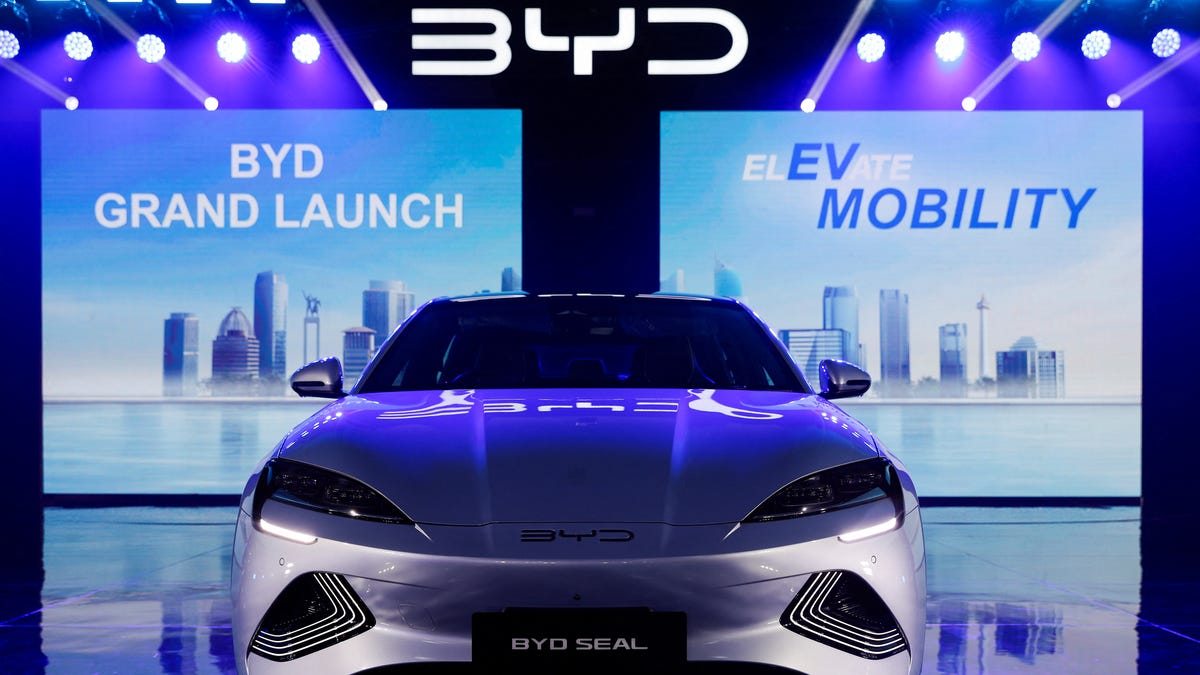
You could soon buy a BYD electric car in Canada under a new trade agreement between the nation and China that was announced on Friday, Jan. 16.
Canadian Prime Minister Mark Carney said Canada will allow up to 49,000 Chinese electric vehicles into its market, with the most-favored-nation tariff rate of 6.1%. Carney’s office said the amount of Chinese EVs it plans to allow to be sold in Canada “corresponds to volumes in the year prior to recent trade frictions on these imports (2023-2024), representing less than 3% of the Canadian market for new vehicles sold in Canada.”
Carney’s office said “it is expected that within three years, this agreement will drive considerable new Chinese joint-venture investment in Canada with trusted partners to protect and create new auto manufacturing careers for Canadian workers, and ensure a robust build-out of Canada’s EV supply chain.”
In case you missed it: BYD surpasses Tesla with 5-minute EV charging breakthrough
“With this agreement, it is also anticipated that, in five years, more than 50% of these vehicles will be affordable EVs with an import price of less than $35,000, creating new lower-cost options for Canadian consumers,” Carney’s office said.
These were the top-selling EV models in Canada from 2020-2024, according to the Canada Energy Regulator:
BYD’s electric cars are currently not sold in the U.S. because of factors such as high tariffs that are currently in place and federal rules regarding connected car technology and vehicle safety standards are the company sees as restrictive.
BYD currently sells commercial vehicles in the U.S., but the company’s US-branch CEO has said in interviews that she thinks the American market is “too restrictive.”
In a May 2024 interview with Yahoo Finance, BYD America CEO Stella Li said the American EV market is, “an interesting market but it’s very complicated.” As consumer interest has appeared to wane, other factors have further complicated the landscape, Li said.
“So we’re saying, ‘No… we don’t have plans to come to the US,” Li said in the interview.
The Trump administration has imposed a 100% tariff on all Chinese imports, including cars, making it fiscally prohibitive for BYD to sell cars in the U.S.
It would also be difficult for U.S. drivers to buy BYD electric cars in Canada or Mexico and drive them into the country because of federal laws regarding imported vehicles that require them to go to through a lengthy customs process to prove they comply with existing federal motor vehicle safety laws.
Under the law, known as the Imported Vehicle Safety Compliance Act of 1988, U.S. citizens can import “non-conforming foreign motor vehicles” for personal use, as long as they can prove the car is not intended for resale at the time of importation. People who import non-conforming foreign cars also must post bond and comply with other terms and conditions determined by the U.S. Secretary of Transportation, according to the law.
The Unifor union, which is Canada’s largest private sector labor group, panned the deal to allow Chinese EVs to be sold in Canada.
“This is a self-inflicted wound to an already injured Canadian auto industry,” Unifor National President Lana Payne said in a statement. “Providing a foothold to cheap Chinese EVs, backed by massive state subsidies, overproduction and designed to expand market share through exports, puts Canadian auto jobs at risk while rewarding, labour violations and unfair trade practices.”
Payne also said the decision will make it harder for Canada to solved problems caused by U.S. tariffs on Canadian vehicles and rollbacks to U.S. EV policies that she said have harmed the nation’s autoworkers.
“Finding a resolution to U.S. auto tariffs just got more difficult as Canada has surrendered the leverage of opening our market to China,” she said.
U.S. electric car supporters blamed President Donald Trump‘s tariffs for opening the door to the Canada-China deal.
“China just gained a foothold in the North American EV market, and it did not happen by accident,” Mike Murphy, CEO of the American EV Jobs Alliance, said in a statement.
“When U.S. trade policy becomes chaotic, unpredictable and destructive, bad outcomes are inevitable,” Murphy continued. “President Trump has really bungled the job when it comes to standing up for U.S. auto jobs and North American auto manufacturing.”
The White House did not immediately respond to a request for comment.
Albert Gore, the executive director of the Zero Emission Transportation Association in Washington and the son of former Vice President Al Gore, said in a statement the Canada-China announcement, and also a previous announcement of a similar deal between China and the European Union, “shows that the global automotive market’s interest in electric transportation remains strong.”
“Electric vehicles are great products and popular with drivers,” Gore said. “If the United States does not invest in them, our global competitors will.”
The U.S. House Select Committee on China said in post on the social media website X, “Canada’s decision to open its market to Chinese electric vehicles risks giving Beijing a foothold in the North American auto market, threatening thousands of jobs and undermining a century of integrated automotive leadership.”
Related Article