
It’s more advantageous for Chinese automakers to go global! Germany and Canada have given the “green light” with their policies.
According to CheDongXi on January 20th, in the past week, there has been significant good news for the globalization of Chinese new – energy vehicles.
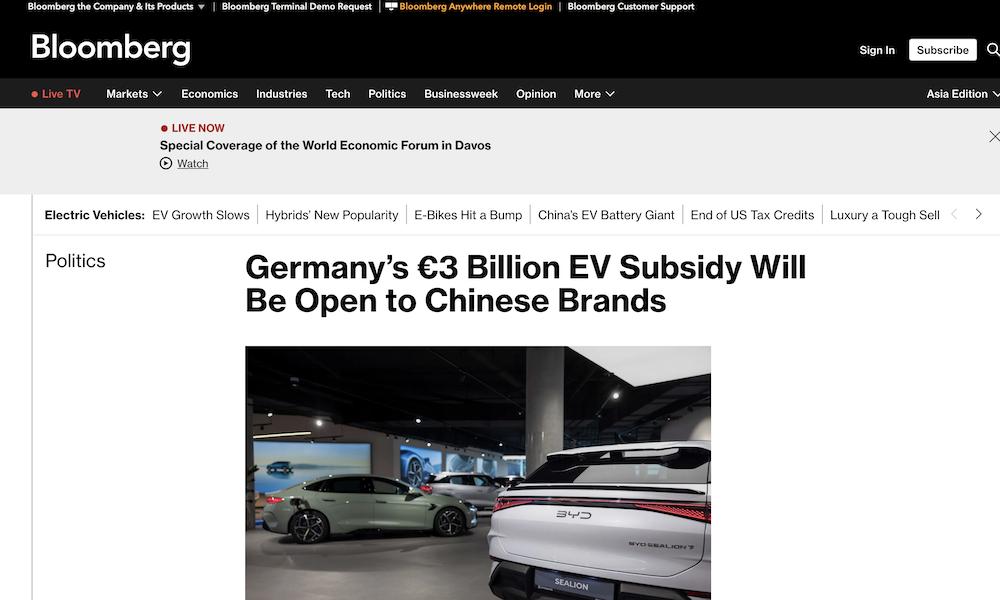
Bloomberg reported recently that the German government announced that it will provide subsidies of up to 6,000 euros (approximately 49,000 yuan) for families purchasing new electric vehicles. The total scale of this subsidy program is 3 billion euros (about 24.5 billion yuan), and it is expected to support up to 800,000 electric vehicles.
Notably, this subsidy program will be open to all automakers, including Chinese brands.
Not only has Germany officially announced its support policy for Chinese electric vehicles, but Canada has also adjusted its tariff policy.
Canadian Prime Minister Carney confirmed that the 100% tariff imposed on Chinese electric vehicles will be cancelled, and China will be given a quota of 49,000 electric vehicles per year. Within the quota, the vehicles will enjoy the Most – Favored – Nation tariff treatment of 6.1%.
These policies will provide more favorable external conditions for Chinese automakers to go global.
Recently, Bloomberg reported that the German government, in an effort to boost car sales, has launched an electric – vehicle subsidy program worth 3 billion euros (about 24.5 billion yuan). This program will be open to all automakers, including Chinese brands.
Bloomberg reported on Germany’s launch of an electric – vehicle subsidy program
This incentive measure aims to promote the popularization of electric vehicles and support the automotive industry, whose demand has declined significantly after the original subsidy policy ended at the end of 2023.
German Federal Environment Minister Carsten Schneider said at a press conference: “I have full confidence in the quality of European and German brands.” “Neither the data nor the vehicles on the road show any evidence that Chinese automakers will flood the German market. That’s why we actively face the competition instead of imposing any restrictions.”
This measure is undoubtedly good news for Chinese auto brands trying to gain a foothold in the European market.
Bloomberg said that although Chinese automakers face tariff challenges when selling electric vehicles to the EU, they can still make a profit in the EU market due to their low manufacturing costs in China.
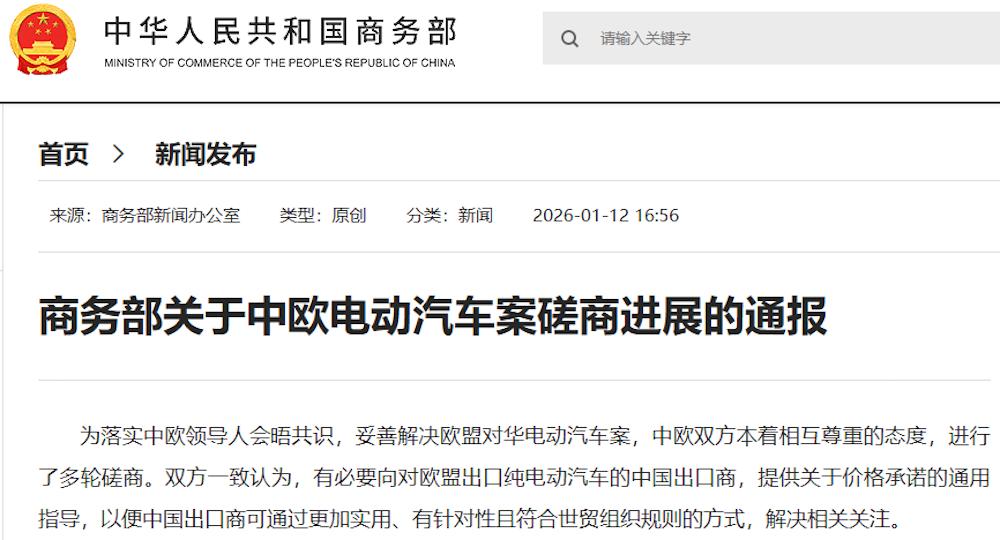
Previously, the Ministry of Commerce released a notice on the consultations regarding the China – EU electric – vehicle case.
The Ministry of Commerce announced the progress of consultations on the China – EU electric – vehicle case
It is reported that according to the notice, both China and the EU agree that it is necessary to provide general guidance on price commitments to Chinese exporters of pure – electric vehicles to the EU so that Chinese exporters can address relevant concerns in a more practical, targeted, and WTO – compliant manner.
The “Guidance Document on Submitting Applications for Price Commitments” (hereinafter referred to as the “Guidance Document”) published on the official website of the European Commission clearly states that the EU will follow the basic principles of non – discrimination, objectivity, and fairness. In accordance with relevant WTO rules, it will evaluate the “price commitment” applications submitted by Chinese auto – exporting enterprises according to unified standards. Eligible enterprises will replace countervailing duties with “price commitments”.
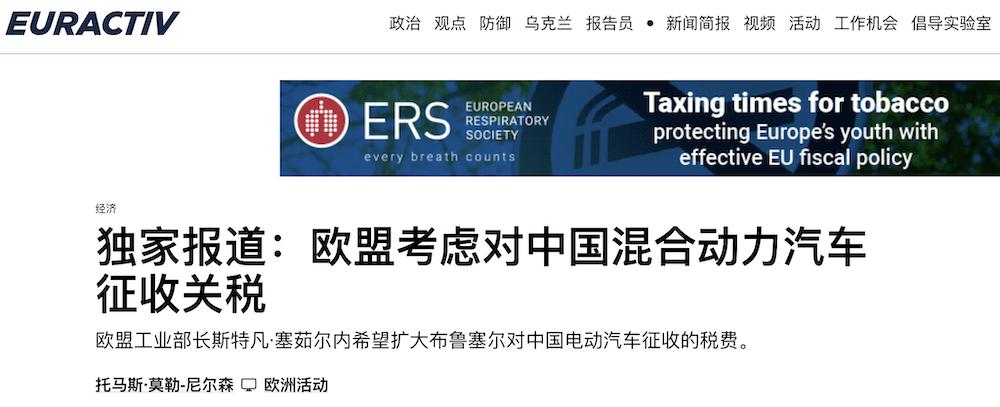
Recently, foreign media EURACTIV revealed that the European Commission is considering expanding the scope of tariffs on Chinese pure – electric vehicles to include hybrid vehicles, and relevant discussions are underway.
Foreign media reported that the European Commission is considering imposing tariffs on Chinese hybrid vehicles
Not only is the European market re – considering adjusting its tariff policy on Chinese electric – vehicle exports, but Canada has also confirmed that it will give the “green light” to Chinese electric vehicles.
According to CCTV news, from January 14th to 17th, Canadian Prime Minister Carney was invited to pay an official visit to China. When interviewed by relevant media, Carney announced that China will be given a quota of 49,000 electric vehicles per year. Within the quota, the vehicles will enjoy the Most – Favored – Nation tariff treatment of 6.1%, and the 100% additional tax will no longer be levied.
Canadian Prime Minister Carney
Carney said that the annual quota of 49,000 corresponds to China’s export volume to Canada before Canada imposed additional tariffs on Chinese electric vehicles, and the quota will increase year by year at a certain proportion.
Carney expects that within five years, more than half of the electric vehicles imported from China will be models priced below 35,000 Canadian dollars (about 176,000 yuan), providing more affordable car – buying options for Canadian consumers.
He also said: “China’s advantage in the electric – vehicle field is undeniable. China produces some of the most affordable and energy – efficient cars in the world. To build a competitive electric – vehicle industry in Canada, we need to learn from innovative partners, enter their supply chains, increase local demand, fully unleash the potential of the cooperation relationship, and reduce the consumption costs of Canadians.”
Overall, the external environment faced by Chinese automakers going global is changing rapidly, and some recent signals are expected to bring positive effects.
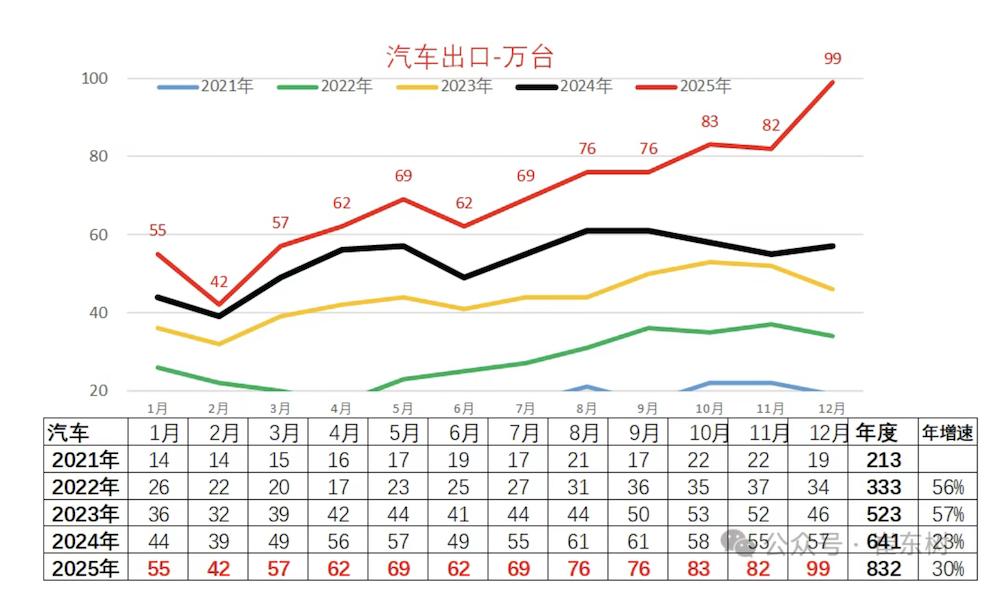
Recently, institutions such as the General Administration of Customs and the China Passenger Car Association released relevant data on China’s automobile exports in 2025. The data shows that from January to December 2025, China exported 8.32 million automobiles, a year – on – year increase of 30%, maintaining growth for five consecutive years.
China’s automobile export data in the past five years (Source: watermark)
China’s automobile export value has shown an explosive growth trend, rising from 34.5 billion US dollars (about 240.1 billion yuan) in 2021 to 117.4 billion US dollars (about 817 billion yuan) in 2024. In 2025, the export value reached 142.4 billion US dollars (about 991 billion yuan), a year – on – year increase of 21%. The scale of foreign exchange earnings from automobile exports is huge.
While China’s automobile export volume has been growing steadily, the brand influence and competitiveness of Chinese new – energy vehicles have been increasing day by day.
According to data from the China Association of Automobile Manufacturers, in 2025, China’s new – energy vehicle export volume reached 2.615 million, a year – on – year surge of one – fold. Among them, the export volume of new – energy passenger vehicles was 2.532 million, a year – on – year increase of one – fold; the export volume of new – energy commercial vehicles was 83,000, a year – on – year increase of 86.8%.
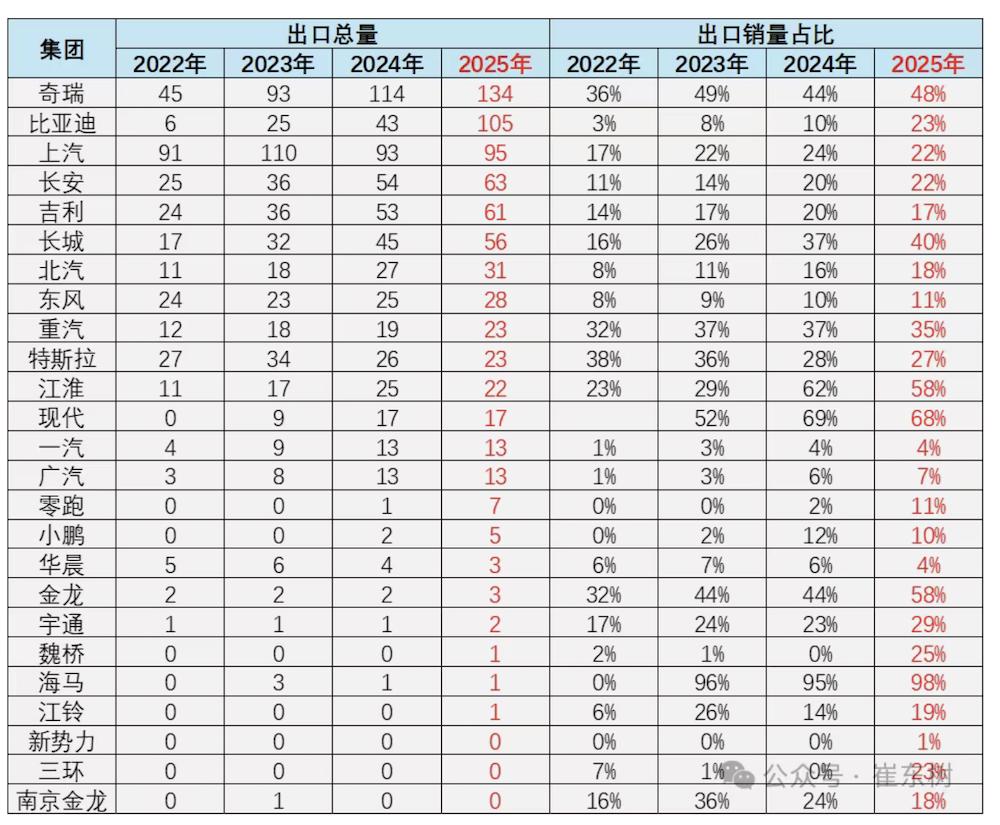
Specifically, in terms of the sales volume of major automobile groups, in 2025, the export sales performance of China’s major automobile groups showed obvious differentiation, especially the export performance of new – energy passenger – vehicle enterprises was the most prominent.
According to data from the China Passenger Car Association, the top ten automobile groups in terms of export volume in China in 2025 were Chery, BYD, SAIC, Changan, Geely, Great Wall, BAIC, Dongfeng, Sinotruk, and Tesla.
Export data of China’s major automobile groups (Source: watermark)
Among them, Chery Group’s annual sales volume in 2025 reached 2.806 million, a year – on – year increase of 7.8%. The automobile export volume reached 1.34 million, a year – on – year increase of 17.4%. Its export sales ranked first in the industry, and the proportion of export sales reached 48%. Basically, half of its sales volume was contributed by the overseas market.
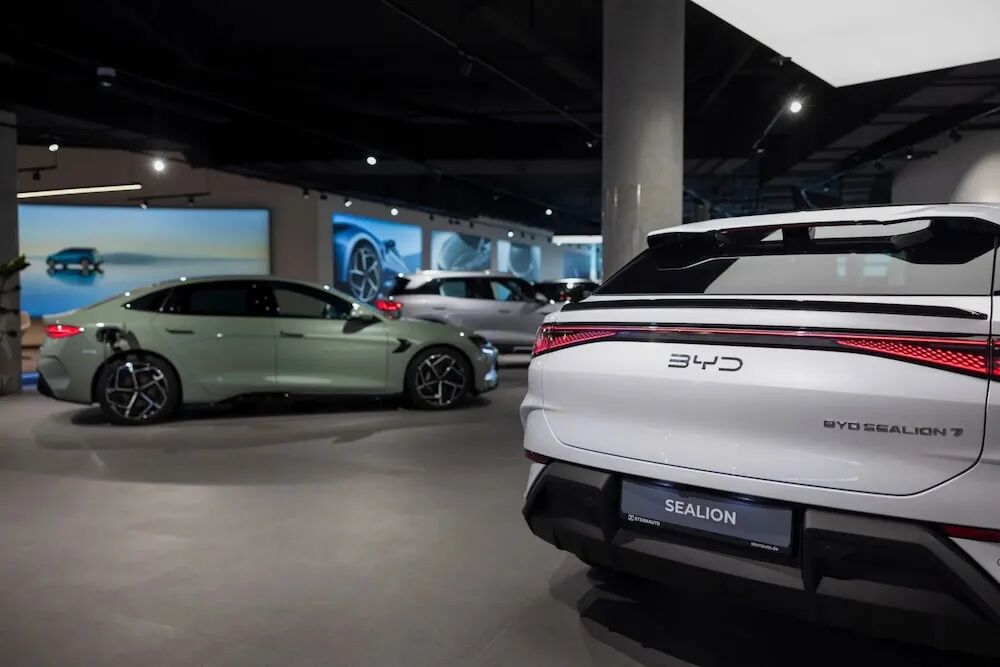
BYD’s export volume of new – energy vehicles in 2025 reached 1.05 million, ranking first among new – energy vehicle enterprises, a year – on – year surge of 144%. The proportion of export sales increased from 10% in 2024 to 23% in 2025.
New cars sold overseas by BYD
SAIC Group exported 950,000 vehicles in 2025. Relying on its joint – venture brands such as SAIC – GM and self – owned brands such as Roewe and MG, it achieved the coordinated development of fuel – powered vehicles and new – energy vehicles.
Notably, among the top 10 domestic automobile groups in terms of total export volume in 2025, Tesla China was the only enterprise whose export sales declined for two consecutive years. In 2025, its export volume reached 230,000, a year – on – year decline of 12%, and the proportion of export sales dropped to 27%.
In addition to the above – mentioned automobile groups, the steady increase in the export volume of some domestic new – force automakers is also worthy of attention.
Leapmotor’s total export volume in 2025 reached 70,000, a year – on – year increase of 600%, with rapid growth. The proportion of export sales reached 11%.
XPeng Motors’ total export volume in 2025 reached 50,000, a year – on – year increase of 150%. The proportion of export sales reached 10%.
In addition, Cui Dongshu, the secretary – general of the China Passenger Car Association, pointed out that some small and medium – sized automobile groups have achieved breakthroughs through differentiated layouts, focusing on niche markets such as commercial vehicles and special – purpose vehicles. Their export growth rate exceeds the industry average, but their overall market share is still relatively low, and the “Matthew effect” in the industry continues to intensify.
As the competitiveness of Chinese automakers overseas continues to increase, China’s automotive industry has achieved a historic leap from “bringing in” to “going out”.
The performance of Chinese automakers in the overseas market has become more and more eye – catching. It not only enhances the international influence of Chinese automobile brands but also provides diverse and high – quality car – buying options for global consumers, allowing more people to enjoy the travel experience with leading technology. The breakthroughs of Chinese automakers in fields such as intelligent cockpits, autonomous driving, and battery technology are also promoting the transformation and upgrading of the global automotive industry.
Currently, the international environment is still complex and changeable, and the global automotive industry pattern is in a period of deep restructuring. Chinese automakers going global are expected to maintain a stable trend and become a key driving force in the global travel transformation.
This article is from the WeChat official account “CheDongXi”, author: Guo Yue, editor: Zhi Hao. Republished by 36Kr with permission.
该文观点仅代表作者本人,36氪平台仅提供信息存储空间服务。
36kr Europe (eu.36kr.com) delivers global business and markets news, data, analysis, and video to the world, dedicated to building value and providing business service for companies’ global expansion.
© 2024 36kr.com. All rights reserved.

Related Article