Sign in with
Forget Password?
Learn more
share this!
Share
Tweet
Share
Email
January 26, 2026
by Kate McAlpine, University of Michigan
edited by Gaby Clark, reviewed by Robert Egan
scientific editor
associate editor
This article has been reviewed according to Science X’s editorial process and policies. Editors have highlighted the following attributes while ensuring the content’s credibility:
fact-checked
peer-reviewed publication
trusted source
proofread
Pilots, drivers and automated safety systems in cars and airplanes could be alerted to icy hazards by a pair of sensors developed at the University of Michigan.
Ice on roads causes about 20% of weather-related car crashes each year, and ice buildup on planes causes roughly 10% of all fatal air carrier crashes by interfering with aerodynamics and controls. For instance, a flight from Brazilian airliner Voepass Linhas Aéreas crashed near São Paulo on Aug. 9, 2024, after the plane’s de-icing systems failed, according to a report in the Aviation Safety Network. An Air France flight also crashed in the Atlantic Ocean on June 1, 2009, after ice blocked the probes that measure the plane’s speed. In both cases, all occupants died.
“More people are traveling by plane each year, and there’s more pressure to fly in all weather conditions,” said Nilton Renno, U-M professor of climate and space sciences and engineering who led the development of the technology.
“Our technology can help airplanes, drones, cars and trucks be as safe and efficient as possible.”
Renno’s team tested their system of two complementary sensors in a single engine airplane, as well as a light business jet equipped with scientific instruments for taking reference measurements. The results of the experiments are described in the journal Scientific Reports.
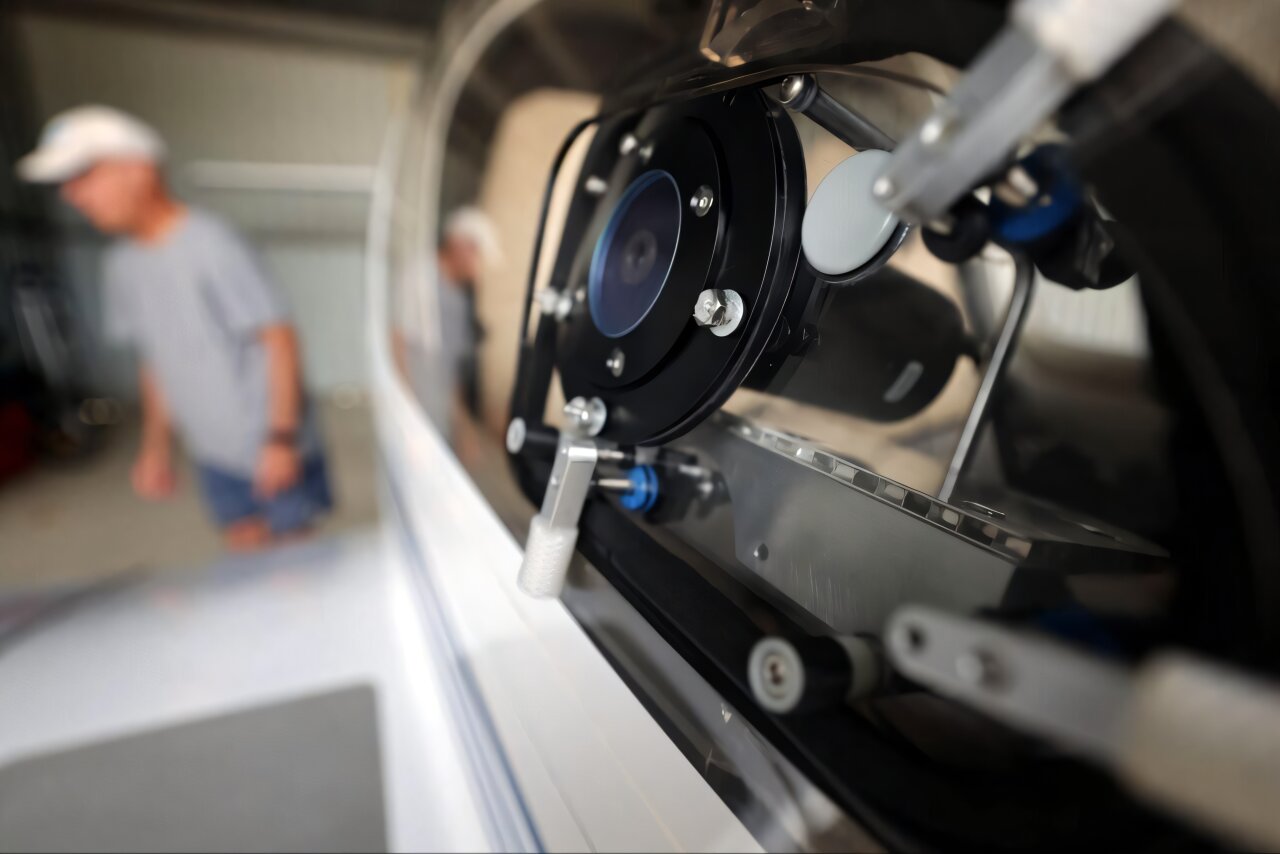
One sensor lies flush against the plane, using microwaves to detect when ice forms on its surface. Another sensor uses lasers to detect freezing rain and large water drops in clouds, alerting pilots of danger in advance. This sensor could also work in cars and trucks, detecting ice on roads.
Development of the microwave sensor began after the Phoenix lander mission, which found evidence for liquid water on Mars. Renno wanted future missions to measure the amount of moisture in soils and differentiate water from ice. But Renno, who is also a pilot, started thinking about how he could help pilots after he found his personal airplane covered in ice one winter. Knowing he couldn’t fly safely, he instead went home and brainstormed solutions.
“Icing of airplanes is a worldwide problem that can happen anytime of the year with aircraft of all sizes, depending on the flight altitude,” Renno said. “I realized that that was a problem that I could do something about because of my background as both a pilot and an atmospheric scientist.”
Airplanes today detect ice with two styles of probes that protrude from the plane, but because they extend above the surface, they don’t provide information about what’s on the plane. The microwave sensor directly detects ice buildup because it’s embedded in the plane’s surface. The frequency of the sensor’s microwave signal changes when the sensor is covered by water or ice.
The complementary sensor detects freezing rain within seconds of entering a cloud by firing three infrared lasers with different wavelengths. The first two beams are absorbed by water and ice differently, so the ratio of the return signals tells pilots whether a cloud contains ice particles, water droplets or a mix. Planes freeze when they hit water drops chilled below the freezing point, but ice particles simply bounce off, so the sensor could help pilots identify a hazardous cloud and fly away before the plane ices over.
The third laser helps determine the size of the water droplets and the number of droplets in the cloud by comparing its return signal with those of the other two lasers. Larger droplets are more hazardous because they are more likely to hit the plane while smaller droplets ride the flow of air around the plane.
The lasers could also warn drivers of black ice before they start sliding, or perhaps trigger the car’s automatic safety systems. Slowing by 4–9 miles per hour can reduce the risk of serious injury during car accidents by half, research shows.
“You can save a lot of lives by just slowing down when you detect a slippery road ahead,” Renno said.
The device was built and developed in part at the U-M Space Physics Research Laboratory. Intelligent Vision Systems, a U-M startup, developed the optical sensor and licensed the technology with the assistance of Innovation Partnerships, which also has patented the sensors. Renno and the University of Michigan have a financial interest in Intelligent Vision Systems.
More information: Renno, N.O. et al, A new type of aircraft icing detection system, Scientific Reports (2026). DOI: 10.1038/s41598-025-30681-3 www.nature.com/articles/s41598-025-30681-3
Explore further
Facebook
Twitter
Email
Feedback to editors
Jan 24, 2026
1
Jan 24, 2026
0
Jan 25, 2026
0
13 hours ago
0
Jan 25, 2026
0
9 hours ago
9 hours ago
9 hours ago
12 hours ago
13 hours ago
14 hours ago
15 hours ago
Jan 26, 2026
Jan 25, 2026
Jan 25, 2026
Jan 20, 2026
Oct 16, 2020
Jun 13, 2019
Apr 8, 2019
Mar 12, 2019
May 6, 2019
13 hours ago
15 hours ago
9 hours ago
Jan 25, 2026
Jan 24, 2026
Jan 24, 2026
A dual-sensor system using microwaves and lasers enables real-time detection of ice formation and freezing rain on vehicles and aircraft. The microwave sensor, embedded in surfaces, identifies ice buildup directly, while the laser sensor distinguishes between water droplets and ice particles in clouds, alerting to hazardous conditions. These technologies can enhance safety by providing early warnings to pilots and drivers.
This summary was automatically generated using LLM. Full disclaimer
Use this form if you have come across a typo, inaccuracy or would like to send an edit request for the content on this page. For general inquiries, please use our contact form. For general feedback, use the public comments section below (please adhere to guidelines).
Please select the most appropriate category to facilitate processing of your request
Thank you for taking time to provide your feedback to the editors.
Your feedback is important to us. However, we do not guarantee individual replies due to the high volume of messages.
Your email address is used only to let the recipient know who sent the email. Neither your address nor the recipient’s address will be used for any other purpose. The information you enter will appear in your e-mail message and is not retained by Tech Xplore in any form.
Daily science news on research developments and the latest scientific innovations
Medical research advances and health news
The most comprehensive sci-tech news coverage on the web
This site uses cookies to assist with navigation, analyse your use of our services, collect data for ads personalisation and provide content from third parties. By using our site, you acknowledge that you have read and understand our Privacy Policy and Terms of Use.