Daytona Beach, Fla. — Before Cadillac and Red-Bull Ford F1, before Cadillac and Ford hybrid Hypercars, before Ford Mustang GT3 racers — there was the OG Corvette.
Twenty-five years ago, Chevy’s sportscar won the Rolex 24 Hours of Daytona for the first time, launching a new era of Motown motorsports that has blossomed into a second Golden Era (after the 1960s) with multiple brands competing across the globe.
Corvette brought an army of five cars to the Rolex 24 this year (two in the GT Pro class, three in GTD) on its anniversary — and nearly won again. After the #3 and #4 Pratt Miller Corvettes dominated the early going in GTP Pro, misfortune struck in the late stages to spoil the party. The #4 Corvette finished fourth in GT Pro while the #13 Corvette finished fourth in GTD class.
Daytona marked a new business model for Corvette Racing as all five cars were sold to — and entered by — private teams.
The anniversary also was a chance to remember one of the most memorable races in Corvette Racing history as 2001 marked — not just Corvette’s first Rolex 24 win — but the debut of NASCAR legends Dale Earnhardt Jr. and his late father, Dale Earnhardt, in a Corvette.
“This is the most significant change in the operational methodology of what Corvette Racing has been,” said Corvette brand ambassador Doug Fehan, who founded Corvette Racing in 1996. “Corvette Racing was (originally) just two factory cars. This is a massive undertaking — completely different business — and we have never done it, (but) we’ve adapted really well. We just finished chassis number 27 back at the shop, and those cars are all going into customer hands.”
The convergence of global motorsports rules for so-called GT3 cars (GT racing’s premier class) allowed North American manufacturers like General Motors Co. and Ford Motor Co. to take their racing products global. Specialty performance-makers like Porsche and Ferrari have long built their brands on international motorsports, and now mainstream automakers have gotten into the game — integrating racing into their production business models.
“For a long time in our industry, racing was a halo for the company. It was basically done for marketing,” said Ford CEO Jim Farley in an interview earlier this month. “That’s not how we look at it anymore. The interplay between racing — and then offering that technology to the average customer who loves the joy of driving — is a different business. Racing is no longer just an expense — it’s our business.”
Today, products like the Mustang and Corvette are built in conjunction with the companies’ racing operations from Day One. That was Fehan’s goal 30 years ago when he created Corvette Racing to help improve production cars from on-track engineering learnings.
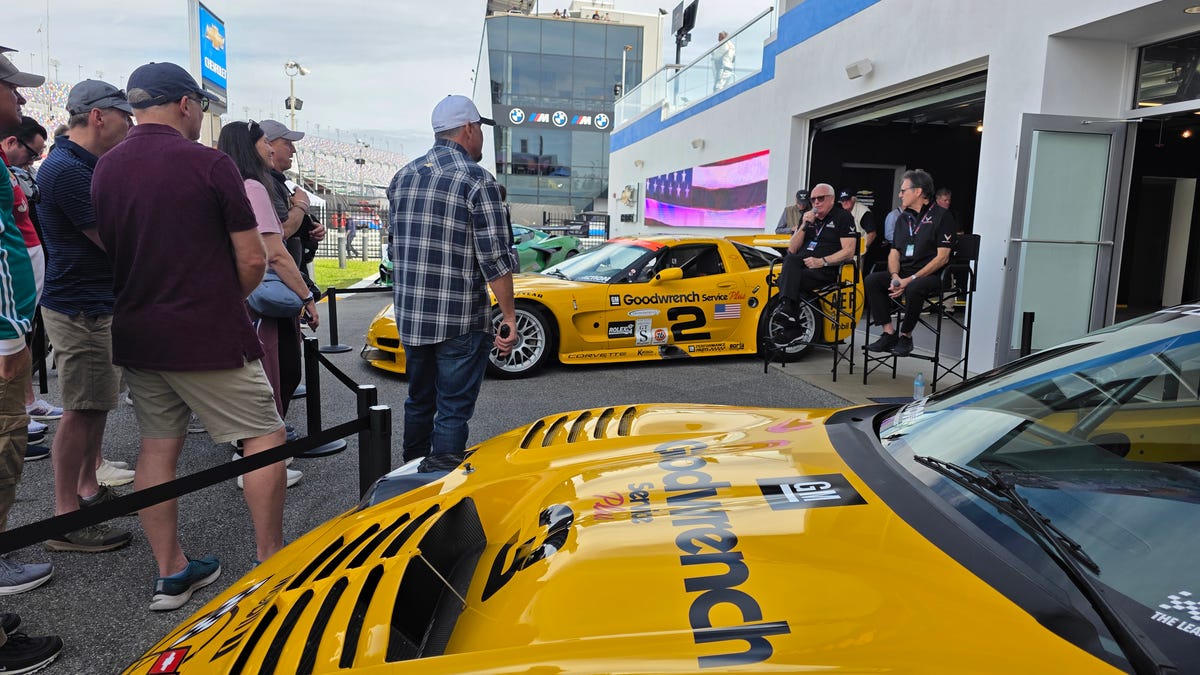
“Money-making was never the motivation,” said Fehan, who — along with one of the 2001 #2 Corvette’s winning drivers, Ron Fellows — regaled crowds at this year’s Rolex 24 with stories of their historic win. “(It was about) building a quality product that’s serviceable, competitive, and would entice teams to race Corvettes. If we can run that operation from break-even standpoint, we’re in heaven.”
For Corvette Racing, heaven was also having the Earnhardts behind the wheel at Daytona. The famed father-son duo were racing royalty and the 2001 Daytona was their first endurance race (tragically, it would also be Earnhardt Sr.’s last as he died at the Daytona 500 two weeks later).
At the Earnhardts’ first, pre-Rolex 24 test at Sebring Raceway, Dale Sr. put his #3 Corvette into the wall, scattering parts and requiring costly repairs. Fehan recalled that Earnhardt was very apologetic over lunch afterwards. But Fehan waved him off.
“I said: ‘You see that pile of parts over there? When you two get done eating, I’m giving you a Sharpie and you’re going to sign every one of them. I’m going to auction those parts off and make my money back!’” Fehan laughed. “We finished lunch, and they both went over there and signed every one of those parts.”
Fast forward 25 years, and Corvette Racing is racing royalty in its own right — a mainstay on podiums with Porsche and Ferrari, burnishing brand credibility and gaining business. Ferrari partner DragonSpeed this year switched to the Corvette Z06 GT33 car for the 2026 season.
“When they said they would do customer racing, I went to them first before we looked at any other GT brand,” team owner Elton Julian told Sportscar365. “I kept saying, ‘C’mon, I want one.’ Eventually, they decided they would pick DragonSpeed.”
A successful team in IMSA, DragonSpeed’s courting of Corvette speaks to the reputation built over 25 years by Fehan, Chevrolet and Pratt Miller — Corvette’s New Hudson-based racecar maker.
Pratt Miller entered two GM factory cars in the 2001 race. When it announced a global program building 20-plus GT3 customer racers, teams lined up.
“We had a lot of hand-raisers. The demand was way higher than supply,” said GM Director of Motorsports Competition Mark Stielow. “We chose to build at a cadence. We put (customers) in our build sequence. DragonSpeed had to wait until we got through earlier hand-raisers.”
While technology transfer has benefited production, so has the production of 20-plus race cars transformed the racing product.
“Technology transfer from racing makes your production cars better,” said Jim Campbell, GM vice president of performance & motorsports commercial operations. “It works the other way too — production cars making your race cars better.”
Today Corvette Racing is bigger, more global.
“We have a number of people to support the powertrain around the globe — running different fuels, different tires.,” said Stielow. “Each (global) sanctioning body is just a little bit different, which drives workload back into GM and Pratt Miller to make sure that we can deliver a car that can run on the odd fuels — over in Jakarta, places like that.”
“The sun never sets on GM motorsports,” he smiled.
Though Corvette Racing has expanded significantly, Stielow said the program is still focused on making sure each GT3 customer gets full support
Ford, like Porsche, is further down the road, producing more cars for GT4 customers as well as the GT3 field. As volumes grow, race program profits can grow, and Ford is in multiple GT4 series, including Michelin Pilot Challenge and Mustang Challenge.
Corvette Racing is closely intwined with Corvette road-car production. The so-called “body-in-white” travels from ‘Vette’s manufacturing facility in Bowling Green, Kentucky, to Pratt Miller, where it’s hardened for racing. The 5.5-liter V-8 engine in the Z06 GT3 is 80% production parts.
“It’s got the stock pistons, stock rods, stock crank, stock camshaft. All that stuff is right off the shelf,” said Stielow of the race engines prepared by Global Powertrain Engineering Center in Pontiac. “(The engine) is testament to the durability and quality of the production engine.”
Added Fehan: “The global demand for product racing has grown. Pratt Miller has done an amazing job: more spare parts, more engineers, more mechanics.”
Building on a sustained investment in GT racing, Hypercar-class racing, NASCAR and Chevy’s 2012 IndyCar commitment to provide engines, GM brings an impressive resume into 2026.
“We’ve sprinkled in some other learnings from other parts of motorsports,” said Stielow. “We were able to leverage our know-how from NASCAR, IndyCar and other parts of our motorsports (portfolio) . . . to figure out how to make Cadillac better, to make Corvette racing better.”
Henry Payne is auto critic for The Detroit News. Find him at hpayne@detroitnews.com or @HenryEPayne.
Related Article