To keep reading the latest motorsport news,
simply subscribe to our free newsletter
Get direct access to our journalists, bonus
podcast episodes, discounts, no ads + much
more when you join our community
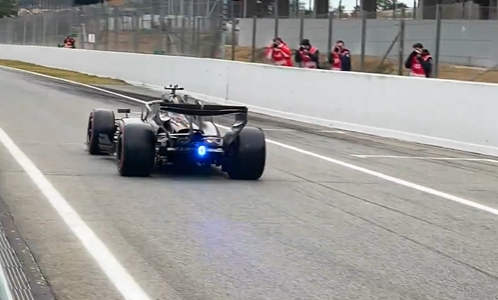
Eagle-eyed observers of the first laps of the new Aston Martin Formula 1 car at Barcelona noticed something very unusual at the rear: its central rear warning light was flashing blue rather than red.
F1 technical regulations stipulate that the 2026 cars must be fitted with rear warning lights: one in the middle, that sits at the back of the rear crash structure, and two that are embedded in the rear-wing endplates.
Although not explicitly stipulated in the rule book, these are typically red and flash at times when there are safety benefits from doing so.
For example, this includes any time that intermediate or wet tyres are used to help with visibility, but they are also activated when cars are on the pitlane speed limiter or when harvesting energy or not running on full power on track.
But as Lance Stroll left the pitlane in the new AMR26 on Thursday, and during Fernando Alonso’s early laps on Friday, it was noticeable that the Aston Martin had bucked the trend and was running a blue central light rather than a red one.
This can be seen clearly in a video that F1 posted on social media on Thursday.
Adrian Newey's first Aston Martin, the AMR26, hits the track in the Barcelona Shakedown! 🤩👀#F1 pic.twitter.com/ytWJSs0s2F
The blue light inevitably prompted some intrigue about why Aston Martin was doing something different.
The mystery was further heightened by F1’s sporting regulations stating that such blue lights must be fitted to cars this year when they are being driven by drivers who do not qualify for a superlicence.
That is not something that can be said about experienced drivers Stroll and Alonso.
Aston Martin itself was not willing to offer an explanation because it said it was not its policy to share details of its run programme.
However, other teams have offered an answer to The Race about the reason behind it, which relates to Aston Martin being on a slightly different run programme as it gets to grips with its new car for the first time.
Looking for more expert insight from F1 testing? The Race Members’ Club is the place to be – join today to claim your seven-day free trial
Aston Martin is understood to have told others that its test plan will involve not going at maximum speed down the straights on some runs, so those teams could tell their own drivers to beware.
The reason for the speed cap is not clear. However, it could have been for aero data gathering reasons or because it did not want to stress components too much early on.
This top speed limit was made obvious with Stroll doing some very slow laps on Thursday. He ran in the 1m40s range on the few laps he completed, almost 30 seconds off the pace of the best lap in testing.
Alonso’s early installation laps around Barcelona on Friday morning appeared to also involve him not running flat-out down the main straight, instead initially being pegged back a little bit.
With F1’s new generation of cars having super aggressive acceleration out of the corners, Aston Martin wanted a way to make its car obvious to other drivers running behind it, so they would not be caught out by getting too close and surprised when it did not maintain a typical speed profile down the straights.
In having a rear blue light activated when it was doing laps that were speed-limited, it helped make it obvious to cars behind that it was the Aston Martin ahead – which may be harder to pick out than usual because it is running in bare carbonfibre trim.
During some late running on Friday morning, it appeared that Aston Martin’s run programme had moved on a bit from being speed-limited down the straights, as the blue light was no longer illuminated.
Video footage below of Alonso’s car from SoyMotor.com showed laps where instead of having the blue warning light on, he instead had the two red endplate lights flashing as is more normal – which likely suggests he was on a similar speed profile to others.
🔥☄️ MÁS del Aston Martin AMR26
👀 Es muy difícil saberlo a día de hoy, claro, pero… ¿primeras sensaciones con Alonso? #F1 #F1Testing pic.twitter.com/KWHxcGsdhV
Alonso’s pace did steadily improve over the course of the morning. Having started out in the 1m25s range, his best effort so far has been 1m20.795s – so in the ballpark with other teams.
Lead image courtesy of Formula 1
Ex-F1 technical director Gary Anderson's full analysis of Adrian Newey's 2026 Aston Martin F1 car, as better imagery appears
Charles Leclerc produced Ferrari's best laptime of the week on the final morning of F1's first pre-season test, with an effort that puts him close to the overall benchmark set by Mercedes
Here is how teams are approaching the three-day allowance in the opening test of the F1 2026 pre-season at Barcelona
Aston Martin recovered from its early reliability drama to begin putting some laps on its AMR26 car on the final day of this week’s Formula 1 test
The Mercedes W17's three-day salvo in Barcelona has lived up to all the pre-season hype
Here are the best times and total mileage from the Barcelona F1 test with one day to go
The Race started in February 2020 as a digital-only motorsport channel. Our aim is to create the best motorsport coverage that appeals to die-hard fans as well as those who are new to the sport.