EUobserver
Society
As of 2026, Euro NCAP (the European New Car Assessment Programme) is introducing its new and improved safety rating system for passenger cars, the largest revision since the introduction of the overall rating scheme in 2009.
It comes ahead of the EU’s General Safety Regulation (GSR2) entering its third implementation phase in July of this year, where a new set of advanced driver assistance systems (ADAS) will become mandatory for all vehicles on sale in the EU, new models and those that have previously been type approved.
As vehicles become more automated and software-driven, Euro NCAP wants to ensure that safety systems are robust, work reliably beyond carefully controlled crash lab and test-track conditions, and are consumer-friendly.
Richard Schram, technical director at Euro NCAP, explains that robustness is about safety technologies standing up to scrutiny: “We want to make sure that the safety systems are not overly-sensitive to small changes in the environment.”
Tests will be expanded across a wider range of scenarios, covering different speeds, configurations and occupant diversity, as well as considering vulnerable road users.
“We are not so much asking for more or different safety systems, which would increase the cost of vehicles, but better performing systems. Especially when it comes to the performance of these driver assistance systems in the real world compared to a test track,” Schram says.
The new rating methodology is adapted to a world where safety technologies are increasingly interconnected, designed to support drivers before, during and after a crash.
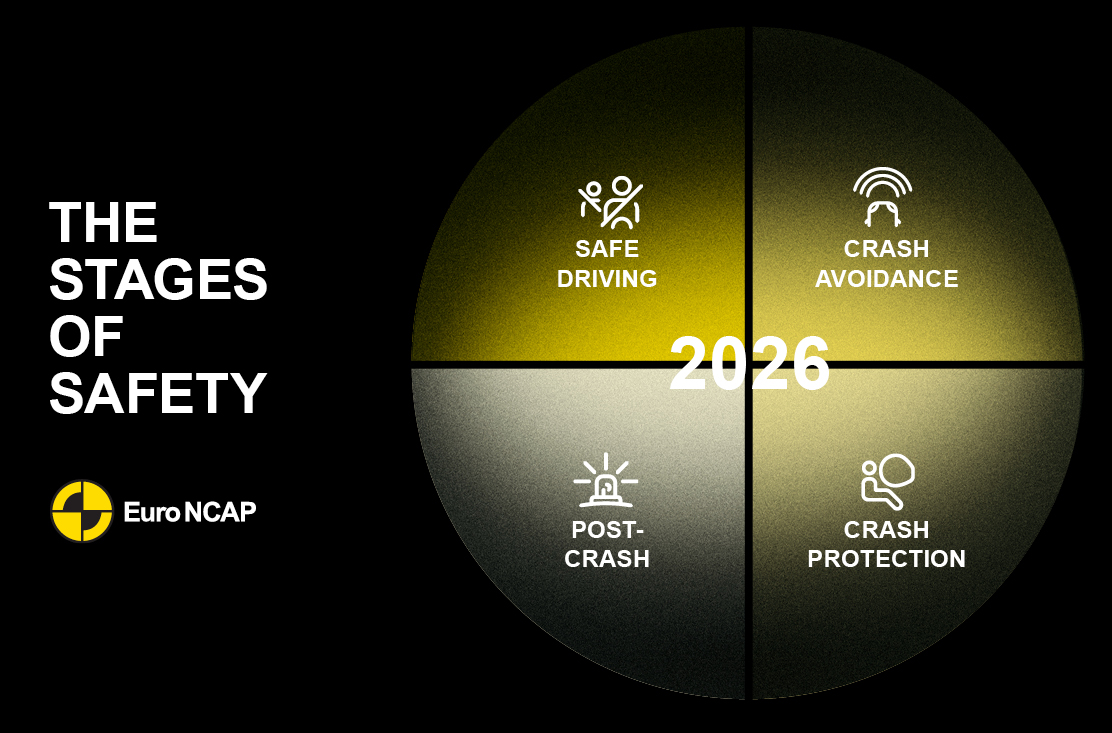
It is structured around four key stages of safety: safe driving, crash avoidance, crash protection, and post-crash safety.
“We are expanding, rather than removing elements from our current rating,” Schram says.
One notable addition is the new ‘safe driving’ component. This allows Euro NCAP to evaluate technologies that help drivers stay out of trouble in the first place, even if they are not designed to intervene in an imminent crash.
The four-stage structure also makes the system future-proof, for as Schram argues, it is adapted to a future where crashes no longer actually happen: “The long-term objective is that the two first stages, safe driving and crash avoidance, prevent all crashes from happening.”
Euro NCAP aims to gradually place more emphasis on those first two stages, incorporating automated driving technology along the way. “It is about preparing our rating scheme for these kinds of philosophies and strategies,” Schram says.
Despite the focus on prevention, Euro NCAP is clear that traditional crash testing remains essential.
“Systems are not perfect, and they will not be able to avoid everything, so we very much continue to focus on crash avoidance and crash protection,” Schram concludes.
A major innovation in the 2026 scheme is the systematic inclusion of on-road testing. Every car tested by Euro NCAP will from now on be driven on public roads in three different countries for at least 2,000km.
“We want to check the car’s behaviour in the environment in which it is actually going to be driven by consumers,” Schram explains.
First and foremost, the road tests will be used to verify the accuracy of speed limit information systems installed in cars.
Secondly, they will also be very useful to investigate so-called ‘driver annoyance’ in the near future; as safety features that issue frequent or unnecessary warnings risk being ignored or disabled by drivers — undermining their performance.
Consumer acceptance is a central pillar to Euro NCAP’s new rating scheme, and therefore driver annoyance needs to be tackled. According to Schram: “We want a low number of warnings, and if there is a warning or an intervention, it only happens when it really needs to happen.”
This becomes an increasingly important aspect to consider, as GSR2 will be widening its scope in July 2026 to include advanced driver distraction warning systems (ADDW) as well as additional pedestrian and cyclist automatic emergency braking (AEB) systems.
“What we do not want is a ‘teaching’ warning system that just yells at you constantly that you are inattentive,” he continues. “We want the car to do this in the background and link it to your smart systems in the vehicle.”
The message is clear: in order to reduce drivers’ current desire to switch things off, safety systems should support drivers subtly and intelligently, rather than overwhelming them with alerts.
In order to achieve a good safety rating and implement the best safety technologies, vehicle manufacturers need to know what to design for.
This is why Euro NCAP has always worked way in advance with manufacturers, and has done so too with the roll out of their new 2026 protocols.
“This is NCAP’s philosophy,” Schram explains, “it’s not our goal to publicly humiliate manufacturers, we want them to follow our procedures and take the time and use their investments to perform well on the safety tests.”
He stresses the benefit of having an open dialogue between Euro NCAP and the car industry: “So that we understand what is feasible, and they understand what we want. That is how we achieve the maximum.”
Giving the manufacturers time to adapt and implement new technologies, has proved to be a very successful method. Over the past two decades, it has helped vehicles exceed minimum legal safety requirements thereby easing the introduction of the latest General Safety Regulation.
“Euro NCAP is a surplus on EU regulation, and has actually brought manufacturers way ahead of regulation,” Schram points out.
The path ahead is clear, Euro NCAP aims to remain a trusted guide for consumers, while pushing manufacturers towards safer, more consumer-friendly solutions.
This stakeholder article is paid for by a third party. All opinions in this article reflect the views of the author and not of EUobserver.
Euro NCAP (the European New Car Assessment Programme) provides consumer information on the safety of new vehicles. This article was produced in collaboration with EUobserver.
EUobserver