Shutterstock
Chinese regulators have introduced safety rules banning electronically-operated concealed door handles, forcing car makers to adopt mechanical releases on vehicles sold in the country.
The new rules will come into effect on 1 January 2027, following a series of incidents in which power failures in electric vehicles prevented the door handles from working, trapping occupants inside.
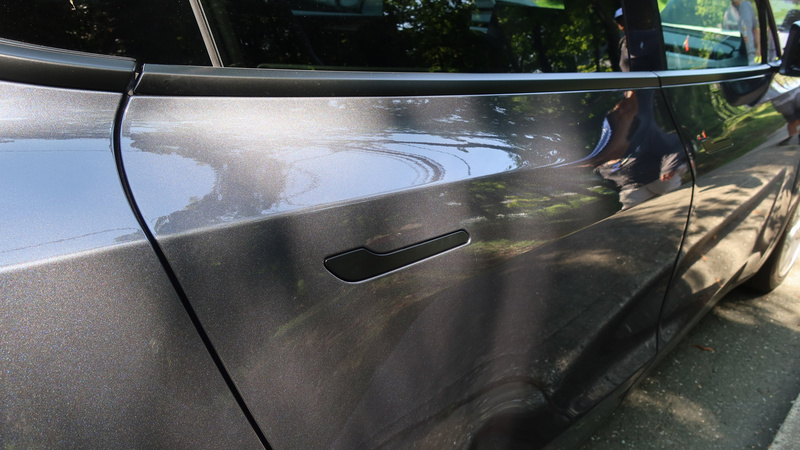
The concealed door handle, popularised by Tesla, is featured on a number of Chinese car models. The handle sits flush with the car’s exterior and must be pressed down to release it. From the inside, an electronic button opens the door rather than a traditional lever.
While aesthetically appealing, over the years the design has raised safety concerns as the doors rely on electrical power to open. This means that if these vehicles are involved in a crash, the occupants or first responders cannot open the doors because there is not enough power coming from the battery to power the locks.
Last October, a Xiaomi SU7 electric sedan crashed and burst into flames, leaving the driver trapped inside as several bystanders were unable to open the doors to free them. This resulted in a fatality.
This is not an isolated incident, with the issue gaining attention globally. But China is the first country to issue a ban, with its Ministry of Industry and Information Technology publishing new safety rules stipulating that cars sold in the country from 2027 must have visible, mechanically operable handles on each door (excluding the tailgate) both on the inside and outside.
The regulator said that models that have already been approved and are in the final stages of launching have until January 2029 to change their designs.
These new rules mean that car makers will be facing potentially costly redesigns or retrofits to include mechanical release systems that work without power. Vehicles impacted in the Chinese market include Tesla’s Model Y and Model 3, BMW’s iX3 and several domestic models such as Nio’s ES8, Li Auto’s L8, Xpeng’s P7 and Xiaomi’s YU7.
While these regulations will only impact vehicles sold in China, hidden electronic door handles are facing growing scrutiny worldwide, especially in the US and Europe.
Bill Russo, founder of Shanghai-based consultancy Automobility, told Bloomberg: “By moving first, Beijing can use its huge domestic market to lock in safety standards that both Chinese and foreign automakers must follow at home – and that may ultimately travel with Chinese EV exports and influence global norms.”
View the discussion thread.
In print
E-newsletters
About us
Newsletters
Contact us
Advertise with us
E+T Jobs
Facebook
Instagram
X (Twitter)
YouTube
Accessibility policy
Anti-slavery policy
Cookies
Privacy policy
© 2026 The Institution of Engineering and Technology.
The Institution of Engineering and Technology is registered as a Charity in England & Wales (no 211014) and Scotland (no SC038698).
For the latest updates and more
Related Article