Despite a push by some carmakers to offer generous incentives on Black Friday and through the end of the year, it may not be enough to overcome the fatigue felt by many consumers over climbing prices for new vehicles, experts said.
Auto industry analysts forecast new vehicle sales are slowing this year as consumers keep their cars longer or look to used vehicles amid escalating prices for new vehicles. It is a trend expected to go through the end of this year and into next year.
“As long as interest rates remain high and uncertainty remains in policy, affordability will be a challenge,” Erin Keating, an executive analyst at Cox Automotive, told the Detroit Free Press on Dec. 1.
When U.S. new vehicle sales for November are released starting Dec. 2, many analysts predict a dramatic dip in sales across the industry compared with the year-ago period based on fewer goverment subsidies on electric vehicles and prices for new vehicles across the board drifting ever higher.
Cox Automotive estimates U.S. sales volume for November will be 1.27 million new cars sold, down 1% from October and down a whopping 7.8% from last year’s finish. J.D. Power has a slightly different estimate for new-vehicle retail sales in the United States. For November, it estimates sales of 1,058,500 new vehicles sold, a 4.8% decrease from November 2024.
“Affordability remains a critical concern, and the November sales decrease reflects a market affected by higher prices and slowing EV sales,” Mark Schirmer, Cox Automotive’s spokesman, wrote in an email.
All of this is a sharp U-Turn on the road to prosperity the auto industry was traveling at the start of the year. That was when many analysts forecast modest growth in U.S. auto sales for 2025. Cox Automotive said on Jan. 26 that new vehicles sales would reach 16.3 million by year’s end, stating that “positive economic” conditions combined with “improved buying conditions should lead to a 2%-3% gain” over 2024 total sales.
That was before President Donald Trump, in March, instituted 25% tariffs on imported autos and auto parts, the latter of which are used in many domestic-made vehicles. Trump later implimented 50% tariffs − the taxes paid when a good crosses a border − on aluminum and steel, which are used in most domestically produced cars.
Many automakers held off raising manufacturer’s suggested retail prices due to tariffs. But J.P. Morgan Global Research said in September that the cost to the industry of the combined tariffs on vehicles and parts will be around $41 billion in the first year and automakers and consumers are expected to share the burden equally, with a projected 3% increase to new vehicle price inflation at some point.
The sales story this year goes as follows: New car sales surged in the spring as buyers rushed to market to beat what they anticipated would be a spike in prices following the tariffs.
That was followed by another wave of consumers rushing to buy EVs after Trump’s Big Beautiful Bill passed in early July. That bill eliminated the $7,500 federal tax credit offered on qualifying EVs at the end of September, so many buyers wanted to get the credit before it disappeared.
“The third quarter was the strongest quarter ever for EVs; however, Q4 is a different story. Sales of EVs and plug-in hybrids are now collapsing after tax credits expired,” Cox Automotive Senior Economist Charlie Chesbrough wrote in a news release.
Cox data showed that industrywide, estimated October new EV sales in the United States totaled 74,835 units, plummeting 49% from September’s record high and down 30% from a year earlier.
To complicate matters, as more tariffed cars are now replacing existing non-tariffed inventory, “prices are drifting higher, leading to slower sales which may last through the remainder of the year and into next year,” Chesbrough said.
For high-income buyers, the price boost might not matter as much and those will be the people supporting the industry for now, Keating said. She said there will be incentives offered for non-luxury cars depending on the brand, but dealers are increasingly reaching into their own pockets to get deals done.
“December and January will expose the gap between what dealers need to move and what consumers can actually afford or are willing to buy since we know December tends to be good for luxury brands especially,” Keating said. “Expect tactical discounting dressed up as ‘year-end events’ while the real story is payment-fatigued buyers who’ve run out of willingness to stretch.”
In October, the average transaction price for a new vehicle − that’s the price you pay after all incentives and trade-in money is deducted from the manufacturer’s suggested retail price − was $49,766, up 2% from October 2024, according to Kelley Blue Book.
Cox Automotive/Moody’s Analytics Vehicle Affordability Index report in October showed that new-vehicle affordability edged down for the third consecutive month. In fact, in September new-vehicle affordability hit its lowest point since December 2024 and didn’t improve in October as automakers signicantly cut incentives that month.
Jonathan Gregory, senior manager at Cox Automotive, wrote in the vehicle affordability report that the average auto loan rate in October inched up 2 basis points to 9.49%, which was still 83 basis points lower than a year earlier.
Still, Gregory said, “The typical monthly payment for a new vehicle increased 0.4% to $766, up 1.2% year over year and reaching the highest level in sixteen months. The number of weeks of income needed to purchase the average new vehicle increased to 36.43 weeks from 36.40 weeks. The average monthly payment peaked at $795 in December 2022.”
Cox Automotive’s November sales forecast shows U.S. car sales down in all vehicle segments compared with the year-ago November − even the popular pickup truck and midsize SUVs segments, though those will be the least affected of the segments.
Cox predicts 190,000 pickups will have been sold in November, down 1.6% from the year-ago period. It estimated mid-size SUV sales to be 210,000, a 0.7% decline from the year-ago period. The mid-size car segment will see the biggest hit at 60,000 sold, a 17.2% decline.
General Motors and Stellantis do not release monthly sales data, only quarterly. But Ford Motor releases its November sales results on Dec. 2.
The first half of the year was good to GM and Ford. GM’s U.S. sales surged 12%, its best first half in seven years. Ford new vehicle sales rose 6.8% in the first-half compared with the year-ago period. Stellantis U.S. new vehicle sales, however, plunged 11% for the first half compared with the year-ago period.
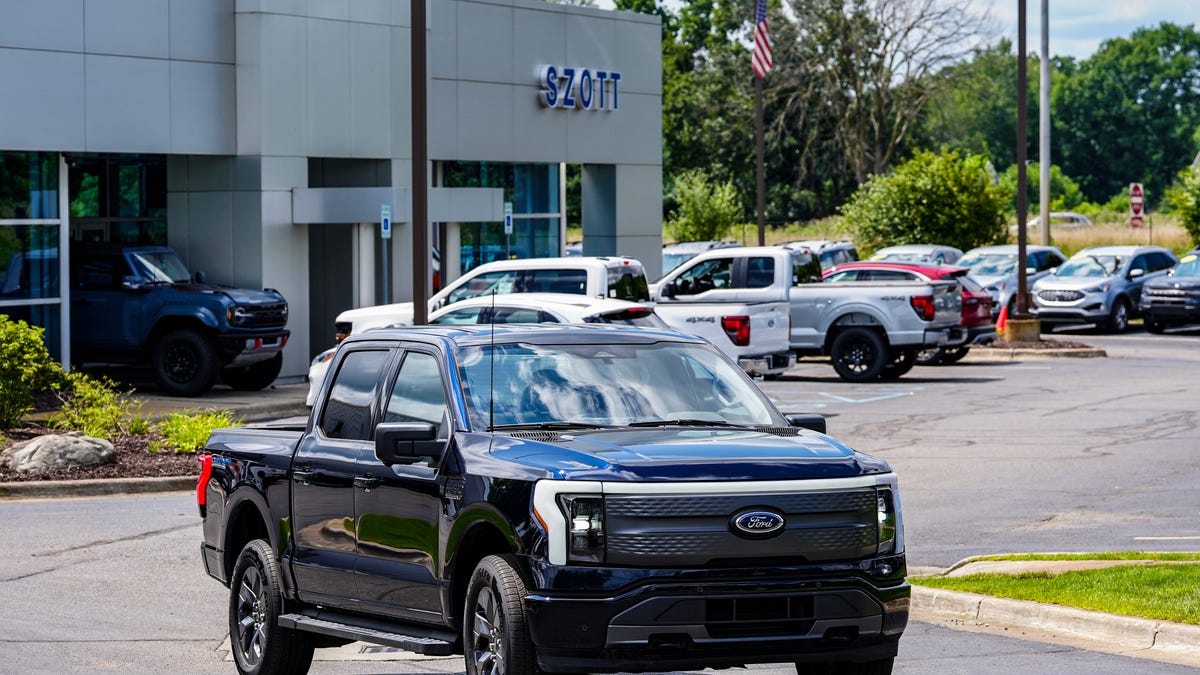
In October, Ford’s U.S. new vehicle sales increased by a narrow 1.6% to 175,584 units sold, supported by the sales of its popular gasoline-powered F-Series pickups. But Ford’s sales of EVs plummeted nearly 25% to 4,709 sold compared with October 2024. Ford reported sales of hybrid vehicles also dipped in October, down 4% to 17,498 sold.
Keating anticipates seeing sales slow for the Detroit carmakers when November results are in, but right now, the mid-month sales data Cox has is too incomplete to forecast how each might finish the month.
Still, cars are sitting on dealership lots longer and that inventory is now higher priced. Data showed that U.S. new-vehicle inventory has been climbing and as of mid-month was at a whopping 88-day supply, said Cox’s Schirmer. The industry norm is 60 days.
“New-vehicle prices have been tracking higher with the arrival of 2026 model year units,” Schirmer said. “Looking at available inventory, more than half of the units out there right now are 2026 model year.”
Jamie L. LaReau is the senior autos writer for USA Today Co. who covers Ford Motor Co. for the Detroit Free Press. Contact Jamie at jlareau@freepress.com. Follow her on Twitter @jlareauan. To sign up for our autos newsletter. Become a subscriber.
Related Article