Formula 1
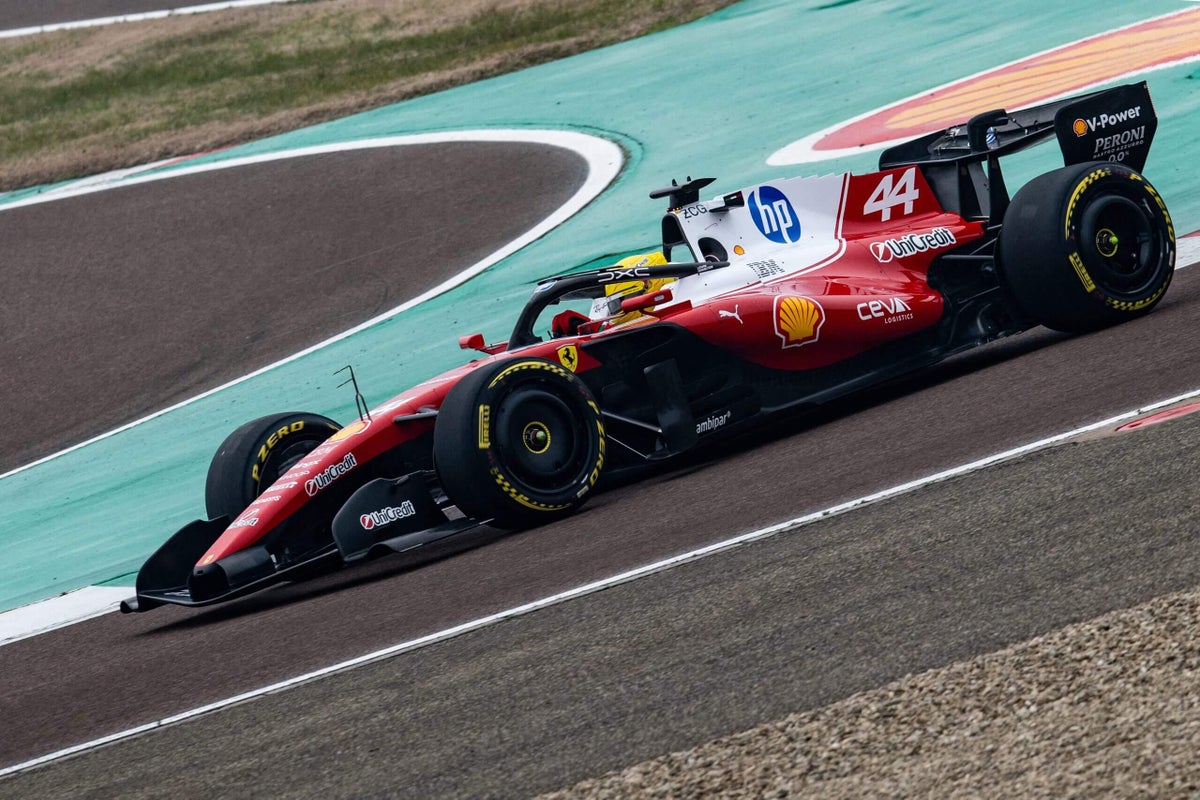
Lewis Hamilton drives Ferrari's new F1 car at its Fiorano test track on Friday. Federico Scoppa/Getty Images
Almost 12 months ago, Lewis Hamilton fulfilled a lifelong dream by finally driving a Ferrari Formula 1 car.
The brief test around a cold Fiorano circuit, next to Ferrari’s factory in Maranello, Italy, was a landmark moment for Hamilton. With his mom watching on and many keen Ferrari fans seeking vantage points around the track, the seven-time world champion was the latest F1 champion to sit in the famous red car with such excitement and hope.
The tone for 2025 quickly changed.
Advertisement
Hamilton endured a rough first year with Ferrari, hamstrung by an underperforming car. But he also failed to regularly match his teammate, Charles Leclerc, for performance. It was the first season of his F1 career, which started in 2007, in which he failed to score even a single podium finish.
Ferrari didn’t win a race all season. Hamilton called it a “nightmare” and an “emotional rollercoaster.”
Hamilton and Leclerc returned to Fiorano on Friday for the first outing of Ferrari’s 2026 car. Hamilton showed no signs of any lingering disappointment or emotional hangover from his poor first season in red.
He was all smiles for the cameras and took time to go and greet the fans who’d again squeezed up against the fence, trying to catch a glimpse of the latest Ferrari.
The Italian team took a low-key approach for the SF-26’s launch. It issued some images and basic information to the media on Friday morning, before the car made its on-track debut on the team’s test track.
This first shakedown may not yield anything like the kind of data or information that the upcoming test running in Barcelona and Bahrain will provide, as teams are limited to just 9.3 miles worth of running on such days.
Yet there is still value in completing even that first handful of laps. Drivers can get an initial feel for new cars and teams want to ensure all the new systems are working as anticipated.
Ferrari Team principal Fred Vasseur hailed the day as an “important milestone for the season, but I would say that’s probably even more true this year.”
The shakedown had added importance for Vasseur because F1’s car design rulebook has been rewritten entirely. As new engines are being introduced as well, it marks the biggest regulatory change in a generation.
For Ferrari, now going into the 18th year of its F1 world-title drought, the opportunity the reset affords is an important chance to try and return to race-winning contention.
Advertisement
Vasseur, who spoke in a news conference after the shakedown, was largely positive. “I am very proud of the guys at the factory,” he said. “It was a huge amount of work over the last weeks, months and probably years — on the engine side. But we are all more than happy with how it went today.”
Hamilton and Leclerc both got the chance to drive the new car on Friday. Beyond the different aerodynamic shapes required by the new design rules, the SF-26 also has a new color scheme for 2026. Ferrari has moved to a slightly brighter shade of red and revived the use of white around the cockpit and airbox as used on some classic Ferrari F1 cars.
The drivers were able to test out F1’s new active aero systems, which automatically open flaps on both the front and rear wings depending on whether a car is in a corner or running down a straight, for the first time.
The most experienced F1 drivers will be able to tell even from their first few laps what they might achieve in a season.
What complicates their feelings and predictions this year is the scale of the rule changes and just how different the cars will feel to drive. They will be slower with less downforce being produced by the aero parts, but the engines have nearly twice as much electrical power compared to last year.
“Immediately you’re trying to get a feel for anything, (the) feeling through your body, through the vibrations of your seat, and the suspension, you’re trying to pick up all these little bits of information in the little time that you have,” Hamilton said, in a video interview issued by Ferrari.
Regardless, Hamilton and Leclerc will have at least welcomed a taste of the challenge coming this year. It’s a season, Leclerc said last December, that is “now or never” for Ferrari, given the rule changes mean F1’s competitive order will likely change. After the SF-26’s launch, Hamilton said the new car changes marked “the biggest regulation shift our sport has seen, at least in my time,” and that it was going to be a “massive challenge” for the drivers to adapt.
Advertisement
But he expressed optimism for 2026. “I’m really hopeful that with (the fans’) support, and with the hard work that everyone is putting in, that we can have a strong year,” Hamilton said. “That’s the dream.”
Leclerc said in another Ferrari video interview that his laps all went as planned. But he claimed it was tough to judge the car’s performance.
“(There were) no big problems or unexpected things, which is a good thing because it’s such a big regulation change,” Leclerc said. That’s all you really want on a day like this. When you only do five laps, it’s not about the performance or anything like that now; it’s about trying to see if all the systems are working properly. Which they did, so it’s been positive.”
Speaking in a news conference after the shakedown, Vasseur remained coy about Ferrari’s prospects going into the new season, which starts in Australia on March 8, despite feeling positive about the initial run-out.
“It’s far too early (to talk) about expectations,” Vasseur said. “We are there to work, to develop, to improve, and we’ll see what the situation in Melbourne is.”
Vasseur also echoed his comments from December, when he noted the rapid rate of car development — finding performance with upgraded aero parts — that was likely in 2026 around the new regulations. Teams often find bigger gains in the early seasons of a new car design rules era.
“Nobody knows what will be the situation in a couple of weeks now,” he said, explaining that Ferrari planned to learn as much as it could about the new car in Barcelona next week before then pushing more with car development from the first Bahrain test. This starts on February 11.
Vasseur is going into his fourth season at Ferrari and he’s under pressure to recover from last year’s setbacks.
Ferrari narrowly lost out on the constructors’ title to McLaren in 2024 before their fortunes diverged. McLaren surged to both championships last year with 14 grand prix wins — Ferrari not once standing on the top step of the podium. McLaren, Mercedes and Red Bull, the other three F1 powerhouse teams, are likely to be Ferrari’s strongest competition again this year.
Advertisement
Since he made his F1 debut in 2007, this is the 20th time Hamilton has been through the preseason routine — testing a new car with all the excitement and unknowns of a new campaign ahead.
But righting the wrongs of 2025, a year in which the novelty of joining Ferrari soon gave way to that frustration and disappointment, brings extra scrutiny. The 41-year-old still bears hope he could clinch a record-breaking eighth world championship, but surely knows that a lot of that hinges on the car Ferrari can give him.
There will also be a change for Hamilton away from the track this year. Ferrari recently announced Hamilton would be getting a new race engineer for 2026 after Riccardo Adami, his previous pit wall contact, was moved to a different part of the company.
The pair appeared to have many moments of friction on their team radio airwaves last season, but Hamilton always denied there were any issues behind the scenes. Ferrari is yet to confirm the identity of Hamilton’s new engineer.
It won’t be until the second day of the Barcelona test, which runs from Monday to Friday next week, that Ferrari will put its car on the track. Teams are permitted to test on three of the five days at the Circuit de Barcelona-Catalunya, but one — Williams — has already confirmed it will not take part in the test at all due to delays with building its new car.
While most teams are expected to only focus on chasing performance from the first Bahrain test onwards, a smooth start in Barcelona next week would at least serve as a confidence boost to Hamilton and Leclerc after such a rocky 2025.
“Part of our job will be to give them the good tools to be at their maximum,” said Vasseur. “It’s true that we are all starting from scratch, we are all discovering the challenges, and I think this is a good feeling, I would say, because it’s our job, our DNA, to challenge this kind of situation. The drivers are part of the equation. It’s a very interesting challenge for us and for the others.”
Advertisement
To get such a fresh challenge at this late point in his career is no bad thing for Hamilton. He’s always embraced and thrived off those opportunities, no more so than his decision to join Mercedes for F1’s last major engine design rule change in 2014. He went on to win six titles in seven years.
But today’s first outing at Fiorano will surely have offered some small clues as to the scale of the task ahead to make up for last year’s Ferrari difficulties.
Luke Smith is a Senior Writer covering Formula 1 for The Athletic. Luke has spent 10 years reporting on Formula 1 for outlets including Autosport, The New York Times and NBC Sports, and is also a published author. He is a graduate of University College London. Follow Luke on Twitter @LukeSmithF1
Related Article