Forget DRS, now it’s all about corner mode, straight mode, and overtake mode.
While not quite a separate dialect, Formula 1-speak can be heavy on the jargon at times. They say “box” instead of pit, “power unit” to describe the engine and hybrid system, and that’s before we get into all the aerodynamics-related expressions like “outwash” and “dirty air.” Next year is a big technical shakeup for the sport, and it seems we’re getting some new terminology to go with it. So forget your DRS and get ready to talk about Boost mode instead.
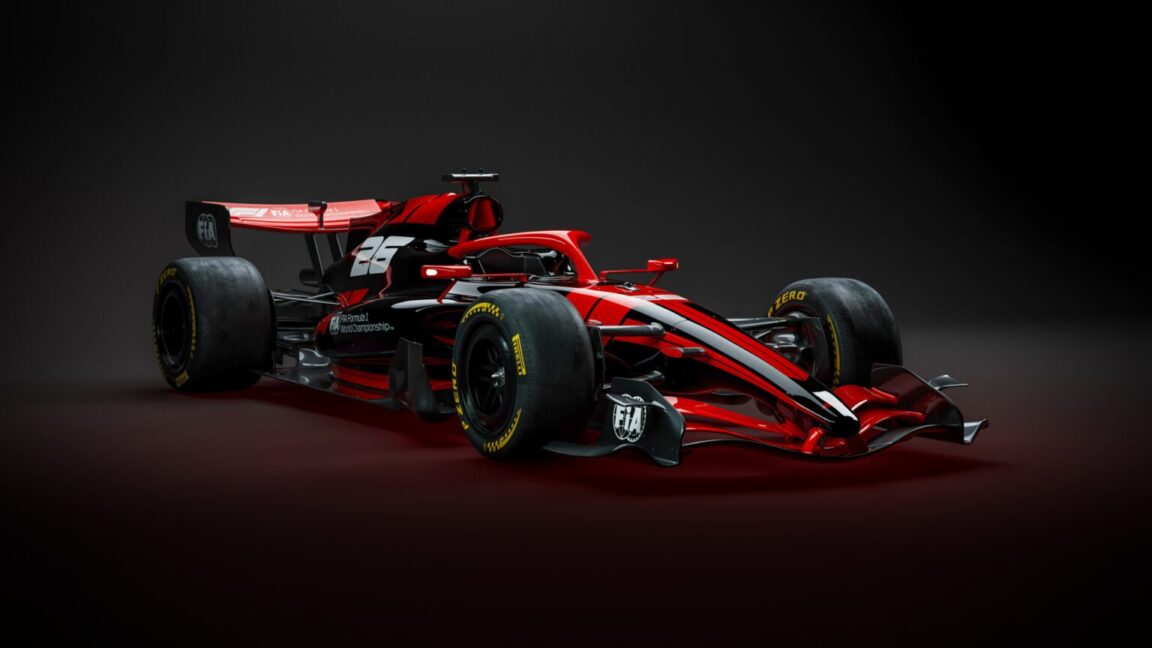
The F1 car of 2026 will be slightly narrower and slightly lighter than the machines that raced for the last time earlier this month. But not by a huge amount: minimum weight is decreased by 30 kg to 724 kg, the wheelbase is 200 mm shorter at 3,400 mm, and the car’s underfloor is 150 mm narrower than before.
The front wing is 100 mm narrower and has just two elements to it, although for the first time in F1 history, this is now an active wing, which works in conjunction with the three-element active rear wing. Active rear wings have been a thing in F1 since the introduction of DRS—the drag reduction system—in 2011, but now there’s a philosophical change to how they’ll work.
With DRS, a driver could activate it to reduce their car’s drag if they were within a second of a car in front and at one of the marked DRS zones on track. From next year, the cars will have Straight Mode, which lowers both front and rear wings to decrease drag—this will be allowed for any drive on any of the designated straights, regardless of whether they’re close to another car or not.
And there’s corner mode, where the wings are in their raised position, generating downforce and making the cars corner faster. Those names are better than X-mode and Z-mode, which is what they were being called last year.
At the start of the season, expect overall downforce to be reduced by around 30 percent compared to this year’s machinery. However, the cars should also produce around 55 percent less drag, says the sport’s organizers, the FIA. The reason for the big decrease in drag down the straights is because of the new powertrains. The complicated and expensive MGU-H that recovered energy from an F1 engine’s turbocharger is gone, and there’s a more powerful MGU-K that drives the wheels together with the V6.
Now, the power split of V6 to MGU-K is 400 kW and 350 kW, but there will be times when the battery pack is not fully charged and the electric motor will contribute much less power. Making the cars slipperier through the air, then, is a way to ameliorate that impinging too much on the show.
Allowing cars to follow each other closely through corners was a big motivating factor for the 2022 rules change that reintroduced ground effect downforce to the sport, although some of those gains were erased by the teams as they developed their cars. So it’s good to know that remains a priority for the 2026 ruleset, too.
“The 2022 cars started off with a significant improvement in their wake characteristics,” said Nicholas Tombazis, FIA single seater director. “I don’t remember the exact numbers, but downforce at approximately 20 metres behind went from about 50 percent on the previous generation of cars to about 80 or 85 percent to start with on the 2022 cars. And then that gradually decayed during the regulation cycle to what it is now, where we are probably talking about 70 percent. We believe that the start of the new cycle will be more like 90 percent, better than it’s ever been.”
Tombazis added that “the front wing end plates morphed into shapes that permitted quite a lot of outwash, while the inside of the front brake drums also worsened the characteristics, as did the side of the floor. We learned a lot from that, and in developing the regulations for 2026 we hope we will maintain the good characteristics for a longer period or hopefully not have this decay again.”
Instead of using DRS as an overtaking aid, the hybrid power units will now fulfill that role. Overtake mode, which can be used if a driver is within a second of a car ahead, gives them an extra 0.5 MJ of energy and up to 350 kW from the electric motor up to 337 km/h—without the Overtake mode, the MGU-K tapers off above 290 km/h. There’s also a second Boost mode, which drivers can use to attack or defend a position, that gives a short burst of maximum power.
Change can often be unsettling, and over the past couple of years, there has been criticism of the rules, specifically the emphasis on so much hybrid power, which now requires active aero to not make the cars too slow. Some have even suggested a swifter end to the incoming rules and then a switch to naturally aspirated engines, although that now seems very unlikely.
F1 CEO Stefano Domenicali rejected that idea. “F1 needs to be relevant. And in terms of technical development, the fact that we receive new manufacturers in our sport means that the relevancy, from the technical perspective I’m talking, of course, it has been more important, has been achieved,” Domenicali told me. “Therefore, as always when there is such a technical change, it is quite massive. Like you said, it is not only a new power unit that you’re managing, it’s a new car, it’s a new way to race.”
As Domenicali said, the new technical regulations certainly have been a success in attracting new manufacturers to the sport. In addition to Audi joining the sport—we spoke with him at the Audi launch last month—Cadillac is entering as a new team as well (albeit without their own engines until 2029). After pulling back from the sport, Honda has recommitted. And Ford has signed up, too, providing the hybrid side of the power unit that will go into next year’s Red Bull and Racing Bull cars.
The first preseason test gets underway on January 26, with the first race weekend in Australia March 6–8.
Ars Technica has been separating the signal from the noise for over 25 years. With our unique combination of technical savvy and wide-ranging interest in the technological arts and sciences, Ars is the trusted source in a sea of information. After all, you don’t need to know everything, only what’s important.
Related Article