
We rely on you, the readers to fund our journalism.
Your contribution is appreciated.
Our stories are your stories: Sign up for our newsletters focused on Savannah and Coastal Georgia, local politics, environment, public safety and more.
Delivered Monday, Tuesday, Wednesday, Thursday, and Sunday to your inbox. Sign up now.
By clicking subscribe you agree to share your email address with The Current and Mailchimp to receive marketing, updates, and other emails from the site owner. Use the unsubscribe link in those emails to opt out at any time.
The Current
In-Depth Journalism for Coastal Georgia
Our newsletters uncover the insights you need to understand the issues facing Coastal Georgia—delivered to your inbox five times a week.
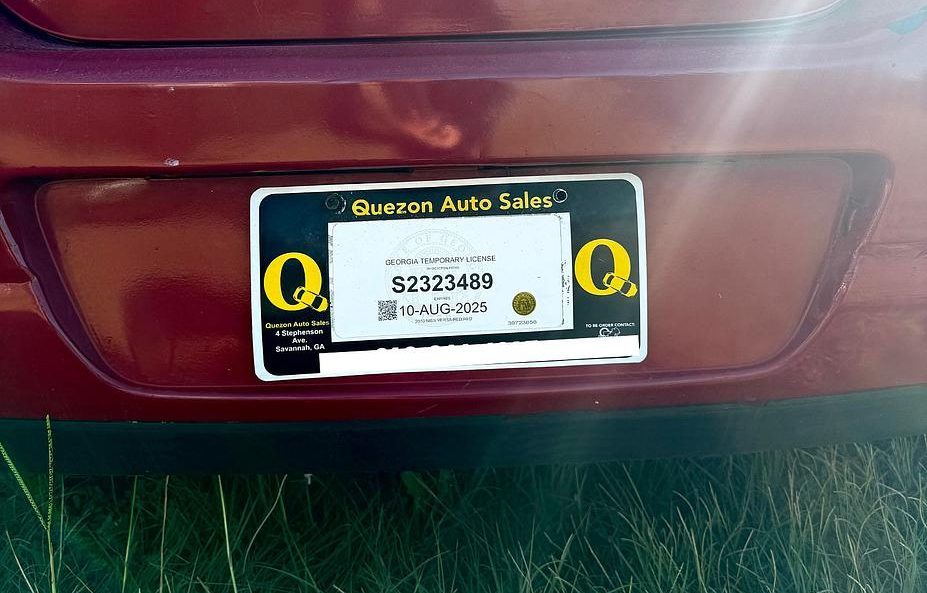
The lucrative illegal market of buying and selling temporary car tags in Georgia is expected to take a hit in January thanks to a new law designed to curb fraud by thousands of shell companies and unscrupulous used car dealers in the state.
Legal car sales require the seller to provide a buyer the title of a car, as well as paperwork that allows the buyer to purchase a license plate. Yet lax enforcement has emboldened ghost firms operating out of empty storefronts and other used car dealers to sell cars without the legal title by abusing their right to issue almost unlimited numbers of temporary tags during a sale.
That loophole in the previous law has cost the state tens of millions of dollars in revenue and allowed out-of-state criminals to purchase vehicles without insurance or without leaving a paper trail, according to John Corbett, the chair of the House Motor Vehicle Committee.
Georgia’s system was blamed for fueling car thieves and criminal gangs in New York, according to national news organization StreetsBlog. But also left thousands of unsuspecting Georgians without cars that they can legally drive.
“There’s been human trafficking, drug trafficking, people evading thousands of dollars because there are so many loopholes in the system,” said Republican Corbett of Echols County, “We’ve been trying to pass legislation for stricter laws for five years now, but there’s always good legislation that doesn’t get passed every year.”
Although regulators have known for years of the fraudulent use of Georgia temp tags, the state did not prioritize investigations or punishments for those abusing the system. Even when law enforcement officials would see an illegal temporary car tag, the $500 fine did little to curb the dealers, said Richard Barber, Sergeant at Chamblee Police Department.
State lawmakers took up the issue last spring, after recognizing that Georgia had the reputation as the worst state for misuse of temporary tags.
Legislators questioned the operating practices of many of the state’s licensed used car dealers during hearings. Statistics from Georgia’s Department of Revenue show that of the state’s 7,200 registered used car dealers, approximately 1,000 sold only two to three cars from March 2024 to February 2025, according to a report cited in a legislative study session held in September. Approximately 2,000 dealers sold no cars, the report stated.
State Rep. Todd Jones from Marietta sponsored the new law. He believes these businesses use temporary tags that provide a veneer of legitimacy while allowing them to avoid the state’s Title Ad Valorem Tax, which funds public services for the state, counties, schools and cities.
The new law going into effect in 2026 changes procedures for car dealers in two significant ways.
Starting Jan. 1, used car dealers can only ask for the same number of temporary tags that they received in 2025. To receive more, they must present proof to Georgia’s Department of Revenue that they have concluded legitimate sales.
As well, the Department of Revenue will be able to monitor temporary tag issuance patterns and suspend a dealer’s access to such tags if investigators observe suspicious activity.
State lawmakers say a key area of focus will be the state’s 4,000 e-commerce dealers who do not own car lots, but instead sell vehicles online. These dealers serve the burgeoning online markets where customers browse, research, and complete an entire purchase online before receiving their vehicle.
These e-commerce dealers must have a business license from the state and lease office space that is separate from their place of residence. But a lack of oversight over the online car sales industry means that hundreds of such companies are suspected of fraudulent business practices.
Friedrich Matthies, an Atlanta businessman who leases offices to such businesses, discovered in 2023 that one of his tenants had ordered three boxes of temporary tags, with 150 tags in each box. Although he called an inspector from the state’s Department of Revenue, there was no consequence or punishment received after such alleged evidence of fraud, he said.
The new law will now require e-commerce dealers to lease offices that are at least 250 square feet if they sell less than 500 vehicles each year, something that lawmakers expect will separate ghost firms from legitimate small business owners.
Matt Beaudry, the head of Oakwood Auto Sales in Atlanta who has also had a profitable business leading office space to e-commerce dealers, said that while he agrees with most of the new law changes, he thinks that the new office space requirements will force smaller dealers to close.
The biggest issue, according to Corbett, is that there is no requirement for e-commerce dealers who run out of small offices to unlock their doors and keep their records open for inspectors. Databases can’t be properly updated and bad actors can’t be caught if inspectors can’t do their jobs, according to Corbett.
He said he spends most weeks assessing upwards of 2,000 used cars, work that means he is rarely at the physical office. He ends up purchasing about 3% of those for resale.
Graig Parker, an e-commerce dealer and tenant in one of Matthie’s buildings, is one of those smaller businessmen who worry about the future.
Just because his office address is empty doesn’t mean that he’s not legitimate, he said.
“When you come down to the office, naturally, we’re not going to be there,” said Parker.
Parker says the state needs better laws to tackle another problem of fraud: open title selling and skip titling. That occurs when someone buys a car without the title, then sells it to someone who doesn’t realize they are purchasing a fraudulent vehicle.
Beaudry agreed that the state should be looking into title fraud and said he feels small businesses and e-commerce dealers are being used as the scapegoats for all of the used-car industry problems. In an effort to show state lawmakers that transparency can be met in other ways, Beaudry has updated his tenant contracts since the Sept. 9 study committee meeting, requiring all tenants to allow inspectors looking for records to enter their office space whether they’re present or not.
Nonprofit, independent journalism needs YOUR support to survive and thrive. Help us achieve our mission of creating a more informed world by making a one-time or recurring donation today.
Your contribution is appreciated.
Jasmine Wright is a 2025 graduate from Indiana University with a Bachelor's in Journalism. While at IU, Jasmine worked as an investigative reporter for the Arnolt Center for Investigative Journalism and… More by Jasmine Wright 
This work is licensed under a Creative Commons Attribution-NoDerivatives 4.0 International License.
- Written content may be republished or shared in print and/or your website, but you may not resell the story. For news websites using paywalls, The Current’s shared content must either:
- Be provided in full for free (and outside any paywall or subscriber restrictions);
- Or, the top three-to-five paragraphs may be republished followed by a link to the rest of the story at its original location on http://www.thecurrentga.org.
- Give us credit. Please publish the author’s name as follows, for example: By Margaret Coker, The Current. Include the following: The Current is an independent, in-depth and investigative journalism website for Coastal Georgia.
- Story content, facts, quotations and other data may not be significantly edited or reorganized without receiving prior and express permission. Permissible edits not requiring permission are: changing references to timing (for example: “today” to “yesterday”) and style edits to follow your publication’s style guidelines. We do not allow the altering of any direct quotes without express prior permission.
- If, in the editing process, you have a question regarding a fact, quote, data or other element of a story, please contact The Current’s editors and not the individual reporter or reporters.
- Let us know as soon as you know you’ll use it so we can watch and track its use.
See full republication policy at https://thecurrentga.org/republication-rights-such/ Thank you!
by Jasmine Wright, The Current
December 4, 2025
The Current is an independent nonprofit news organization providing trustworthy journalism without bias, fear or favor, with the goal of empowering the communities of Coastal Georgia to solve our shared problems.

Sign in by entering the code we sent to , or clicking the magic link in the email.
By signing up, you agree to our Terms and Conditions. This site is protected by reCAPTCHA and the Google Privacy Policy and Terms of Service apply.
You must be logged in to post a comment.