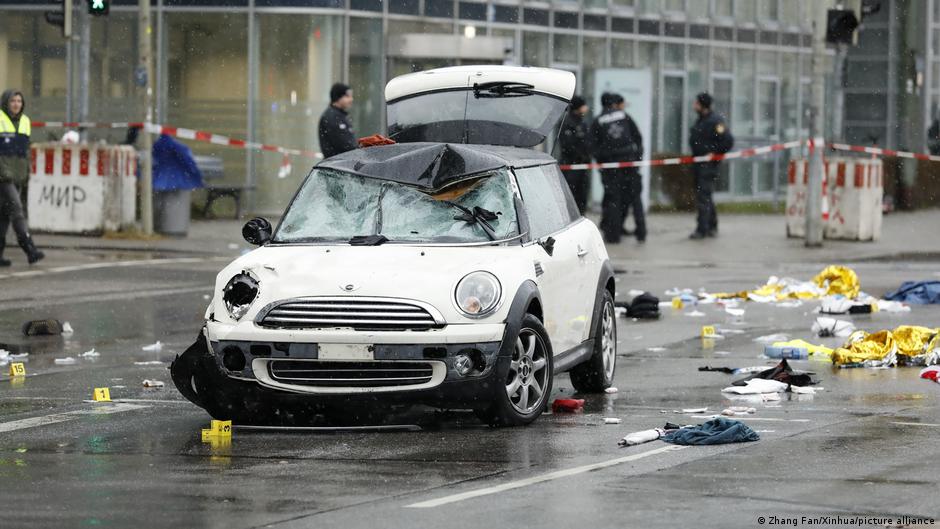
An Afghan national faces murder and attempted murder charges for the February car ramming attack. In Brussels, German carmakers look set to get a massive break over emissions. DW has the latest.
Here are the latest updates and reports making headlines in Germany on Tuesday, December 16:
Confidence among financial market experts in Germany has picked up sharply in December, signaling growing optimism about an economic rebound.
The ZEW economic expectations index for Europe’s largest economy rose by 7.3 points to 45.8, the Mannheim-based Leibniz Center for European Economic Research said on Tuesday.
The gauge for current conditions edged down slightly, falling 2.3 points to minus 81.0. ZEW President Achim Wambach said expectations had clearly improved after years of stagnation.
“After three years of economic stagnation, the mood points to good chances of an economic upswing,” Wambach said, citing hopes tied to the federal government’s more expansionary fiscal policy.
He cautioned, however, that uncertainty remains over trade disputes, geopolitical tensions, and weak investment.
Several key industries have shown a less pessimistic outlook. The balance for the auto sector improved by 7.7 points to minus 22.0, while export-oriented industries such as chemicals, pharmaceuticals, and metal production also posted gains, though to a lesser extent, the ZEW said.
Sentiment in the wider eurozone has strengthened even more. Expectations rose by 8.7 points to 33.7, while the assessment of current conditions slipped slightly but remained well above Germany’s level at minus 28.5.
To view this video please enable JavaScript, and consider upgrading to a web browser that supports HTML5 video
German authorities have searched the home of a suspected supporter of the “Islamic State” militant group in the state of Baden-Württemberg amid concerns about possible attack planning.
Prosecutors and state police said on Tuesday that officers searched the apartment of a 22-year-old Syrian man in Karlsruhe but found no items that substantiated the suspicion and no evidence of concrete attack plans.
The man remains at liberty. Investigators also searched two apartments in the central state of Hesse, where he is believed to have stayed frequently.
Authorities said the suspect is under investigation for alleged links to IS and for possibly seeking training in handling explosives or improvised explosive devices with the aim of carrying out an attack. They declined to provide further details about the man or the source of the intelligence.
Officials said there were currently no indications of an acute threat. The suspect’s mobile phone was seized for further analysis, and he was released after police measures were completed.
Investigations into the suspicion of preparing a serious act of violence against the state are continuing.
To view this video please enable JavaScript, and consider upgrading to a web browser that supports HTML5 video
To view this video please enable JavaScript, and consider upgrading to a web browser that supports HTML5 video
Authorities in the eastern state of Saxony-Anhalt say they are preparing to deport a 21-year-old Central Asian man on suspicion of planning a terror attack in Germany.
State criminal police say the man, who arrived in Germany in June 2024, was arrested in the city of Magdeburg on Friday, adding that he had not been on their radar until they received a tip last Thursday.
Authorities say the man, whom they say may have been motivated by his Islamist beliefs, planned to attack “large crowds.”
Citing a “fact-based prognosis,” officials in Saxony-Anhalt deemed him a “terrorist threat” who should be deported.
The 21-year-old’s Friday arrest also came at the same time police in the southern state of Bavaria detained five men — three Moroccans, a Syrian and an Egyptian — in a raid to foil a plot to carry out an Islamist car ramming attack in the state.
Bavaria’s Higher Regional Court in Munich is also in today’s updates (see below), as Afghan national Farhad N. goes on trial for ramming a car into a crowd of people there in February. Here, too, radical Islamist views were given as the perpetrator’s motivation for killing a mother and child and seriously injuring 44 more people in a random act of violence intended as retribution for the suffering of Muslims worldwide.
Magdeburg was the scene of that kind of attack last December when a Saudi Arabian man killed six people, including a nine-year-old child, and injured more than 300 people when he sped a rental car into a crowd of holiday revelers at the city’s Christmas market. He was later revealed to have espoused far-right and Islamophobic ideologies online.
To view this video please enable JavaScript, and consider upgrading to a web browser that supports HTML5 video
Germany’s Navy has taken delivery of the first of 30 new helicopters intended to support anti-submarine warfare.
Defense Minister Boris Pistorius says the aircraft will help defend against underwater and surface threats from the air and hunt submarines.
“[Russian President Vladimir] Putin is continuing to massively upgrade his navy. He has little or no need for it in Ukraine. The Black Sea Fleet is one thing, but the North Atlantic Fleet is something else,” Pistorius was quoted by dpa as saying.
“This means that we, as NATO and as the Federal Republic of Germany, need to equip our naval forces quickly and better.”
The Sea Tiger is designed for use on frigates and marks a significant modernization step for Germany’s naval forces.
The NH-90 Sea Tiger will replace the Sea Lynx, which has been in service with the German Navy since 1981.
The European Commission on Tuesday is expected to halt a proposed ban on internal combustion powered vehicles from 2035 after intense lobbying by industry and car-producing nations in the EU including Germany, Italy and France.
Rather than the complete elimination of carbon dioxide emissions laid out in the 2023 Green Deal, the Commission is now expected to set a target to reduce the overall CO2 emissions of carmakers’ fleets by 90%. This could enable carmakers to retain some internal combustion engines, either a very small number of higher-emission cars or a larger number of lower-emission ones like hybrids.
According to analysis from the European automobile sector lobbying group ACEA, just 16% of all vehicles sold in the first nine months of 2025 were electric.
Regardless of whether customers want them, Germany has been late to ramp up electric vehicle production and its industry now faces increasingly stiff competition from its vehicle manufacturing protege China.
“There is a clear demand for more flexibility on the CO2 targets,” European Commission spokeswoman Paula Pinho said Friday, adding that Brussels was “aiming for balance.”
Critics accuse the EU of backpedalling, saying the bloc risks undermining its own green agenda with the move.
Advocates say the decision is critical to survival of Europe’s automobile sector.
To view this video please enable JavaScript, and consider upgrading to a web browser that supports HTML5 video
The Financial Times (FT) newspaper has reported that German parliamentarians and staff were unable to access their e-mail accounts for more than four hours Monday as the result of a suspected cyber attack.
The incident came in the middle of three days of urgent diplomatic talks as Berlin hosts numerous US, Ukrainian and European officials to negotiate a unified approach to ending Russia’s nearly four year war of aggression in Ukraine.
The incident, according to one of three senior parliamentarians cited in the article, occurred as Ukrainian President Volodymyr Zelenskyy was being welcomed to the lower house of Germany’s parliament by Bundestag President Julia Klöckner.
“We know who it’s probably coming from,” said the parliamentarian.
The implications are alarming considering the fact that Zelenskyy is engaged in the highest-level talks with US and European leaders at a critical time in the war. But a Russian cyber attack is also in line with German and European accusations that the Kremlin is intensifying its now decades-long hybrid war against them.
In 2015, Russia is thought to have stolen significant amounts of data when it hacked then-Chancellor Angela Merkel’s cellphone.
Last week, Berlin’s Foreign Office accused Russia of seeking to undermine “confidence in democratic institutions and processes in Germany.”
On Friday, Berlin summoned Russia’s ambassador to Germany to question him regarding accusations of sabotage, cyber attacks and election meddling.
The trial against Farhad N., a 25-year-old Afghan man accused of driving a car into a crowd of people in Munich this February, began at the city’s Higher Regional Court on Tuesday.
The defendant faces two counts of murder and 44 counts of attempted murder for the February 13 incident.
Prosecutors say the Afghan citizen was “motivated by exaggerated religious zeal” when he carried out the attack.
State prosecutors say that during questioning the defendant spoke of a sense of obligation to arbitrarily kill people in Germany as a direct response to the suffering of Muslims worldwide.
The attack, which targeted a union demonstration staged during the Munich Security Conference (MSC), killed a 37-year-old woman and her 2-year-old daughter, as well as gravely injuring some 44 more.
Farhad N. was apprehended at the scene of the crime and has been in police detention since.
Authorities say Farhad N. had been denied asylum in Germany but maintain that he nevertheless resided in the country legally.
They say his attack did not target the MSC — which annually hosts high-ranking international politicians — but rather the crowded union protest.
His trial is set to end in late June 2026.
To view this video please enable JavaScript, and consider upgrading to a web browser that supports HTML5 video
Guten Morgen from the DW newsroom in sunny Bonn.
Thanks for joining us today as we report on the start of a trial against an Afghan man accused of ramming a car into a crowd of people during the Munich Security Conference this February, killing two and injuring 44.
As we reported yesterday, Germany’s car industry is in a slump, but… carmakers may be in for some good news from Brussels this Tuesday as lawmakers there appear set to drop — at Berlin’s insistence, among others — a proposed ban on new internal combustion vehicles from 2035 as originally proposed.
In Berlin, German, UK and Ukrainian defense ministers are set to address the so-called Ukraine Defense Contact Group as discussions about security guarantees tied to ending Russia’s invasion of Ukraine continue for a third day in the German capital.
Follow us here for this and the latest headlines throughout the day
Related Article