If General Motors’ new headquarters were one of the vehicles it makes, it would be a Chevrolet Corvette ZR1 or a Platinum trim Cadillac Escalade.
Those walking the upper floors of 1240 Woodward Ave., GM’s new home through at least 2041, will see leather pillows stitched from the same materials as the recently revealed Corvette CX concept, sculptures of the Goddess hood ornament and a slew of other Easter eggs that highlight GM’s design history and corporate accomplishments.
The Detroit automaker officially sets up shop at the $1.5 billion development of Dan Gilbert’s Bedrock real estate firm on the former site of J.L. Hudson’s department store on Jan. 12 as its “anchor tenant” ― opening the doors to an undisclosed number of employees relocating from the labyrinthian Renaissance Center.
GM would not disclose the number of employees planned for the move nor the total capacity, though leadership noted that the space is designed to be flexible to accommodate larger groups when needed but not wasting costs when fewer people work in the office.
The new building’s luxury feel and (comparatively) open concept serves as the epicenter for GM’s long-term strategy to attract younger, more tech-savvy employees to the Motor City.
Downsizing from five towers in the iconic seven-tower RenCen it occupied since 1996 opens the automaker to rent payments for the first time but also relieves it of operating costs such as taxes, utilities and janitorial expenses of a mostly empty building. GM can also lean, in part, on Bedrock’s on-site security team to secure the building.
But more importantly, Hudson’s Detroit is far more approachable ― allowing employees direct access to the city, and the city direct access to GM, according to David Massaron, vice president of infrastructure and corporate citizenship.
Unlike the RenCen, which served as an indoor metropolis with numerous dining options, a hotel, a movie theater and even a tailor tucked away in its connected riverfront towers, Hudson’s has only one small cafe in the atrium for its tenants. Bedrock also plans to open on the 12th floor an upscale restaurant from the Union Square Hospitality Group. The building’s main entrance opens right onto the sidewalk of Woodward Avenue.
“Your headquarters is, at some level, a beacon of what the company wants to be,” Massaron said. “Everything around us is thoughtful about how we approach our products. We have the same kind of attention to detail here, too. It’s going to be a great place for us to attract employees.”
Other building details include:
GM’s distinctive mid-century modern style profile that now echoes through the halls of Hudson’s first emerged with the construction of the Warren Tech Center, the company’s sprawling engineering and design campus in Macomb County.
Completed in 1956 under modernist architect Eero Saarinen, the Warren Tech Center solidified the design cues that have since defined the company’s visual heritage.
Re-creating and modernizing Warren’s design features at the new HQ came under the purview of Crystal Windham, executive director of global industrial design. An employee since 1994, Windham started out designing vehicle interior, rising to director of Cadillac Interior Design in January 2016.
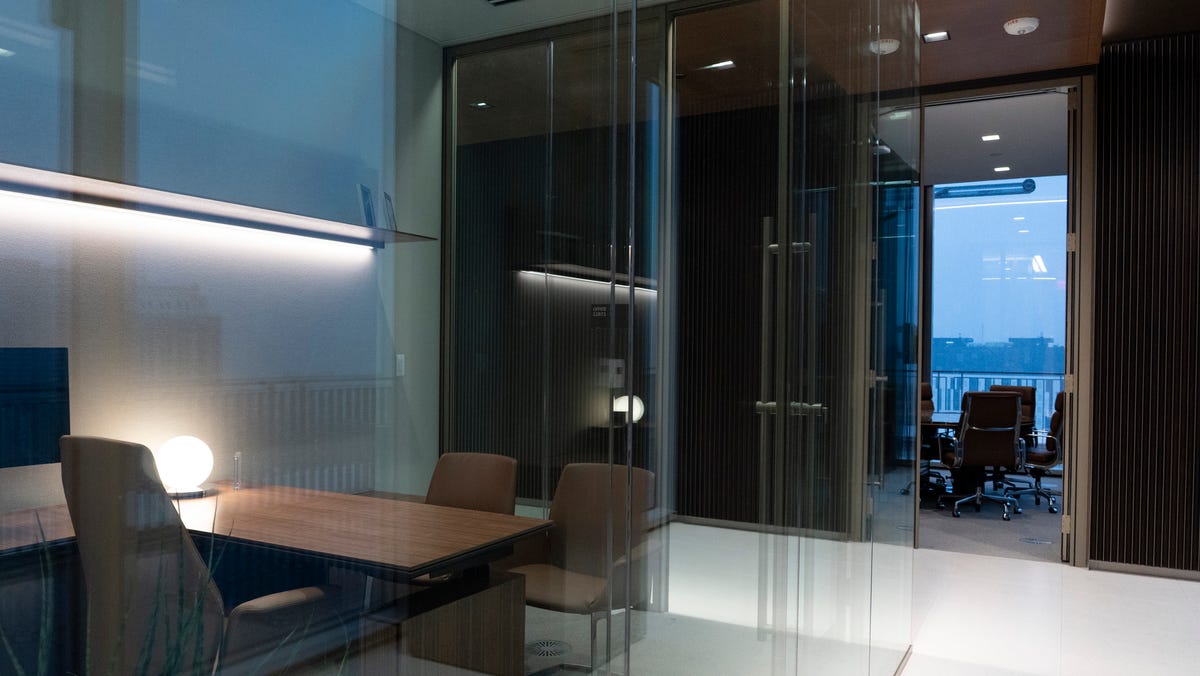
“Simple, clean, linear lines ― wood tones and stone,” Windham said. “Keeping things clean and timeless, that was the goal, that was the mission, that was the ask, of our leadership.”
Windham also pointed out a variety of speedforms ― mostly of Corvettes ― adorning the walls and resting on shelves in the new space. Speed forms are aerodynamic three-dimensional sculptures created by automotive designers that serve as a foundational shape of a vehicle.
Executive offices at Hudson’s feature the same vertical metal and wood fluting along the walls that can be seen at Warren, and the tech center’s trademark chain-mail curtains adorn the wide windows at Hudson’s, including that of CEO Mary Barra’s that overlook Comerica Park and Ford Field from the 11th floor.
The interior spaces and finishes, custom furniture and art at the Warren Tech Center were produced in part by GM designers and famous artists like experimental sculptor Alexander Caldar, who designed the fountain, and Harry Bertoia, a sculptor and modern furniture designer who now has pieces at both sites.
GM brought that same styling of dark woods, real plants and soft warm light to the crafting of its Hudson’s offices for good reason.
If Warren’s campus serves as GM’s heart, the Detroit headquarters has long represented its brain. The conference rooms, offices, phone booths and executive suites serve to receive all the information vital to running the largest U.S. automaker.
Housing GM’s key corporate staff in finance, legal and accounting only steps away from the company’s top executives enables faster decision-making, GM says. Decisions like greenlighting or canceling a vehicle launch or whether to open or close a plant can impact thousands of employees, millions of customers and billions of dollars.
Democratizing the executive offices is part of an ongoing initiative of Barra and GM President Mark Reuss, Massaron said. GM years ago dispensed with mahogany row, a hall of fancy offices reached by an elevator reserved for executives at its Global Technical Center, and GM’s Hudson’s space was designed to reflect that shift.
“Mary and Mark work out of lots of areas. If you go to their offices in Warren, they’re out in the open,” Massaron said. “Here, they’re out in the open, along with Grant Dixton, our chief legal officer, and (GM CFO) Paul Jacobson, who want to be with the employees and be part of the culture going forward.”
While GM’s history has been meticulously preserved in the nooks and crannies of the new office space, technological upgrades also are on full display.
“Entrance One,” the showroom on the ground floor named from the employee entrance of the original J.L. Hudson’s department store, will allow Detroiters to interact with some of the company’s emerging technology with GM product specialists while exploring the city’s downtown.
Entrance One can hold up to seven vehicles at a time and is planned to open to the public during the Detroit Auto Show.
“It’s an area where we can not only showcase our vehicles, our innovation, but it’s an extension where the community can come in for a different experience,” Windham said.
There’s plenty of tech upstairs as well. Mounted on the walls of each of the GM-leased floors are interactive flatscreen wayfinding displays from Cisco Spaces for indoor navigation. Employees can see at a glance of the virtual floor plan how many conference rooms are available and can book rooms via the screen.
To find their way, visitors can select the room they’re seeking and the mapping tool produces a QR code they can scan on their phones, Mike McBride, vice president of non-manufacturing facility operations, explained. A window will open with step-by-step directions to lead them to their destination ― technology that would have been helpful when navigating the disorienting RenCen towers.
“We wanted to put something in place for our employees to show them the amenities, show them where the food (is), show them how to route to their location,” McBride said.
While the space is undeniably corporate, there’s still room for whimsy. GM designers created custom wallpaper in the hallways that feature stacks of cassette tapes all bearing the names of songs that feature GM vehicles, from Bruce Springsteen’s “Pink Cadillac” to Prince’s “Little Red Corvette.”
Designers framed additional patent sketches in the space. One of a heart pump is framed on a shelf in Barra’s office, and another with the first automatic transmission rests on a shelf in Reuss’ office.
Wallpaper bearing design sketches from 300 GM patents winds around the open area overlooking the atrium. The building’s middle floors derive natural light from the eye-shaped glass skylight inspired by the headlight cover on a 1954 Corvette.
GM’s Hudson’s Detroit building is the second headquarters on Woodward Avenue and its fourth in the company’s nearly 118-year history.
GM’s first address was a small office on 127-129 Woodward Ave., between Fort and Congress, from 1911 to 1923. GM then relocated to the 15-story Albert Kahn-designed General Motors Building at 3044 West Grand Blvd., deemed in 1985 a National Historic Landmark, before snagging the RenCen in 1996.
Commissioned by Henry Ford II, the RenCen opened in 1977 from a design by Atlanta-based architect John Portman and became the tallest building in the state, what one GM executive called “the Eiffel Tower equivalent for Detroit.”
But a lot has changed in 30 years. In 2024, GM opened a new Mountain View Technical Center in California, creating a West Coast footprint to help bridge the distance between the automaker and Silicon Valley where some of its executives are based. And flexible work-from-home and in-person office time, already progressing thanks to leaps in telecommunication applications but further expedited by the COVID-19 pandemic, meant that GM had little need for a fortress-like headquarters so large that it famously had earned its own ZIP Code.
“The driving decision of moving here was we wanted a space to fit the needs of where we are, and for the Renaissance Center, we wanted a way to unlock the riverfront so those buildings could finally be successful,” he said. “In a post-pandemic world, that complex needed to be unlocked to fully reach its potential.”
GM purchased the RenCen, a building that turns 48 years old this year, for $73 million, and has since poured $1 billion into the site. The cost of the renovations needed to open up the space were estimated at the time to be $1.6 billion, including $250 million in public funds. GM said in a proposal in 2024 the RenCen’s tallest tower would remain while two others are slated for demolition.
More: Inside Ford Motor’s new world headquarters are nods to the past and cues to the future
Though it is smaller than their latest base of operations, the floors at Hudson’s Detroit are more spacious. Each floor is about 50,000 square feet, according to Massaron, compared with 17,000 square feet in the towers, allowing for a more open environment.
The newest headquarters is more compact than the 14-acre RenCen and may have a higher concentration of GM employees across the occupied space.
Across its tenants, which included staff at the Andiamo’s restaurant, the Marriott hotel and the Panera Bread, about 5,000 workers were active at the RenCen at the time of the new headquarters’ announcement April 15, 2024.
For context, GM has approximately 50,000 employees in Michigan across its corporate and manufacturing operations, and the Warren Technical Center has a capacity of about 19,000 people.
Though Detroit is a smaller, but no less impressive, footprint, GM has no plans to exit the city anytime soon.
“We’re a part of Detroit, and Detroit is part of us,” Massaron said. “The main central nervous system of the company is going to remain here for a long time going forward. It is a lease, and we can’t discuss the terms of the lease, but this is our long-term home.”
Jackie Charniga covers General Motors for the Free Press. Reach her at jcharniga@freepress.com.
Related Article