The Mazda MX-5 Miata has always been one of the finest sports cars to ever exist. Its peerless handling and low price point go some way towards explaining why it is the world’s best-selling sports car. With the RF version, the Miata further broadens its appeal with the option of a folding hard-top offering maximum protection from the elements. While other sports cars like the Audi TT might be faster, they come at a premium over the little Mazda and aren’t necessarily any more enjoyable to drive.
However, now that the Audi TT has gone out of production, it might be worth seeing what sort of deal you can get for a used example, especially as the MX-5 RF can easily have you spending nearly $40,000. A used Audi TT can, of course, be had for much less than this, but you can even get the more performance-oriented TTS variant from the third and most recent generation for considerably less than a brand new hard-top MX-5. This is why we will be carrying out a deep-dive comparison of the Audi TTS vs the Mazda MX-5 RF, which is the Audi’s closest Mazda equivalent, to determine which sports car will give you the most driving pleasure for your money.
For this comparison, manufacturer’s specs were used, along with anecdotal impressions from the author’s experience driving both cars.
You may have forgotten about it, but this little sports car deserves your attention.
Nobody will need much convincing that these two are sports car icons. The MX-5 Miata, which has seen only four generations after it launched nearly 40 years ago, is still going strong and has hardly deviated from that basic formula. That formula included having a naturally aspirated four-cylinder gas engine, as well as being rear-wheel drive and, of course, super light.
The fourth generation first launched in the previous decade, and it has had two updates since then, which have added more power and more sophisticated tech. The RF arrived for the first time in this generation, and while it introduced a metal folding targa roof, the rest of the recipe remained the same.
The Audi TT concept launched to much fanfare in 1995, and the road-going version arrived a few years later with surprisingly few changes made to that original design. The TT has always been based on the same platform as the Volkswagen Golf, and has always been available with either front- or all-wheel drive. The second generation introduced the performance TTS and more extreme TTRS variants to the lineup.
The third-generation Audi TT kept the original philosophy of the design but simply added sharper angles. The third, or ‘8S’ generation, TT only received one major facelift, which brought styling updates, more power and another gear for its dual-clutch automatic transmission. Father time came for this generation and for the Audi TT as a model, however, in 2023 when it went out of production.
Make Model/Segment Comparison
Model
Average Used Price/Starting MSRP
Engine
Drivetrain
Transmissions
2025 Mazda MX-5 Miata RF
$37,850
2.0L NA Inline-four
RWD
6-speed Auto, 6-speed Manual
2019-2023 Audi TTS
$35,000
2.0L Turbocharged Inline-four
AWD
7-speed Automatic
While a Mazda MX-5 is one of the most refreshing and affordable new sports cars on the road, you could have one of the best-sounding drop-tops ever.
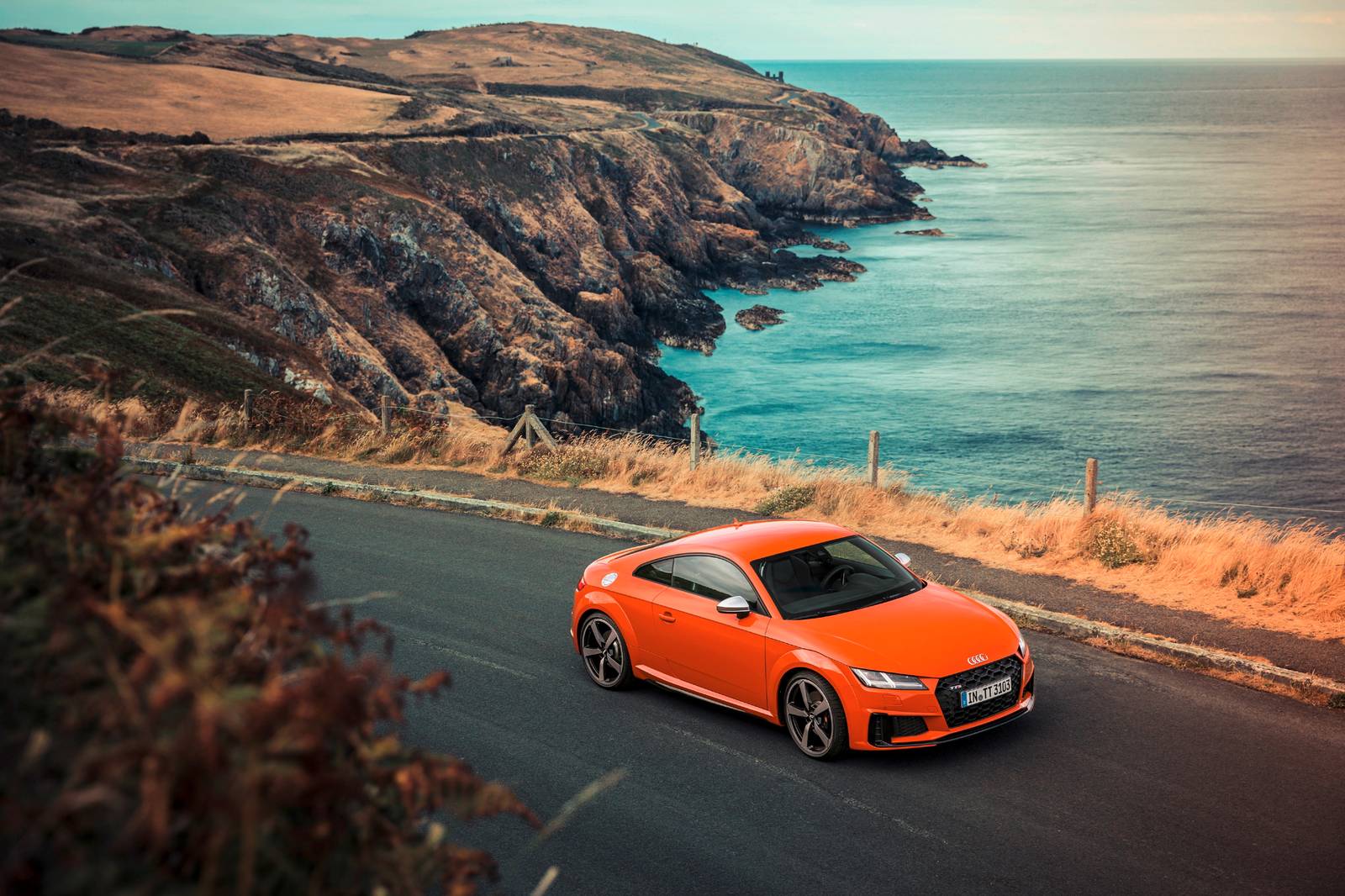
Both the Audi TTS and the MX-5 Miata RF we will be looking at here have exterior design elements that can be traced back to their respective first generations. The third-gen Audi TT differed from the original due to an evolution of the design language for the third to keep consistency with other Audi models. The TTS and the base TT don’t look all that different but for some sportier flares to denote the extra performance. The MX-5 Miata RF also follows the same design language that defined Miatas of old up to the A-pillar, but with the new Targa-style roof, things have been changed up slightly.
The design of the fourth and current generation of the Miata didn’t receive universal acclaim when it launched because, as you can see, it has a slightly scowling facial expression at the front end. However, the Japanese ‘Kodo’ design themes remain throughout, defined by swooping lines and a long bonnet that belies the car’s small size.
The exterior design of the RF is perhaps the biggest change over the standard Miata. Previous generations might have offered a metal folding roof as well as a traditional soft-top, but the fast-back look of this RF gives it its own unique identity. This is not lost when the roof is stowed, either, as the rear buttresses are fixed, giving it a decidedly targa-top design.
As mentioned already, the third-generation Audi TT continues with the design language that debuted on the original from the 90s. This means a sleek profile, dramatic sloping roofline with a wide grille, and large fenders. It is a design that can turn heads even though there is not all that much to it.
If we turn our attention to the TTS, its design does not shout about its extra performance over the base model, which confirms it as a champion of understatement. It has the same sharp lines, crisp daytime running lights as well as the hexagonal front grille that defined the mid to late 2010s Audi design language. For the TTS, Audi merely added silver door mirror caps, larger intakes at the front and a more aggressive diffuser stye rear bumper.
Fun-to-drive is the defining aspect of the Mazda Miata, but some alternatives scratch the same itch.
Even though raw grunt is not as essential in a sports car as it is in, say, a muscle car, it is still important to explore what is under the hood of these two cars and the performance that results.
The MX-5 Miata RF has the same naturally aspirated 2.0-liter four-cylinder engine, producing 181 hp and 151 lb-ft of torque, that any other Miata has. It sends its power exclusively to the rear wheels via a six-speed manual transmission, or if you so desire, a six-speed automatic transmission. Zero to 60 mph takes just over five and a half seconds, but this is as much to do with the Miata’s lightness as anything else, and this is still two tenths slower to 60 than even the base Audi TT.
While the Audi TTS does have a 2.0-liter turbo-four engine just like the base model, it received a whole host of upgrades to give it a load of extra power. These include a bigger turbocharger, a beefier intercooler and a different ECU tune, which, all in all, give the TTS 72 hp and 22 lb-ft more than standard. While the Mazda is not exactly slow, it does have a fairly large performance gap to make up in the corners compared to the Audi, as the TTS will get to 60 mph more than a whole second faster than the Mazda.
Performance Specs
2023 Audi TTS
2025 Mazda MX-5 Miata RF
Horsepower
292 hp
181hp
Torque
280 lb-ft
151 lb-ft
0–60
4.6
5.7
Top Speed
155 mph
137 mph
On the road, one would normally expect the Mazda to be far superior to any Audi TT. Given its smaller size and weight, it is understandable to worry about 100 pounds of extra weight the roof mechanism adds to the top of the car. It is still far lighter than most sports cars, however, including the TT, and you can tell this when pushing, as the MX-5 Miata RF feels as communicative and responsive as you would expect. Perhaps the best thing about the Miata is that you can have all this excitement without straying too far over the speed limit.
“It revs high, it sounds great, and because there are no turbos, the throttle response is snappy. Combine that with a positive-feeling six-speed manual with a snappy shift action – honestly, unless you’re medically declared unable to drive a manual, you shouldn’t even consider the automatic – and it’s sublime.”
– Adam Lynton, CarBuzz Road Tester, on driving the Mazda MX-5 Miata RF
The Audi TTS tips the scales at a whole 900 pounds more than the Mazda, so it is a good thing it has more power to haul all that extra weight around. The TTS has more than power up its sleeve to help its performance case, however, as it has Audi’s quattro all-wheel-drive system sending its power to all four corners and bigger brakes than standard to haul off the extra speed. Everything from the steering and transmission to the suspension and the stability control has multiple settings, allowing you to find the configuration that works for you. The TTS is a sports car that will do everything you ask of it when you drive it like one, but it lacks that final level of communication the Miata has that some drivers crave. It would, however, work better as a grand tourer than the Mazda.
Because the Miata is such an iconic sports car, a certain Italian carmaker wanted to copy the recipe, but with a twist.
The space and amenities the interior of a sports car provides can often go some way to determining whether you can use it every day, or if it is limited to only being a weekend toy. In the case of the Miata, the latter has always been true, and this is no different with the RF. For most adults, the interior of the MX-5 will feel snug, but for those over six feet tall, it will feel like a real squeeze fitting in. The roof opening does provide some fresh air but not as much as the soft top due to those fixed rear buttresses.
Once you’re in, however, you will notice that the quality of the materials is improved if you’re used to a Maita of old, and there are all the convenience features you’d expect on a brand-new car, with adaptive cruise control being a new addition since 2024. The only meaningful space for cargo, however, is in the trunk behind the seats, and it comes at a massive premium.
The inside of the TTS is where it really makes the best case for itself, both because of the quality and the cargo space on offer. The seats are more plush than those in the Mazda, and it feels less cramped overall. This is partly because in the hard-top TTS, there is actually a second row of seats. But while they can only comfortably seat a child, tthey make for useful cargo space outside of the trunk. The trunk alone is also bigger than that of the Mazda.
The design of the cabin is chic and timeless, largely thanks to it being one of the last new cars to be sold without a large central infotainment screen. All the navigation, media controls and even Apple CarPlay can be accessed on the large driver display behind the steering wheel. The rest of the interior is of the usual Audi quality, which means all the materials are that bit more premium than they are in the Mazda.
Audi has confirmed it will build the Concept C sports coupe, but there’s no contingency for a gas model.
When comparing the pricing of both the latest version of the Audi TTS and the Mazda MX-5 Miata, we have to remember that we are comparing a car that is available to buy new to one that is only available on the used market. If you simply have to have a brand-new car that you can spec up to your exact liking and has never been kept by another person, the Mazda is the only option. It is definitely the more expensive option, however, as the Miata RF starts at $37,850 for the Grand Touring trim. The Club trim is even dearer, starting at $41,150.
It is hard not to see the Audi TTS as a better value proposition, given that you can have a TTS made after its one and only 2019 facelift with a little over 50,000 miles on the clock for as little as $35,000. You will also not have to skimp on equipment either, as it will have heated seats, keyless entry, and even a Bang and Olufsen sound system. The third-generation TT is also thankfully more reliable than the previous one, but just check that there are no ailments with the virtual cockpit system and be prepared to pay the extra servicing costs the TTS demands over a base TT.
Two cars, one platform. However, the 2015 S3 and Golf R differ in character, everyday usability, and value in the used market.
The Audi TTS and the Mazda MX-5 Miata RF are both small, front-engined four-cylinder sports cars, but this is about where the similarities between the two of them end. We have appreciated the different ways that Audi and Mazda have gone about making their most iconic sports car, and how that applies to the most recent, most similar iterations of the two. But which one will you be most satisfied with?
A lot of this depends on what is most important to you. Do you only want to buy a new car? Buy the Mazda. Do you want the most space and luxury possible? Buy the Audi. You should also buy the Audi if out-and-out performance is the most important thing for you. But if all that matters is the wind in your hair and maximum driving pleasure, the Mazda, even in this slightly different RF guise, is the one to go for. Driving pleasure is, after all, the main thing someone buys a sports car for.
Sources: Mazda, Audi
Related Article