Honda’s mini camper
Last November, as we toured Honda’s R&D studios in Torrance, California, we were promised a look at a vehicle unlike any that Honda has ever produced. For an OEM that has produced everything from race cars to motorcycles to Kei cars to trucks, that’s quite a statement.
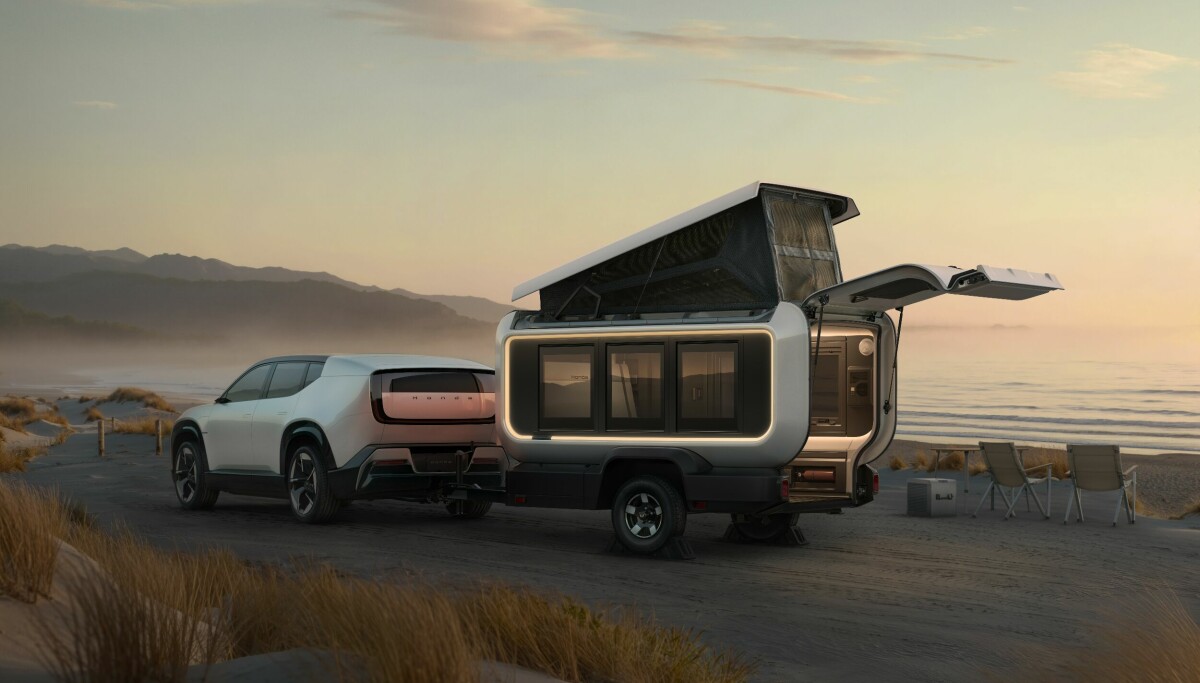
We were invited to step behind a screen to attend the reveal, watched as a drape was removed and revealed a compact camper, the Base Station. Conceived as a lightweight mini-camper that can be parked in a standard residential garage, or in a traditional parking space, the Base Station reflects Honda’s design philosophy, “Man Maximum/Machine Minimum.”
The rectangular shell is accessed through the top-hinged rear door. Inside is a basic rectangular room, with a futon-like couch that folds down to make a queen-sized bed. A kids bunk bed will be available to expand the sleeping area. The roof of the Base Station pops up to create 7 feet (2.1 meters) of head room. Five modular windows allow a lot of light inside, and the LED light that rings them lights up a campsite.
Honda noted that all manner of modular elements, such as a external kitchen, external shower and air conditioner extend the basic “Station” to engage its surroundings to create a home that embraces the outdoors, even if that engagement is just temporary.
Honda has serious competition in this space and knew it could not just replicate the cute and curvy of its competitors from brands like Scamp, Taxa, Little Guy, and the grandaddy of them all, Airstream. Retro design rules in this class of tiny campers, as all the 1930/1940s curves fit in with the “so cute” vibe. Even Airstream couldn’t resist with its Basecamp 16X (notice the similarity of the names).
Honda took a different path with an updated rectangular architecture, combined with modular components like bunkbeds, kitchen units, storage and the like. If the competition speaks of nostalgia, Honda’s entry into this space is more modular and plug-in, more in tune with the personal computer/laptop age, where a base machine accommodates all manner of peripherals.
Modern-day technology dominates in the Base Station, with LED lighting, Lithium-ion batteries and induction cooktops among the many features of the deceptively simple, lightweight design, which Honda engineers targeted at a maximum weight of 1400 pounds (635 kilograms). If this tech seems well-established and anodyne, consider that some competitors are twice as heavy or rely on lead-acid batteries and decades-old styling and tech. RVs and campers are sold in a very conservative market, at least in the U.S.- there’s not much incentive to innovate – the customers tend to be older and more familiar with 20th century tech.
Which brings us to marketing and selling the Base Station. We asked if Honda would sell this through the traditional Honda dealership system, or have dedicated “stores” (like Tesla or Rivian), or through RV dealers. We were told that decision has not been finalised. But it is a critical decision, one that could mean the difference between success and failure.
Still, the time seems right for the Base Station. Its modular approach seems congruent with simpler approach to vehicle design. Witness the Slate truck, which is similarly modular in its approach to design, with all sorts of snap-on add-ons to customise a very basic package.
Do these vehicles signal a return to simpler, modular design language? It’s too early to extrapolate from only two examples, but there seems enormous potential here. Whatever happens in the larger design world, we certainly wish the Base Station every success.
Experimental all-terrain motorhome, the Hymer VisionVenture, makes the American RV recipe look even more stale
Related Article