If you’ve driven a modern car, you’re almost certainly experienced the tech that gently nudges you back into a lane, automatically tries to avoid a crash, or performs some base-level self-steering. Motorcycles don’t have that tech, but Honda wants to change that. One of Honda’s newest motorcycle patents calls for a system that would make a motorcycle automatically dodge a danger, just like a car. It’s fascinating – and maybe a little bit scary.
This news comes to us from our friends at RideApart, and it’s another interesting example of how motorcycle safety technology sometimes lags behind cars. In 2020, BMW announced radar-based active cruise control on its R 1250 RT touring bike. A year later, I tested the same system on the R 18 Transcontinental, and it was mind-blowing as the system works just like the radar cruise that’s been in cars for more than two decades, but tailored to bikes.
Over here in America, it was big news when Indian Motorcycle introduced blind spot monitoring, tailgate warning, and a rear collision warning. That hit the market only this year! Even my lowly Smart Fortwo had a collision warning in 2016, and much fancier cars have had the tech for more than two decades. Until most recently, some of the more advanced motorcycle tech has involved cornering ABS, cornering traction control, wheelie control, riding modes, and the aforementioned safety tech.
You’ve probably noticed that none of the above technologies actively intervene with your motorcycle’s steering. All of the above tech won’t do much to stop you from wiping out into the back of a car, or stop you from accidentally changing lanes into a car. Motorcycle companies have been toying with the idea of self-balancing and self-riding motorcycles for some time, but usually, these ideas never go further than wild concepts. That’s why Honda’s new patent caught my attention. While the idea of a self-riding motorcycle is something teased at seemingly every futuristic motorcycle show, Honda’s invention seems somewhat realistic.
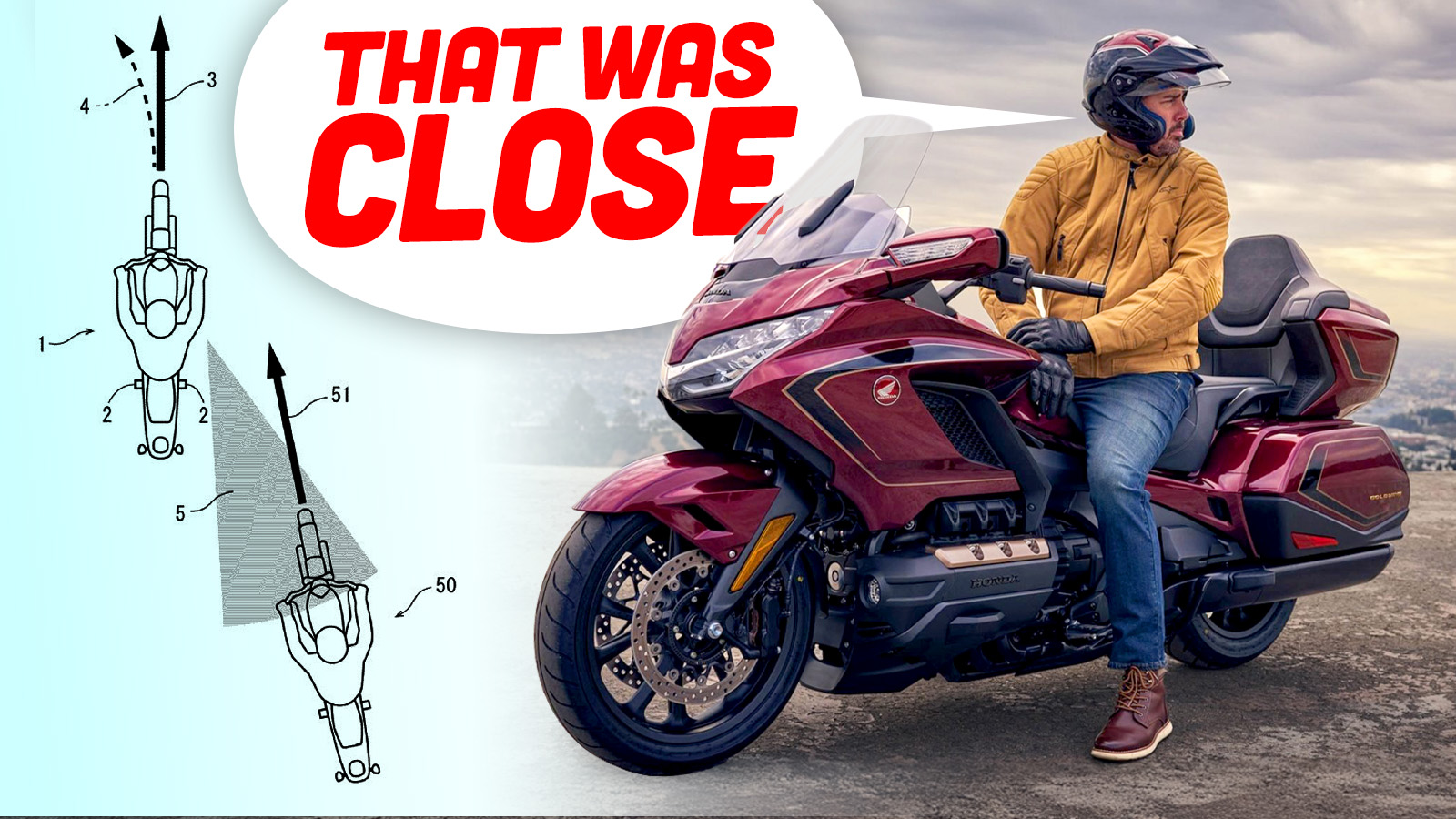
To oversimplify, Honda has developed a camera-based monitoring system that detects what’s going on in the motorcycle’s blind spot. If the system detects a vehicle is on a collision course with the motorcycle, the system will use an actuator to automatically steer the motorcycle out of the path of danger.
The abstract of the patent goes deeper:
Provided is a steering control device for motorcycle, capable of executing steering control appropriate for a characteristic of a motorcycle. The steering control device for motorcycle comprises: an imaging unit (2) which captures the outside of an own vehicle (1); a blind spot recognition unit (8) which recognizes that another vehicle (50) is approaching from a blind spot (5) of the own vehicle (1) on the basis of information from the imaging unit (2); and a steering-device control unit (10) which carries out steering control on the basis of information from the blind spot recognition unit (8), wherein the steering-device control unit (10) carries out the steering control to avoid the other vehicle (50) according to a riding state of the own vehicle (1). The riding state of the own vehicle (1) includes a path change operation, an acceleration operation, and a deceleration operation of a rider and the steering-device control unit (10) changes an intervention amount of the steering control according to the path change operation, the acceleration operation, and the deceleration operation of the rider.
Honda says the device works through a multi-step process. First, the blind spot monitoring system detects that there’s a vehicle closing in on the motorcycle. Then, it issues either a visual or an audible warning to the rider. This part is no different than the system that Indian has for its motorcycles.
Where Honda goes further is what happens after this. A system that only warns you of hazards has no way of intervening if you either do not see the warnings or do not act on them. Honda’s proposed system monitors steering, acceleration, and braking. The system apparently can determine if you’re reacting to the closing vehicle. If you start avoiding the vehicle yourself, the system can add steering assist to amplify your reaction.
Should you do nothing at all, the system would automatically ease you into a turn to avoid the obstacle. Apparently, the goal is to do this gradually in the hopes of not upsetting the rider or destabilizing the bike and thus causing a crash.
From the patent:
FIG. 3 is a flowchart illustrating a procedure of approach avoidance controls according to a preferred embodiment of the present disclosure. In step S 1, the host vehicle 1 is traveling as normal. In step S 2, the other vehicle 50 having entered the blind spot 5 is detected. In step S 3, the blind spot recognizer 8 determines whether or not the other vehicle 50 that has entered the blind spot 5 is approaching, and when an affirmative determination is made, the procedure proceeds to step S 4. In step S 4, an approach alert is issued by a display on a meter, a buzzer sound, or the like. When a negative determination is made in step S 3, the procedure returns to step S 1.
In step S 5, whether or not the rider has performed an avoidance operation is determined, and when an affirmative determination is made, the procedure returns to step S 1. As described above, the presence or absence of the avoidance operation is determined based on output signals from the piloting torque sensor 15, the throttle opening degree sensor 6, and the brake pressure sensor 7. In contrast, when a negative determination is made in step S 5, that is, in a case in which the rider has failed to perform the avoidance operation when the other vehicle 50 that has entered the blind spot 5 approaches the host vehicle 1, the procedure proceeds to step S 6, and whether or not piloting (turn) control intervention is possible is determined. In a case in which an affirmative determination is made in step S 5, turning control can be immediately executed with a maximum target torque.
When an affirmative determination is made in step S 6, the process proceeds to step S 7, and a piloting intervention is executed by the turn device controller 10. In the preferred embodiment of the present disclosure, in this piloting intervention, control that reduces the initial intervention amount of turning control and gradually increases the piloting torque is executed. In contrast, when a negative determination is made in step S 6, that is, when it is determined that piloting control intervention is not possible, the process returns to step S 1. In step S 8, whether or not the piloting control can be continued is determined, and when an affirmative determination is made, the procedure returns to step S 7. In contrast, when a negative determination is made in step S 8, that is, when it is determined that the piloting control cannot be continued due to a change to the target course for avoiding the other vehicle 50 being completed or the like, the process proceeds to step S 9 to release the piloting control and end the procedure of approach avoidance controls.
I like that this isn’t just a car system. Honda seems to know that it can’t have a system that just jerks the handlebars, because that would scare the rider and might make the situation worse.
You might be wondering how exactly this system works with countersteering, and what happens if the rider isn’t paying attention. Honda doesn’t mention countersteering at all, but does say maximum torque is not applied to the handlebars until the system detects that the rider is paying attention and is ready to execute an evasive maneuver. Otherwise, the system is supposed to gently attempt to initiate a turn with the hope that you’ll notice, not freak out, and be prepared for the turn.
The part of me that loves fresh technology is impressed. Making an active collision avoidance system for a motorcycle brings its own challenges. It has to be aggressive enough to be effective, but not so hard that it throws the rider from the bike. It has to do its job while keeping only two contact patches still on the road. Assuming this technology could be used in the real world, a motorcycle that can avoid crashes by itself might have the potential to save some lives.
It also makes some sense that Honda has even explored this technology. The Insurance Institute for Highway Safety says that, per an examination of fatal crashes involving 65 motorcycle models with ABS from 2013 to 2019, motorcycles with ABS were involved in about 22 percent fewer fatal crashes. Advancements in motorcycle safety technology have made our passion a bit safer.
IIHS also says that technologies like automatic emergency braking can reduce rear-end car crashes by 50 percent, while lane departure warnings can reduce single-vehicle, head-on, and sideswipe crashes by 11 percent. Maybe implementing similar technologies into motorcycles could have a positive effect?
I suppose one day we might find out, but it’s one idea that I’m not sure motorcyclists will be rushing to sign up for. A lot of motorcyclists don’t like the fact that some new bikes are full of buttons, screens, and technology. Plenty of motorcyclists, myself included, love the simpler kind of motorcycling where it’s just you and your machine, not a million computers. Your brain is your traction control, and your eyes are your collision avoidance. I’ve even heard some bikers say that if you’re going to surround yourself in car-like tech, you might as well just drive a car. How many of these motorcyclists will accept a bike with built-in steering intervention?
Some folks might also wonder if technologies like this could lead to complacency. Motorcycle training classes give you the tools to stay alive and to be a better rider. You learn how to always be scanning for an emergency exit and to always watch your surroundings. Riding a bike and flying a small plane have something in common in that having good situational awareness can very much save your life. Will there be riders who rely too heavily on tech to save them rather than their training?
I think that is a fair question. Sadly, we’ve seen how people are misusing driver assistance technology in their cars. Some folks watch videos, eat meals, scroll social media, and even read books while completely trusting their car’s tech to keep them out of trouble.
All of this is impossible to say for now. Also, it’s entirely possible, likely even, that this patent goes nowhere. The patent does suggest that Honda has been working on this technology since at least 2021, so it’s probably not a patent that was submitted just for the sake of patent work. But there’s also no indication that Honda is going to have a self-steering motorcycle anytime soon.
Still, I find it so fascinating. Here we are in an age where there are pickup trucks with hands-free cruise control systems that can change lanes and tow trailers. Yet, motorcycles are beginning to flirt with tech that cars have had for years. Will you eventually be able to buy a Honda that can avoid a crash by itself? I’m not sure, and I don’t know how many people would even want to buy it, but it’s still awesome that some inventor somewhere actively thought this out.
Top graphic images: Honda: USPTO
Follow us on:
Google News
MSN News
Apple News+
I’m trying to have an open mind. I remember being skeptical of radar cruise and blind spot monitoring. While I still don’t trust these systems, I can’t think of a time they’ve messed up so who knows, maybe this could work.
What I WOULD pay money for today is a system that can detect when I initiate a panic stop, calculate the stopping force needed, and control the brake pressure.
(For those unfamiliar, you cant/shouldn’t just grab the brake handle. You need to first use moderate braking to shift the weight over the front wheel so it can handle the full force. Otherwise you’ll either lock it up or ABS will come in too soon and extend your stopping distance. Sure you can (and should) practice, but it’s impossible to know how you’ll respond when your response matters most. An instructor told me a lot of fatal accidents involve the rider applying only rear brakes. I guess ppl reflexively only use their foot in panic situations. Point being, this is the sort of thing a
reliable system could do better and more consistently than a human.)
1 – Tesla’s aside, being run down from a cager in my blindspot is much less of a risk than a cager turning left in front of me.
2 – slowing/stopping at intersections is where bikes are at greatest risk of being rear-ended. this system would have done nothing the 3 times i’ve been rear- ended on motorcycles in these circumstances.
3 – this addresses an infrequent corner case in a way that a rider will naturally react against (much as i would if a wind gust blows the bike from where i intend it to be positioned in the lane).
They’ll need to add a bidet.
These are the ppl who added heating ducts and airbags to motorcycles. DO NOT underestimate them.
Not being a motorcycle man myself perhaps someone can answer a question. I know on a bicycle turns above a slow speed are done by leaning not the steering. I can’t imagine going 60mph and having the motorcycle just turn the wheel without flying over said handlebars. In fact I did it knowing full well what I was doing and it ended badly. Also once on a moped I hit a pothole and did an immaculate double flip over the handlebars and slid face first on the landing and miraculously didn’t hurt myself at all. No thanks for the motorcycle or the surprise steering technology
Turning is leaning and leaning is turning. To lean/turn the bike left, you steer the wheels out from underneath you to the right so you have a reaction point to push the bike to the left, but the bars eventually are turned to the left while you’re going left. It’s the same for all 2-wheeled vehicles (and oddly, sort-of snowboarding, skateboarding, etc) but most aren’t aware that they’re doing it.
No. I don’t even trust this stuff in a cage with inherent balance. If it can only gently nudge the bars in the hope that the rider will notice and then react appropriately (that’s a huge assumption even with training, but untrained or trained long ago? Good luck), then it probably isn’t going to be enough to avoid an actual collision event, as those are likely to happen too quickly. It’s similar to what I argued to a state inspection tech about the horn—if I have time to hit the horn, which might not do shit to prevent anything and might even cause someone to panic in alarm, then it wasn’t that much of an emergency. In a real emergency, I need to react to avoid the situation through operating the vehicle controls. Expressing anger or frustration afterwards through a loud blast is not a safety issue. So after going home and wiring in a working horn button, I was able to pass inspection. Anyway, dumb anecdote and my complete distrust in the efficacy of these systems backed up by the litany of failures and false positives experienced in cars aside, I don’t see how this could engage a meaningful and proper emergency response without the motorcycle being self-stabilizing. Even worse, if that’s what’s required to make it work properly and it does come to market, I wonder how long it will be until that system is either outright or effectively made mandatory for all motorcycles. If I was a motorcyclist, the simplicity and connection through balancing myself would be big parts of the appeal. If I cared so much about safety, I wouldn’t be riding.
Agreed however the importance of the horn is to get the other drivers attention so he looks at you and can see you flipping him the bird.
Yeah, but I feel that’s not really a safety issue and the horn is a safety requirement. They didn’t buy that, though. It was the aftermarket steering wheel I put on that had a horn button that barely worked before eventually shorting out, so I disconnected it. Ended up just wiring a momentary switch onto the column. Wasn’t terribly ergonomic, but it just had to work.
It’s reminiscent of accidents involving automated systems on airliners that took precedence and surprised pilots who, instinctively, tried to counterbalance them.
On a two-wheeled vehicle, Honda seems frankly ambitious to prejudge the driver’s behavior.
Is ABS saving motorcyclists, or is there a bit of selection bias for motorcycles which have ABS (if stats fall back to 2013) would have been ridden by more experienced & mature riders.
All I know is that police forces that use motorcycles prefer ABS.
One panicked squeeze of the front brake means you’re going down unless you’re going perfectly straight. ABS saves a lot of crashes but probably doesn’t do much for the cause of most really dangerous crashes: squids being squids, and cars turning left 50ft in front of a bike doing 60mph.
I’m all for innovation, but I don’t see this going anywhere. I don’t want my bike steering into a hazard it doesn’t detect just because a fellow rider is coming in hot. The liability in those scenarios seems huge. I like the 6-axis IMU on my MT-10, but I don’t want to give a computer control over my steering.
Yeah, that was my other concern. Will the system know not to, you know, steer you into more danger while trying to avoid another?
© 2025 The Autopian. All Rights Reserved. Design by Jazel.
Related Article