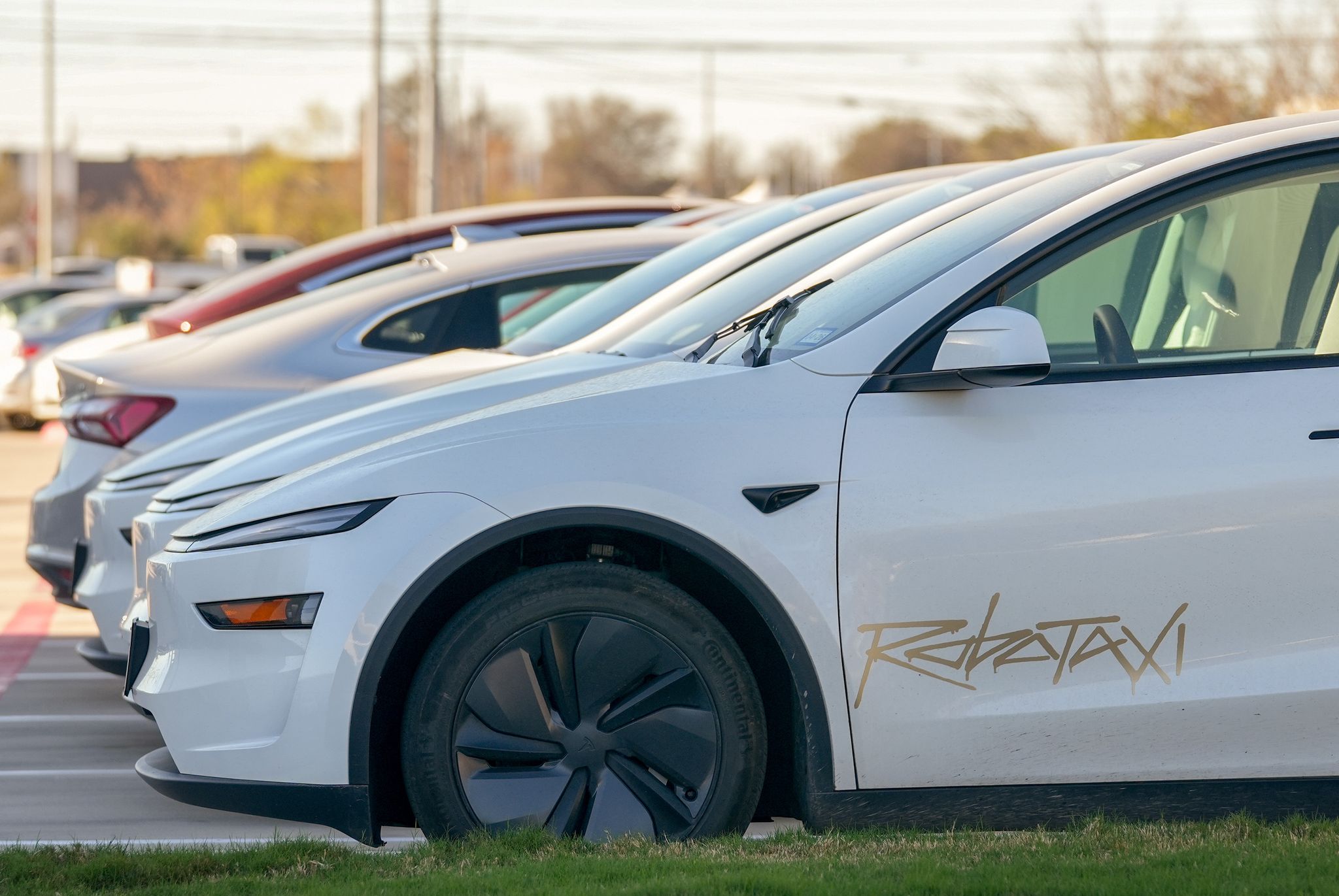
New Tesla Model Y electric cars, some with Robotaxi markings, are parked on a lot in southeast Austin on Jan. 2, 2026. Austin has emerged as a major testing ground for autonomous vehicle technology amid a broader federal debate over regulation.
A U.S. House of Representatives committee hearing could have ramifications for how Texas regulates and oversees autonomous vehicle deployment.
The House Energy and Commerce subcommittee will consider several draft proposals Tuesday, with some members aiming to ban states from setting rules for AVs and others looking to ease exemption requirements.
Advertisement
Article continues below this ad
The discussion comes as driverless robotaxi testing and deployment expands nationwide, with Austin as a major launching pad. Automakers have urged Congress for years to make those deployments easier, with pressure intensifying in recent months.
Waymo, operated by Google parent Alphabet Inc., and Austin-based Tesla Inc. both launched driverless ride-share services last year in Austin. Waymo, the industry leader, operates in four other major U.S. cities with plans to enter more markets this year, including Dallas and San Antonio. Tesla has limited operations in the San Francisco Bay Area and is undergoing regulatory approvals in Arizona, Florida and Nevada.
Amazon’s Zoox, Austin-based Avride and Volkswagen’s ADMT are currently testing in Austin as well.
Safety advocates and some state lawmakers have called for stricter guardrails on deployment and for mandating human supervision during testing. Most companies test vehicles with human drivers before full commercial service, though some Tesla robotaxis still use safety monitors in the front passenger seat, despite CEO Elon Musk’s earlier claim that all such monitors would be removed by the end of 2025.
Advertisement
Article continues below this ad
Any easing of federal autonomous vehicle regulations could have long-term implications for how Texas navigates the emerging sector, particularly as Austin’s robotaxi operations face increased scrutiny over safety concerns.
Congress has long been divided over autonomous vehicle regulation, slowing deployment and leaving the federal government without strict guidelines. Michael Brooks, executive director of the Center for Auto Safety, said that for now the federal government is limited to enforcing recall and exemption laws because there is no federal framework to regulate autonomous vehicles.
For the past year, Washington has said it would consider new regulations, with U.S. Transportation Secretary Sean Duffy saying last April that a new department framework to boost AVs is necessary to help the country compete with Chinese rivals.
Advertisement
Article continues below this ad
In June, major automakers including Tesla called for the Trump administration to make necessary regulatory changes faster. Tuesday’s hearing will see lawmakers consider proposals to establish those regulations, but Brooks said they fall short of the standards applied to other vehicle safety requirements.
One proposed bill would raise the National Highway Traffic Safety Administration’s annual exemption cap from 2,500 vehicles per automaker to 90,000. The exemptions allow automakers to deploy vehicles on a limited basis without meeting certain safety standards — such as requirements for steering wheels or pedals — if they can demonstrate the vehicles are safe. The agency has approved few exemption requests so far.
One bill would remove rearview mirror and steering wheel requirements for driverless robotaxis, reflecting automaker suggestions that those features are unnecessary. Another proposal would bar states from setting rules for autonomous driving systems and self-driving vehicles altogether.
“The states wouldn’t be able to regulate autonomous vehicles. The federal government is not regulating autonomous vehicles,” Brooks said. “At that point, the only backstop for consumer protection is the courts. And there’s even language in proposed bills that would bring into question the ability of consumers to access the civil justice system. It’s all highly problematic.”
Advertisement
Article continues below this ad
Waymo autonomous vehicles are seen charging at a facility in Southeast Austin on Nov. 19, 2025. On Tuesday, a U.S. House subcommittee is scheduled to consider legislation that could reshape how autonomous vehicles are regulated nationwide.
During the previous legislative session, Texas revised its 2017 framework governing AV operations.
Although the new regulations took effect Sept. 1, the authorization process will not be enforceable until May 28, according to Texas Department of Motor Vehicles spokesman Adam Shaivitz. Beginning that date, AV operators will be required to obtain TxDMV authorization to operate commercially on Texas roads.
Advertisement
Article continues below this ad
To obtain approval, operators must show that their vehicles:
The new law relaxed aspects of the 2017 framework, removing much of municipalities’ ability to regulate AVs within city or county limits.
Even that limited state control could be eroded by the federal regulations now under consideration.
Advertisement
Article continues below this ad
“The preemption language of the bills that are proposed is so broad that it's hard to say that it wouldn't touch on virtually any state trying to regulate any aspect of autonomous vehicle impacts,” Brooks said. “The language is so broad and vague in many ways that it raises the question of whether states will be able to enforce any of their laws, including traffic laws, against autonomous vehicle companies.”
As self-driving technology evolves, many automakers have argued that autonomous vehicles are central to a safer future. Industry reports, including one commissioned by Waymo, have found that autonomous vehicles are involved in fewer serious crashes than other vehicles.
RELATED: Waymo releases safety report, says its Austin robotaxis had 81% fewer injury crashes than human drivers
Advertisement
Article continues below this ad
But critics argue the technology is not ready for widespread deployment and that bypassing regulatory steps set by states and the National Highway Traffic Safety Administration could lead to traffic violations and potentially life-threatening crashes.
NHTSA has opened a number of investigations in self-driving vehicles operated by Waymo, Tesla and Zoox. Waymo most recently came under fire after an Austin ISD investigation found that the self-driving robotaxis illegally passed Austin school buses more than 20 times between August and December.
A Tesla Cybercab is tested on Guadalupe Street in Austin, Monday, Jan. 5, 2026. The purpose-built robotaxi was unveiled in 2024 as a fully autonomous vehicle.
Tesla’s first AV-related probe came after videos online circulated showing the company’s robotaxis driving erratically and violating traffic laws shortly after launching in Austin. The company’s other probes focus on its Full Self-Driving technology updates, now available in all Tesla vehicles. The company has also recently been targeted by other auto safety bills, like one introduced by U.S. Rep. Robin Kelly (D-Illinois), which would require Tesla to modify the design of its door handles.
Advertisement
Article continues below this ad
The Austin-based automaker is beginning production of its new two-seat driverless robotaxi, the Cybercab. A prototype of the pedal-less, wheel-less AV has been spotted on Austin streets at night, including the MoPac Expressway, officially known as Loop 1.
More automakers are looking to jump on the AV train. Mercedes-Benz said last week it plans to launch a new advanced driver-assistance system in the U.S. later this year, software that would allow its vehicles to operate autonomously on city streets under driver supervision.
Karoline Leonard joined the Austin American-Statesman in November 2024. Leonard graduated from The University of Oklahoma in May 2024, where she worked in student media as a reporter and news editor and later served as editor-in-chief of OU Daily. She previously interned at the Tulsa World and BusinessDen via the Dow Jones News Fund business reporting program. Leonard hopes that through her reporting she can hold those in power in the technology industry accountable while also making tech news accessible to all readers. She encourages anyone with story ideas, tips or feedback to reach out to her via email.
About
Contact
Services
Account
Related Article