News
Reviews
Buyer's Guide
Events
Ask MOTORTREND
With 2025 behind us, it’s time to look at the best, most important, and most interesting new cars of the year.
Automakers had a busy 2025. From hybrids and EVs to roaring V-8s, the industry delivered a wide range of vehicle debuts that could excite just about anyone. While many automakers continue to move away from sedans, others are rolling out new sports cars to keep enthusiasts interested. One thing remains clear: SUVs and crossovers are still the vehicles of choice for many consumers. Here are the best, most important, and most interesting vehicle debuts of 2025, in no particular order.
The Toyota GR GT is the road-legal sports car version of the GR GT3 race car, and it’s powered by a 4.0-liter twin-turbo V-8 paired with an electric motor. Output will be at least 641 hp and 627 lb-ft of torque. Toyota hasn’t announced when the GR GT will go on sale, but a select number of U.S. Lexus dealers that meet Gazoo Racing (GR) sales and service requirements will receive limited allocations. We can’t wait to get behind the wheel.
Pay for what you want. That’s Slate’s mindset with the 2027 Slate Truck, a small all-electric pickup expected to go on sale for $27,000 to $30,000. With a minimalist design and the option to add comfort features or keep it bare bones, the Slate Truck can even be converted into a two-door SUV for those who need a larger enclosed cabin.
Believe it or not, this is Nissan’s first hybrid vehicle in ages in the U.S. It took the automaker a long time to bring it to market, and while the current generation won’t be around much longer, it finally gives Nissan a hybrid option in a key segment to compete with the Toyota RAV4, Honda CR-V, and Kia Sportage. Like its Mitsubishi Outlander cousin, this plug-in hybrid Rogue adds a third row, a notable departure from the non-hybrid, two-row Rogue.
The 2027 Mercedes-Benz GLB will be offered as both an EV and a hybrid when it goes on sale in the U.S. in late 2026. Sharing its platform with the new CLA, the GLB will be available with front-, rear-, or all-wheel drive, depending on the powertrain. Output will range from 268 to 349 horsepower for all-electric models, while the hybrid will produce around 208 hp.
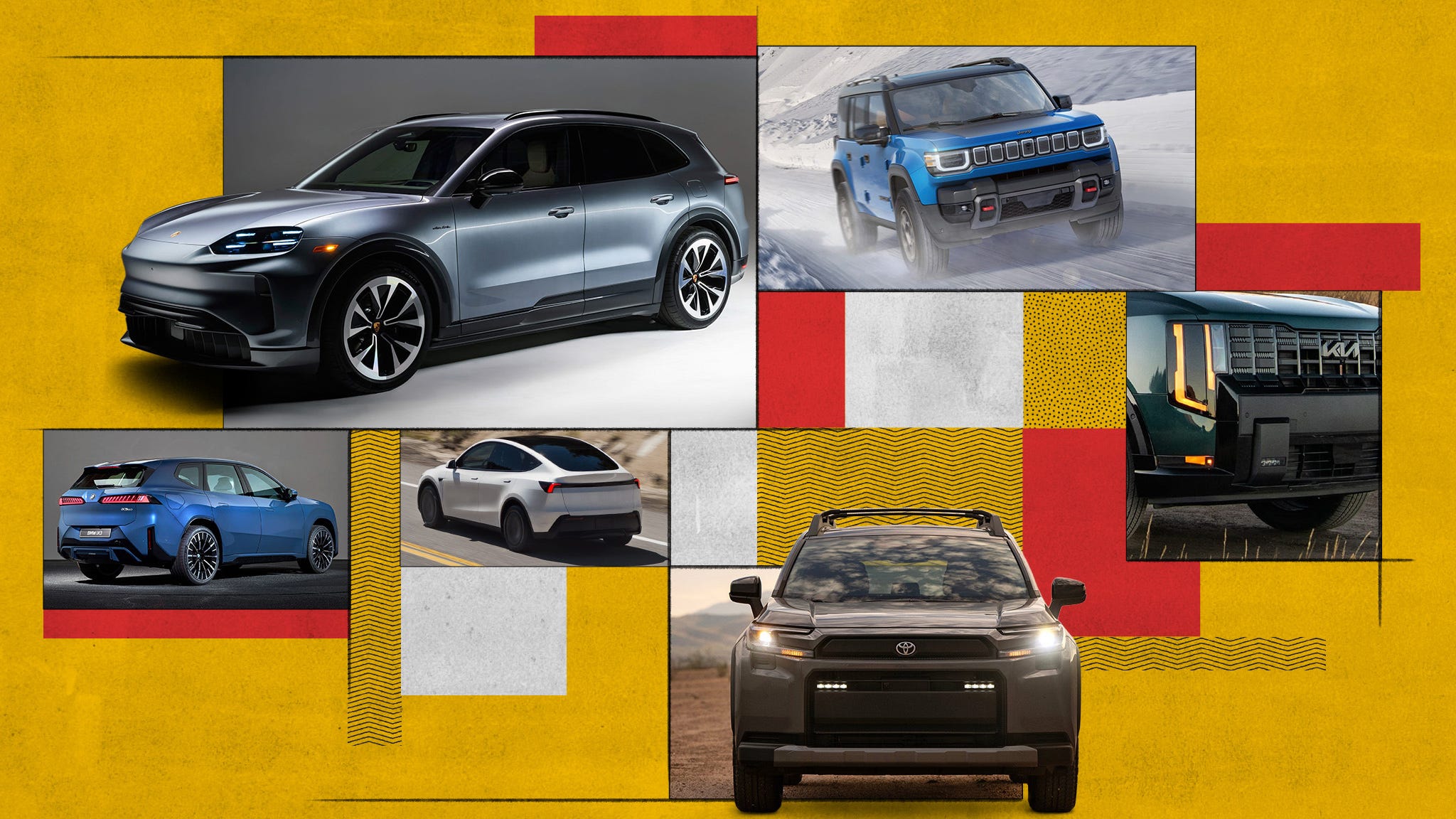
One of Kia’s most popular models is entering its second generation with a styling update that recalls the Range Rover. Along with a more upscale cabin and major tech upgrades, the Telluride gains its first hybrid powertrain, rated at 329 hp. The downside? The V-6 is gone, replaced by a turbo-four base engine producing 274 hp.
America’s bestselling SUV is going all-hybrid. The RAV4 drops its gas-only engine in favor of new hybrid powertrains, along with fresh styling and a first-ever GR variant. Toyota has stuck to its promise to prioritize hybrids over EVs, and so far, it’s paying off. The RAV4 becomes the eighth hybrid-only vehicle in Toyota’s U.S. lineup.
After rolling out major updates to the Model Y and Model 3, Tesla introduced budget-friendly versions of its two most popular models. The Model Y Standard is easy to spot thanks to the missing front and rear lightbars, while the Model 3 Standard rides on new 18-inch Prismata wheels. Both Standard trims are rear-wheel drive, and in addition to losing some comfort features, their glass roofs are replaced by a conventional headliner.
The CX-5 is Mazda’s most important model globally, so expectations were high when the new generation was announced. The 2026 CX-5 is significantly larger and replaces its physical buttons with a large touchscreen, but Mazda chose to stick with its aging 187-hp 2.5-liter naturally aspirated inline-four. While the automaker is developing its own hybrid powertrain, it isn’t expected to arrive until 2027.
BMW’s long-awaited Neue Klasse architecture finally arrives in the iX3, an all-electric two-row SUV roughly the size of an X3. BMW says 400-kW charging can take the battery from 10 to 80 percent in just 21 minutes, and EPA range is expected to land around 400 miles. Its “Heart of Joy” central computer unit was developed in-house by BMW engineers and removes a lot of complexities common to modern vehicles.
Porsche’s newest EV isn’t just blisteringly quick, it’s also loaded with cutting-edge tech and serious range. When it arrives in 2026, the Cayenne Electric is expected to deliver between 365 and 380 miles on a single charge and will become the first Porsche to offer wireless charging. At the top of the lineup, the Cayenne Turbo Electric packs a staggering 1,139 hp and 1,106 lb-ft of torque in Launch Control mode, with Porsche claiming a 0–60-mph time of just 2.4 seconds.
While the debut of the 2027 Chevrolet Bolt was highly anticipated, the hatchback’s styling hasn’t changed much from the 2023 model, which is a bit of a letdown. Decent range and improved charging speeds are nice, but its $28,995 starting price stands out. Affordable EVs remain scarce, and the Bolt will once again be the cheapest EV you can buy in America.
The Cherokee nameplate is back. Slightly repositioned for 2026, the Jeep Cherokee now sits between the compact and two-row midsize crossover segments. Its boxier new design, hybrid powertrain, and off-road capability put Jeep back in the fight with rivals like the Toyota RAV4 and Honda CR-V.
Toyota is reviving the C-HR nameplate—this time as a full EV. The 2026 Toyota C-HR looks nothing like its predecessor, sporting sleeker lines and a sportier design. With an estimated 290 miles of range and 338 hp, the new C-HR should be a far more likable option than the Toyota bZ.
The name may be odd—Nathan Drake, is that you?—but Subaru is once again leaning on its partnership with Toyota to bring another EV to market. The Uncharted is Subaru’s take on the Toyota C-HR EV, and its more rugged exterior design sets it apart from the Toyota. Notably, the Uncharted will be Subaru’s first model in decades not to come standard with all-wheel drive.
The V-8 is back! After briefly ditching the Hemi in favor of an inline-six, the Ram 1500 is once again adding two cylinders. The 5.7-liter V-8 is a $1,200 option on Laramie and Rebel trims, while Limited and Longhorn models get it at no extra cost. Rated at 395 hp and 410 lb-ft of torque, and with a maximum towing capacity of 11,470 pounds, the return of the V-8 should make Ram loyalists very happy.
After much anticipation, the Jeep Recon EV is finally headed to the U.S. The Recon isn’t the all-electric Wrangler some had hoped for. Instead, it’s a midsize electric SUV roughly sharing its length, width, and wheelbase with the Wagoneer S. Still, its rugged off-road persona and 650 hp should be enough to win over new buyers.
The bZ Woodland is a longer, more outdoorsy version of Toyota’s updated all-electric bZ. Using the same 74.7-kWh battery as the standard model, the Woodland produces 375 hp, an increase of 37 horsepower. The trade-off is range: It drops from a maximum of 288 miles in the bZ XLE AWD to just 260 miles in the Woodland.
Like the Toyota C-HR and Subaru Uncharted, the Trailseeker and Toyota bZ Woodland are essentially the same vehicle. Both share their architecture and powertrains, with styling serving as the primary differentiator. With 8.3 inches of ground clearance, the Solterra-related Trailseeker and bZ Woodland sit 0.2 inch higher than their non-rugged counterparts.
Sharing its powertrain with the Ioniq 5 N, the Hyundai Ioniq 6 N will produce 601 hp and 546 lb-ft of torque, with 10-second bursts of 641 hp and 568 lb-ft available via the N Grin Boost feature. Power comes from an 84.0-kWh battery pack. The Ioniq 5 N is one of our favorite EVs, and the Ioniq 6 N shouldn’t disappoint.
The entry-level Mercedes-Benz CLA may not sit at the top of the luxury brand’s lineup, but the all-new 2026 model punches well above its weight in importance. The third-generation CLA is the first of Mercedes’ next wave of EVs, riding on the new Mercedes Modular Architecture (MMA). Offered as both an all-electric model and a hybrid, it arrives packed with tech aimed squarely at first-time Mercedes buyers.
The goal is to make EVs look just like their gas counterparts—or at least that’s Mercedes’ new strategy. The 2027 Mercedes-Benz GLC EV carries a massive 39.1-inch single-panel touchscreen and is nearly indistinguishable from the gas-powered GLC. The electric GLC is about 5.0 inches longer than the gas model and should deliver roughly 300 miles of range on a single charge.
Miguel Cortina is Mexico Editor at MotorTrend, covering the auto industry in the U.S. and south of the border. He joined MotorTrend in January 2015 and is an avid automotive enthusiast who enjoys playing golf, surfing, and running in his free time.
Read More
Join Newsletter
Subscribe to our newsletters to get the latest in car news and have editor curated stories sent directly to your inbox.
Explore Offerings
A Part of Hearst Digital Media
©2025 Hearst Autos, Inc. All Rights Reserved.
Report Issue
Cookie Choices
Follow us
Related Article