Notifications can be managed in browser preferences.
Please refresh the page or navigate to another page on the site to be automatically logged inPlease refresh your browser to be logged in
Swipe for next article
It’s goodbye to Tesla and hello to Slate for our EV editor. One day all cars may be this simple– and this cheap, says Steve Fowler
I would like to be emailed about offers, events and updates from The Independent. Read our Privacy notice
I’ve got a thing for American electric pickups. I ordered a Tesla Cybertruck back in 2019 after attending the launch party in LA– remember the event when the truck’s unbreakable glass smashed? I’ve still got that order and there’s still no sign of the Cybertruck coming to the UK in any form.
Time moves on quickly and the appeal of the Cybertruck has dimmed . I’m about to cancel because there’s a new all-electric pick-up that’s taken my fancy – and it’s called Slate.
My first in-person encounter with Slate was at the annual Car Design Event in Munich last May when I met Slate’s head of design Tisha Johnson. I’d already speculatively put my $50 (£37.50) order in for a Slate, but Tisha had a scale model of the first Slate pick-up for me to look at. It was then that the whole Slate business began to really impress me.
Why? Because the Slate is everything the Cybertruck isn’t. It’s small, usable, affordable, ultra-cool, cleverly designed and – crucially – socially acceptable. It’s not a statement of excess or ego; it’s a quietly confident symbol of how smart design can make electric vehicles genuinely democratic.
This is the first model from Slate Auto, a new American EV maker with a brilliantly refreshing philosophy: strip away the unnecessary, make it modular, make it personal and make it affordable. Slate’s founder and CEO, Chris Barman, has a clear mission – she aims to put power back into the hands of ordinary car buyers.
“The definition of what’s affordable is broken,” she says. “Slate exists to put the power back in the hands of customers who have been ignored by the auto industry.” That’s not marketing fluff – it’s a manifesto.
The result is a beautifully simple two-seat electric pickup, the first Slate Truck, designed from the ground up to be practical, adaptable and – above all – accessible. It’s sold in one configuration from the factory, and instead of being painted (which saves a fortune on production costs), its polycarbonate body panels come in a neutral grey that owners can personalise themselves. Want a different colour? Wrap it. Want a different body? Bolt it on. Slate has made the whole thing modular, right down to those panels.
And it’s not just the bodywork. You can personalise everything: over 100 accessories are available to turn the basic ‘Blank Slate’ into whatever you want it to be – a workhorse, an adventure vehicle, or even a family SUV thanks to a DIY flat-pack SUV conversion kit that adds a roll cage, rear seats, airbags and extra storage. You can fit it yourself or Slate will do it for you.
Inside, it’s just as brilliantly back-to-basics. No giant screen, no fingerprint-attracting piano black plastic, no endless menu maze. Instead, you get wind-up windows (remember them?), physical knobs for the air con, and space for your phone or tablet on a universal mount, meaning you bring your own tech rather than learning yet another complicated infotainment system.
Get your charger and tariff now.
Save happily EV after.
T&Cs apply
ADVERTISEMENT
Get your charger and tariff now.
Save happily EV after.
T&Cs apply
ADVERTISEMENT
I’ve been behind the wheel of a full-size, prototype version and I’m even more convinced by it. It’s one of the best pieces of car design I’ve ever seen – not only for the way it looks and what it represents, but for doing all that and keeping costs down.
The Slate is everything the Cybertruck isn’t. It’s small, usable, affordable, ultra-cool, cleverly designed and – crucially – socially acceptable
Back at the Car Design Event, I spoke with Tisha and a selection of other car designers from some of the major global car companies. Slate was a hot topic of conversation, and I asked the other guys why it had taken a start-up business to rethink how cars could be made to make them cooler and more affordable. They all looked at each other and collectively shrugged. None of them could offer an answer and I detected a hint of embarrassment, although it could also have been envy.
So, when I was in California judging the latest new cars for the World Car Awards recently, and the call came in from Slate to come and take a look at a full-size car in person, I jumped at the chance.
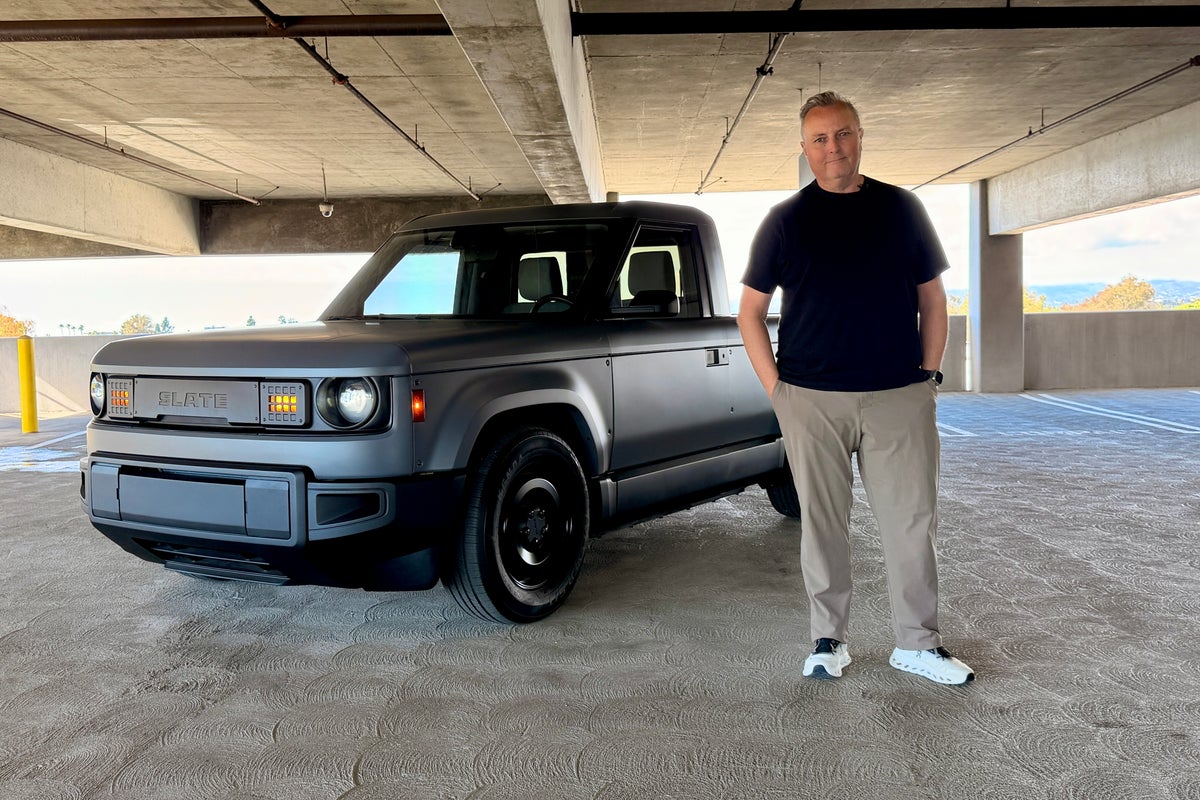
We headed to Century City, to the top floor of a car park, and there it was – with a hint of the coolest 1960s US pick-ups about it but reimagined for today and with an electric power train.
After a quick walkaround with the Slate team, I pulled on what felt like a very familiar door handle – just like the ones on the original Range Rover that also featured in great British cars like the Morris Marina, Austin Allegro, Triumph TR7 and even the Lotus Esprit.
The doors are light, partly because there’s very little inside them. There’s no speaker for a fancy and expensive audio system, and no electrics for powered windows. Instead, there’s a winder – it was good enough years ago, so why not now?
You sit fairly upright on what look like flat, basic seats covered in hard-wearing but nicely stitched fabric which feel surprisingly comfortable. The steering wheel is simple with a nice thick rim and a dimpled finish on the boss in the centre, with SLATE proudly stamped in the middle.
Buttons on the left of the wheel look after the basic cruise control functions, while buttons on the right adjust the settings on the slim digital display which simply shows speed, remaining battery range, mileage, what gear you’re in and a bank of warning lights. All simple, but effective stuff.
Unlike in the Cybertruck, there are stalks either side of the steering wheel. The one on the left takes care of lights, indicators and wipers; the one on the right is the gear selector. Other than three basic knobs for the heating and ventilation, and buttons to open the hood, for the stability control and speed limiter, plus an electronic parking brake, that’s it.
The ‘Blank Slate’ could cost as little as $25,000, less any US incentives but plus any state taxes. That $25,000 equates to £18,718 right now
A row of vents sits above interchangeable panels, while our car also had a cradle for a smartphone to sit in and act as your navigation and infotainment.
I was behind the wheel of the ‘Blank Slate’ – which could cost as little as $25,000, less any US incentives but plus any state taxes. That $25,000 equates to £18,718 right now.
Every Slate rolls off the production line as a Blank Slate – literally a plain-grey, minimal truck – because every Slate is meant to be customised by its owner. Slate gives you the opportunity to wrap your vehicle in any colour or finish you like – satin, gloss, matte – and change or update it whenever you want.
Beyond simple colour changes, you can add decals, graphics, racing stripes, or bold two-tone schemes. There are multiple ‘starter pack’ themes that combine wraps, wheels and exterior details to create distinct personalities.
You also have full control of your exterior hardware – bumpers (front and rear), side-steps, fender-flares, spare-tyre mounts, and more can be swapped depending on whether you want a work truck, a clean city runabout, or something that’s more ready for adventure.
The Slate’s stripped-back cabin isn’t a limitation – it’s a canvas. Inside you can choose from at least two seat upholstery options (black or a green-and-brown combo), and you can customise the armrests, centre console, dash panels, door tops and interior trim accents. Even the air con vent surrounds and control knobs can be given different finishes for a subtle but personal feel.
Slate expects owners to ‘bring their own tech’ – there’s no built-in infotainment, but a universal mount and USB ports. That means you slot in your own phone or tablet (with your own apps, maps, tunes) – and you can even bolt in additional speakers or screens if you like, making the Slate a ‘your tech, your way’ cabin.
And because it’s modular, you’re free to upgrade or swap parts later – so the Slate can evolve as you do.
Perhaps the most radical personalisation option is that the Slate isn’t locked into a single body style. Though it starts life as a modest two-seat pickup, you can transform it into a five-seat SUV (with either a boxy or fastback silhouette) using a bolt-on ‘SUV Kit.’ These kits allegedly need no major mechanical skills – a bit like a flat-pack conversion you could (in theory) do at home.
So, whether you need a little city pickup today but foresee family needs or more space later – you’re not stuck. That flexibility is built into Slate’s DNA.
You can also tweak ride height (with lift or lowering kits), swap wheels (17- or 20-inch options) and swap tyres (on-road, all-terrain, low-profile). Basically, you can tune this vehicle to your own driving style or look.
Slate doesn’t assume you want your personality stamped onto the car at the factory – instead, you become its maker. Through Slate’s ‘Slate Maker’ scheme, you have access to over 100 accessory attachment points and lots of third-party or factory upgrade options.
You can choose to install many of these accessories yourself – the company even provides ‘Slate U’ DIY-style instructional content to help you do so – or they’ll do it for you.
Underneath, it’s all very sensible. The standard 52.7kWh battery delivers around 150 miles of range, while an optional 84.3kWh pack extends that to 240 miles. The single rear-mounted motor produces 201bhp, enough for a brisk 0-60mph in about eight seconds, and it’ll charge from 20 to 80 per cent in under 30 minutes on a 120kW DC fast charger. It’s even fitted with the USA’s NACS charging port, giving future access to Tesla’s Supercharger network.
The Slate looks and feels compact – it’s just 4.4 metres long yet still manages a 635kg payload and a 454kg towing capacity, so it’s genuinely useful. The rear door came down heavily in the prototype which nearly caught me out, but that does at least mean it’s reassuringly solid.
For me, it’s the accessibility of the Slate that really makes it special. Slate isn’t aiming for billionaires or tech obsessives – it’s building cars for the people who simply want an EV that works, looks good and doesn’t cost a fortune. The company’s direct-to-consumer sales model keeps prices transparent and servicing will be simple through a network of service centres.
And let’s not forget the design itself. I think it’s cool. Properly cool. Not the try-hard kind of cool that involves stainless steel panels and bulletproof glass, but that timeless, utilitarian cool that comes from doing less, better.
So yes, I’m officially cancelling my Cybertruck order. The Tesla might be fast and flashy, but it’s also huge, impractical and, frankly, never really likely to come to the UK. It’s a car that turns heads for all the wrong reasons. The Slate, on the other hand, is humble, ingenious and a breath of fresh air – the car every other car maker should have thought of first.
I’ve put my name down for one. When production ramps up and Slate starts shipping internationally – expected from 2027 – I’ll be ready to take delivery, although it might have to live with my friends in the US. Sadly there are no current plans for Slate to come to the UK, but there’s always hope.
After years of reviewing EVs that promise the moon and cost the Earth, this is the first one that feels like it could genuinely change the world by keeping things beautifully simple. The Slate isn’t just a truck. It’s a statement – and it’s saying that the future of electric cars should be clever, personal and affordable. And I’m all in.
Join thought-provoking conversations, follow other Independent readers and see their replies
Please refresh the page or navigate to another page on the site to be automatically logged inPlease refresh your browser to be logged in
Related Article