Justin Pritchard is a seasoned Sudbury, Ontario-based automotive journalist, producer, and technical writer. With a passion for cars and a talent for storytelling, he’s established himself as a prominent figure in the Canadian automotive scene. His work, which encompasses automotive reviews, insightful analyses, and stunning photography, is featured across multiple Canadian television programs, print publications, and online platforms. Justin’s dedication to his craft has earned him numerous awards and accolades, solidifying his reputation as a trusted voice in the automotive industry.
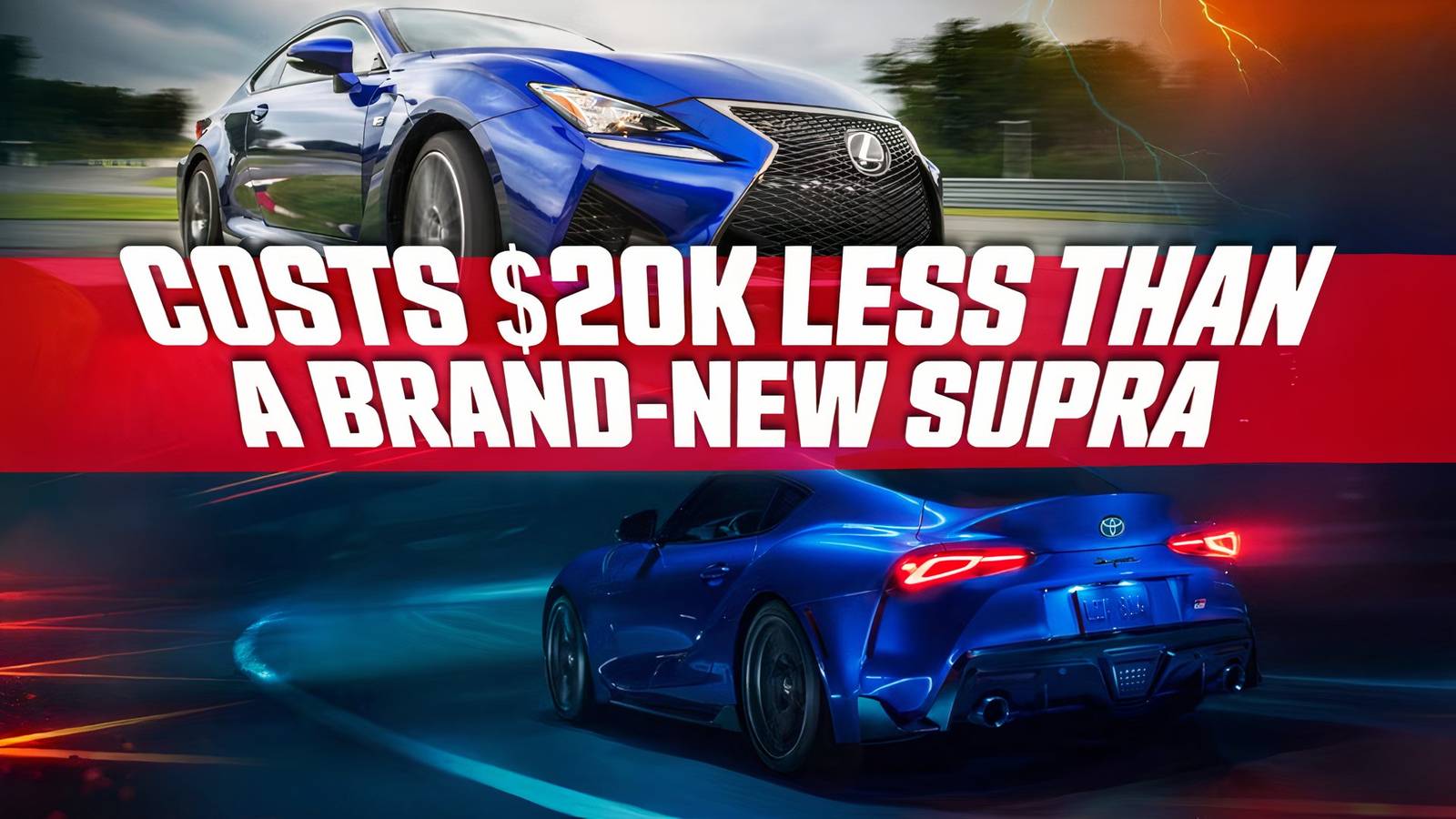
You can now pick up a copy of Lexus’ stunning V8 coupe, the RC-F, for $20,000 less than a brand-new Toyota Supra. Even if you’re a card-carrying car-nut, you’ve got to admit that this is a head-scratcher of a question: for the same amount of money, do you buy a brand-new 2025 Toyota Supra with its howling straight-six, or choose the V8 option from the same family tree in a used two-door Lexus RC-F instead?
Shoppers after a high-performing daily driver that’s track-day ready, take note: both these machines are factory-equipped for racetrack duty, and both can be had for around $20,000 cheaper by choosing an older, higher-mileage unit if you’d prefer to free up some budgetary bandwidth for regular weekend lapping, which will help you get the most out of your new machine’s performance.
The Lexus IS F sport sedan and its V8 drivetrain had been established for seven years when Lexus introduced the RC Coupe and its hot-rod RC-F variant in 2015. By now, earlier models like the IS-F and LFA had firmly established the brand in the sights of performance enthusiasts and the RC‘s arrival came five years after the long-running previous-generation Lexus SC left the market in 2010. The 2015 RC represented the first time in 13 years Lexus had brought a new, dedicated two-door model line to market – just in time for a do-over by the brand’s go-fast ‘F’ department, which was looking for a new coupe to add to its portfolio.
Modern Lexus performance cars trace their roots back to 1992.
When the RC-F arrived, a powertrain update gave the existing 5-liter V8 engine more breathing and more revs, with a new 7,100 rpm redline helping enable 12% more power than earlier versions of the engine (which had a redline of 6,800 rpm and made 414 horsepower). The enhanced new V8 made 467 all-motor horsepower, making this Lexus’ most powerful V8 with the help of a new throttle body, cams and exhaust manifolds. Several new technologies debuted in the RC-F as well, including Lexus’ first Expert traction management mode for racetrack use and the world’s first application of a torque-vectoring differential in a front-engine, rear-drive vehicle.
2019 Lexus RC-F vs 2025 Toyota Supra
RC-F
Supra
Engine
5.0-liter V8 gas NA
3.0L twin-turbo inline 6-cylinder
Power
467 hp
382 hp
Torque
389 lb-ft
368 lb-ft
Transmission
8-speed auto
6-speed manual / 8-speed auto
Drive
RWD
RWD
0-60 mph
4.1 seconds
3.9 seconds
EPA Annual Fuel Cost
$3,200
$2,900 (manual) / $2,350 (automatic)
The Lexus’ technological and horsepower advantage come with added weight, to the tune of 500–600 lbs versus the Supra, which doesn’t carry around a rear seat like the RC-F. This partly explains the lack of much differentiation in performance metrics despite the RC-F’s major advantage in power: even with a big advantage in horsepower, torque, and cylinder count, the RC-F ties the Supra for 0-60 figures at best.
There are some notable hardware differences outside of the engine department, too.
The Supra is the only machine on your page available with a manual six-speed, complete with intelligent rev-matching that can help reduce driver workload and improve comfort at the touch of a button when desired. With the ability to engage electronic assistance with manual shifting, the Supra makes it easier for drivers to stay smooth and consistent as they learn their new car’s character.
The RC-F is the only machine on your page available (optionally) with a torque-vectoring rear axle. This tech works on the same principle as the rear axle in the new Audi RS3, and uses a separate clutch to precisely control power distribution to each rear wheel, individually. At the direction of a computer system that monitors a constant stream of sensor data in real time, these clutches can be worked with millisecond precision to adjust clamping force (and therefore power distribution) across the rear axle at any time, whether or not the wheels are moving or slipping.
Drivers can even select from pre-set modes that alter the RC-F’s handling characteristics based on calibrations to the trick rear axle, which helps the RC-F handle like a smaller and lighter car and gives skilled drivers easy access to throttle steering on demand.
It might be past its sell-by date, but we’ll miss the RC F with its brutish V8 engine.
A 2025 or 2026 Toyota Supra comes with an MSRP of around $60,000, give or take a few accessories. The RC-F will be discontinued after 2025 when its $94,000 ‘Final Edition’ sells out. This final pricing push represents a considerable ramp-up in pricing towards the end of each machine’s life cycle, with the Supra having spent most of its latest generation with an MSRP in the mid to high 40s, and the RC-F having spent most of its life with an MSRP in the mid-to-high 60s.
Today, in 2025, with a $60,000 budget, what’s an enthusiast driver to choose? There’s the brand-new GR Supra with straight-six turbo power and a two-seat driving experience, or a lightly used Lexus RC-F with that 5-liter V8 and its beefy snarl and trick torque-vectoring rear axle.
The RC-F doesn’t come with a manual six-speed like the Supra, but it does have two more cylinders and by far the more stunning interior of the pair. You’ll pay around $60,000 for a new Supra these days, give or take a few options and accessories. According to data from Autotempest.com, that same spend lands you comfortably into a few-year-old Lexus RC-F that hasn’t seen its third oil change.
Of course, there are arguments for and against both choices here.
Domestic or import? Why not both?
Look, not everyone was happy when the Toyota Supra returned to market with an engine and interior straight from the BMW Z4‘s parts bin. If something about the use of BMW parts in a resurrected Japanese legend didn’t sit quite right with you, the RC-F is especially worth extra consideration.
Enhancements to the Supra’s engine over the years, and the introduction of a six-speed manual transmission, helped refine its recipe and make it more compelling than ever – especially for drivers set on exploring the full spectrum of its capabilities in both touring and racetrack settings.
The Supra is the more straightforward performer here: less drive modes and gadgets, less seats, less weight and less cylinders. It’s more minimal and focused, where the heavier RC-F has to accommodate a back seat and the array of high-end goodies expected of a luxury brand’s flagship rocket-coupe.
By subscribing, you agree to receive newsletter and marketing emails, and accept Valnet’s Terms of Use and Privacy Policy. You can unsubscribe anytime.
Also, the Supra is easier on fuel, just as quick if not quicker, and for your $60,000 spend, you’ll get to shift your own gears and peel the plastic covers off the interior and take advantage of the full factory warranty. For some shoppers, that’s the end of the discussion.
Still, consider how much originality you want for your dollars. The RC-F is by far the more Japanese choice here, with the engine, platform, driveline and design being 100% Lexus. Ditto the instrumentation, the development of the Torque Vectoring Differential and associated drive modes, and the long-running production and enhancements to its legendary 5-liter V8 engine.
These machines represent two different approaches to achieving the same goal of making drivers smile. After over 1,000 miles of testing each of these machines in real-world and racetrack settings, the bigger smiles for your writer came from the RC-F. That’s a surprise because I love two-seat performance cars with a stick-shift in the middle, but I love the RC-F’s V8 engine and high-tech gadgets even more.
Will the RC-F’s stellar soundtrack and techy gadgets tempt you away from the lighter, three-pedal Supra? You’ll just have to test drive both and decide for yourself. It’s always nice to have choices.
Sources: Toyota, Lexus
We want to hear from you! Share your opinions in the thread below and remember to keep it respectful.
Your comment has not been saved
This thread is open for discussion.
Be the first to post your thoughts.
Related Article