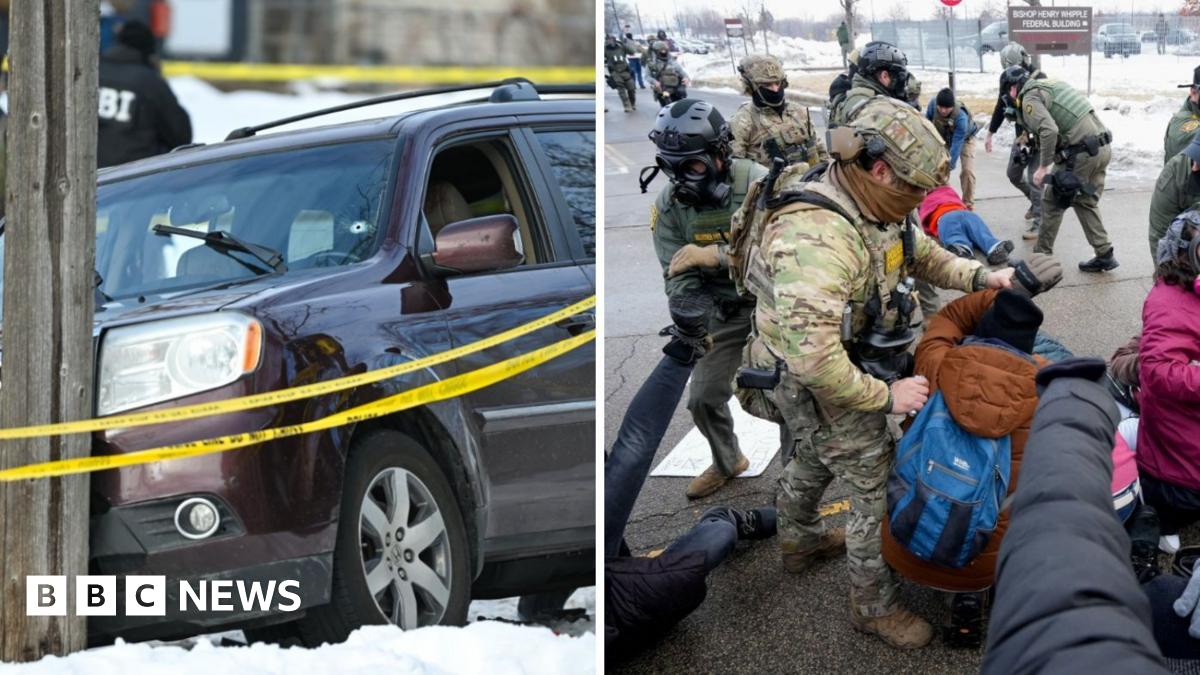
Minnesota officials say they have been blocked by the FBI from the investigation into 37-year-old Renee Good, who was shot and killed by a US immigration agent on Wednesday
In response, Homeland Security Secretary Kristi Noem says local authorities have "no jurisdiction" in the investigation
Our BBC Verify colleagues have analysed a video showing how the deadly ICE shooting unfolded – here's what we know, and don't know
Federal and local authorities give differing accounts of the shooting, with Noem saying Good tried to "weaponise her vehicle", while Mayor of Minneapolis Jacob Frey says the agent was "recklessly using power that resulted in somebody dying"
Meanwhile, protests against ICE are taking place in Minneapolis
Hundreds of ICE agents have been deployed to Minneapolis, in the state of Minnesota, as part of the White House's crackdown on illegal immigration
Edited by Oliver O'Connell and Brandon Livesay, with Madeline Halpert reporting from Minneapolis
This video can not be played
BBC speaks to Minneapolis residents gathered at shooting site
Minnesota residents are demanding a full and thorough investigation into the fatal shooting of Renee Good and urging ICE to leave the state, State Senator Zaynab Mohamed tells the BBC.
The community is "outraged" by the federal government's decision to not coordinate with local authorities on its investigation, she adds.
"Our community is not backing down. This community is a community that has been through so much over the last five years," she says,
If federal authorities do not complete an honest and thorough investigation, then the state government "will have to play a role in suing the federal government for the files of this case", she adds.
Democratic Representative of California, Sara Jacobs, is condemning US Immigration and Customs Enforcement over its officer's fatal shooting of Renee Good.
Jacobs tells the BBC that the video of the incident is "appalling".
"What I saw was ICE agents kill in cold blood a suburban mom who literally had stuffed animals in her glove compartment," Jacobs tells the BBC.
"ICE does not have the same authorities as local law enforcement, so they are not actually supposed to be stopping people," Jacobs adds. "They are only supposed to be doing immigration enforcement, and this woman was a United States citizen."
She adds that local law enforcement "absolutely" should have the authority to investigate this "crime". Grace Eliza Goodwin
Live reporter
Earlier today, Homeland Security secretary Kristi Noem said Minnesota's local authorities will not be included in the FBI investigation because, she said, they have "no jurisdiction" in the case.
One legal expert tells the BBC that that he thinks that statement is "preposterous".
"Of course Minnesota authorities have jurisdiction over an investigation, because what is to be investigated is violations of state homicide laws," saysSubodh Chandra, a civil rights litigator and former federal prosecutor.
"The fact that it's a federal official doing it doesn't immunise that official from the jurisdiction of local law enforcement," Chandra says. "There is no such legal principle."
Chandra said that even without federal cooperation and sharing of case materials, Minnesota authorities can still pursue their own investigation into the incident.
Governor Tim Walz has authorised the Minnesota National Guard "to be staged and ready" as protests continue in the aftermath of the killing of Renee Good.
"The National Guard remains ready if needed to help keep the peace, ensure public safety, and allow for peaceful demonstrations," a statement from the governor's office reads.
According to the order, the National Guard will be prepared to "protect critical infrastructure and to assist local law enforcement with additional tasks as requested".
Additional law enforcement resources will be provided to local authorities. Madeline Halpert
Reporting from Minneapolis, Minnesota
One of the many people here protesting is Susie Hayward, a minister who says she has been praying since she heard of Renee Nicole Good’s death.
Susie has been dismayed by the presence of ICE in her neighbourhood, which is home to many Somali Minnesotans.
She believes the immigration raids go against the ideal of “loving your neighbour”.
After the shooting yesterday, Susie told me she hoped the news wasn’t true and drove to the scene of the crime to “verify” with her own eyes.
“I saw Renee’s car. I saw Renee’s blood,” she tells me. “I held the grief and the anger in that space.”
“I was horrified." Anthony Zurcher
North America correspondent
Minnesota's central role in this latest flare-up is unsurprising because it marks the culmination of conflict, controversy and scandal that had been building for months.
An under pressure Governor Walz abandoned his bid for re-election last week, as allegations mounted of corruption in state social services, including childcare and food aid.
The surge in immigration enforcement in the state is just the latest example of the Trump administration using federal officials to target communities suspected of having high rates of undocumented migrants. The use of force during this operation is far from an isolated incident, either.
According to the New York Times, the Minnesota incident was at least the ninth immigration-enforcement-related shooting since September – all involving individuals who were targeted while in their vehicles.
The intensity with which the immigration actions have been undertaken – in a expanding list of cities across the US – has led to protests and calls from Democratic officials for greater oversight, accountability and restraint among law enforcement agents.
The fatal Minneapolis shooting has already given these efforts new urgency among their advocates.
Minneapolis Mayor Jacob Frey says the Homeland Security Secretary "doesn't want an impartial investigation because she [Kristi Noem] knows her narrative about domestic terrorism is bullshit."
He's referring to how state officials in Minnesota say they have been blocked by the FBI from the investigation into the shooting.
Noem says that Minnesota's Bureau of Criminal Apprehension (BCA) has not been cut out of the investigation and that it doesn't have any jurisdiction
"Lets call a spade a spade," the Mayor Frey writes on X.
For context, the US administration has called Renee Good's actions "domestic terrorism" and have claimed that she was trying to strike an ICE officer with her vehicle.
The BBC's Sarah Smith, Justin Webb and Marianna Spring discuss the fatal Minneapolis shooting and whether it has the capacity to lead to a larger protest movement across the nation.
As recent polling suggests more Americans are growing dissatisfied with some of the tactics used by ICE, the team ask what it would take to change Donald Trump’s mind on his flagship deportations policy.
You can listen to the podcast on BBC Sounds, or through this link. Pratiksha Ghildial
Reporting from Minnesota
Molly Ames placed flowers near where Good was killed
Crowds have started building this afternoon at the site where Renee Good was killed. They are protesting peacefully so far.
Periodically, I can hear chants of "Arrest the shooter". Many are stopping to look at pictures of Renee put up on a traffic signal post.
20-year-old Molly Ames says she wanted to pay her respects as she finds the situation heartbreaking.
She placed some purple flowers below the traffic post and said, "It's hard to say what this means for the future because it was a peaceful protest."
Federal authorities have continued to say the officer acted in self-defence.Anthony Zurcher
North America correspondent
The fatal shooting of a woman in Minneapolis by a federal law-enforcement officer is laying bare the sharp divides in American politics – and threatening to inflame an already contentious debate over immigration policy.
The incident took place in broad daylight. There are multiple videos taken by bystanders from various locations. And yet even the basic facts are being disputed.
Almost immediately after the shooting, two starkly different accounts began to take shape. Any ambiguities in the videos shared online were seized upon – different angles and different screengrabs were used to push a particular narrative.
And on the public stage, state and federal officials openly disagreed.
Each person sees the same images and draws decidedly different conclusions – ones that frequently, perhaps not surprisingly, reinforce their previously established positions.
The BBC has spoken to a parent who witnessed emergency services running towards Portland Avenue yesterday, after Renee Good was fatally shot by an ICE officer.
Below you can listen to him describe what he witnessed after dropping his children off to school.
This video can not be played
Shooting aftermath witness tells BBC he saw emergency services running towards the sceneGrace Eliza Goodwin
Live reporter
As we reported earlier, local Minnesota authorities say they've been cut out of the FBI's investigation into ICE's fatal shooting of Renee Good.
After initially agreeing to a joint investigation with Minnesota's Bureau of Criminal Apprehension (BCA), the FBI then "reversed course" and said it would not be giving the BCA access to case materials and evidence, BCA superintendent Drew Evans said earlier in a statement.
Secretary of Homeland Security Kristi Noem argues that local authorities do not have jurisdiction over the case.
"From a criminological perspective, jurisdictional claims in cases like this are often less about legal requirements and more about political efforts to control the investigation and shape its outcome," Edward Maguire, a criminology and criminal justice professor at Arizona State University, told the BBC.
And, Maguire added, excluding state authorities is "likely to undermine public trust, especially where confidence in federal law enforcement—particularly ICE—is already fragile".
But, while BCA not being involved in the investigation "certainly can impact the investigation itself, it doesn't necessarily mean that the state could not file criminal charges later" against the federal officer who fatally shot Good, said Bryna Godar, a staff attorney with the State Democracy Research Initiative at the University of Wisconsin Law School.
Both state prosecutors and federal prosecutors have the jurisdiction to bring charges if a crime was committed at the state or federal level, Godar told the BBC.
Whether state prosecutors are able to file charges against the officer "depends on what happens from here", Godar said.
If the FBI conducts a complete and thorough investigation into the incident and, once complete, then turns over the full investigative file to state officials, then state and county prosecutors can decide whether to file charges, Godar said.
"If that file is not turned over, or if the investigation is not thorough, especially regarding aspects of the state law crimes, then that would present significant hurdles to bringing a criminal case" at the state level, Godar said.
And if state charges led to the conviction of a federal officer for state-level crimes, then President Trump cannot issue a pardon, Godar added.
Attorney General Pam Bondi has posted on X to suggest that obstructing law enforcement or damaging federal property through protest could lead to a prosecution.
In a post on X, she says: "MINNESOTA: Peacefully protesting is a sacred American right protected by the First Amendment.
"Obstructing, impeding, or attacking federal law enforcement is a federal crime. So is damaging federal property.
"If you cross that red line, you will be arrested and prosecuted. Do not test our resolve."
The White House press briefing has concluded after a combative showing from Vice-President JD Vance.
Stick with us as we bring you more analysis and and the latest from on the ground in Minnesota.
Asked if the officer is still on duty and what the target of the Ice operation was on Wednesday, Vance says: "It was a legitimate law enforcement operation, we were going door to door to try to find criminal illegal aliens and deport them from the United States of America."
He says that he does not know whether the officer has been placed on administrative leave and asks people to pray for the agent.
Vance also says he is "certain" that Renee Good "violated the law" and the officer involved had "every reason to think that he was under very serious threat of injury" or for his life.
He goes on to say: "The idea that this was not justified is absurd and I think everybody knows it in their heart".
Vance is asked what his message is to the leaders in Minnesota.
The vice-president says: "Why can't you just disagree with our immigration policy, without turning law enforcement into the enemy?"
He calls ICE "patriotic Americans who are trying to enforce the law".
Asked why he thinks Minnesota Governor Tim Walz should resign, Vance says it's "very clear" he "looked the other way" over childcare fraud in the area.  Bernd Debusmann Jr
Reporting from the White House
Vance's comments have focused, in large part, on the media.
According to the vice-president, many in the US media have portrayed the agent involved in the shooting as "some kind of federal assassin".
"The reporting over this has been one of the biggest scandals I've ever seen in the media," he says, his voice notably elevated. "I've never seen a case so misrepresented and misreported."
This is another frequent talking point of this administration, which has a combative relationship with many in the media.
The language today, however, is stronger than usual.
While Vance said that the exact circumstances of the event and the driver's intent are up for "debate", he has not backed down from his broader accusations that Democrats and others have "turned enforcement into the enemy".
We are unlikely to hear from President Trump directly today, as his only remaining event – a policy meeting this late afternoon – is currently closed.
For now, the White House seems content to let Vance take a primary role in speaking for the administration.
Vance is asked about Minnesota's state agencies being cut off from the investigation by the US attorney's office.
The vice-president says he wishes state officials would investigate why "so many people" are using vehicles to interfere with law enforcement.
He says the ICE agent involved has "absolute immunity" to do his job, which is a "federal issue".
Vance says it would be unprecedented for a local official to prosecute a federal official with absolute immunity, referring to the ICE agent.
Vance says part of him feels "very, very sad" for the woman killed yesterday, calling her a "victim of left-wing ideology".
"What young mother shows up and decides they're gonna throw their car in front of ICE officers enforcing legitimate law?" he says. "You've gotta be a little brainwashed to get to that point."
He says he knows the ICE officer who shot her "very much wishes he was not put in the position where he had to fire a gun to defend his own life".
Copyright © 2026 BBC. The BBC is not responsible for the content of external sites. Read about our approach to external linking.