Formula 1
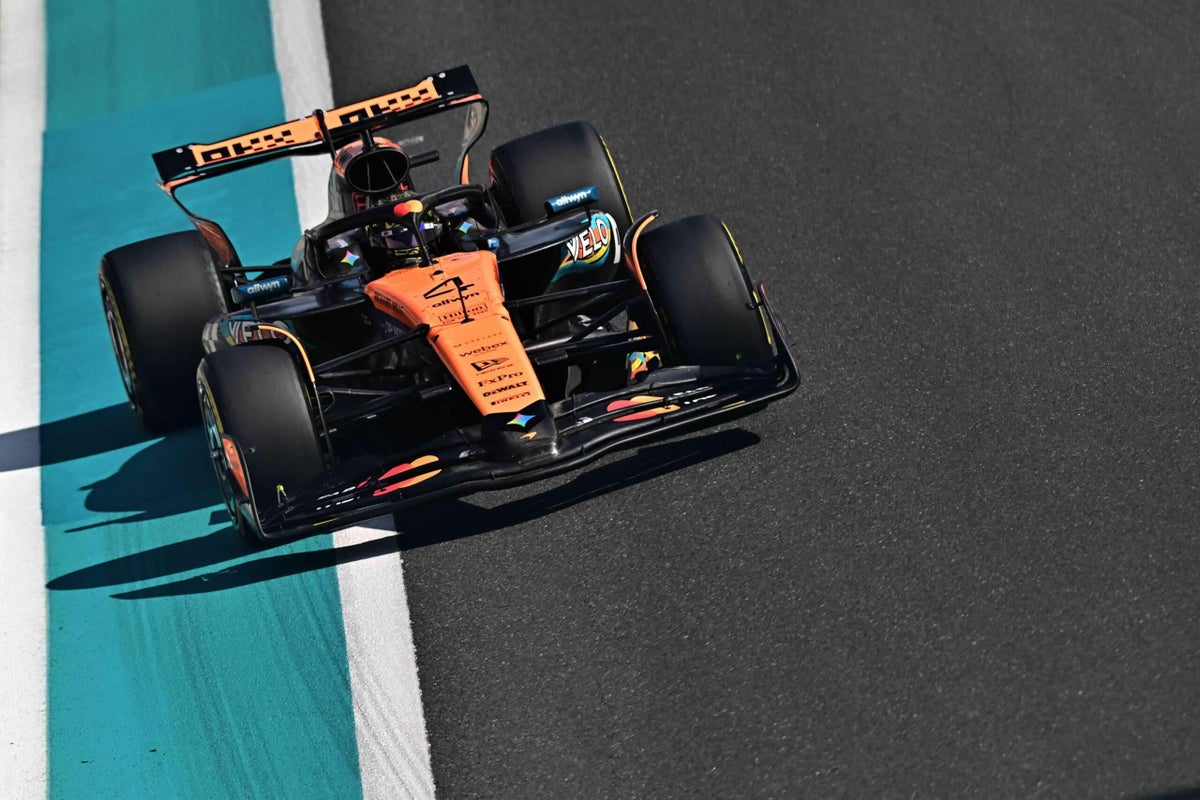
Let's take a look back on the 2025 Formula One campaign, captured by Lando Norris. Giuseppe CACACE / AFP via Getty Images
Prime Tire Newsletter | This is The Athletic’s F1 newsletter. Sign up here to receive Prime Tire directly in your inbox twice a week during the season and weekly in the offseason.
Welcome back to Prime Tire, where today I’m looking back on the 2025 Formula One campaign. ‘Tis season review season, after all.
Advertisement
I’m Alex, and with Luke Smith and Madeline Coleman either on well-deserved holidays or finishing their final pieces for The Athletic this year, it’s just my words arriving in your inbox today.
You’re welcome/I’m sorry. Please delete as appropriate.
I hope you went with the apology above, because quite frankly, “I’m sorry” just isn’t a phrase heard enough in our society these days.
I’m not getting into the always thorny subjects of politics in this humble newsletter about racing cars, but I’m a big believer that journalists should be up front when they get things wrong. The theme of apologies is also fairly newsworthy right now, given Denny Hamlin is seeking one from SiriusXM NASCAR Radio in the wake of the blockbuster NASCAR antitrust lawsuit being settled.
Sometimes, even if there’s plenty of research, analysis and logic behind any article or point, the unexpected just happens. That was a major narrative of this year’s F1 campaign.
And I count reviewing failed predictions as a season review. So, here’s everything I got wrong in 2025:
1. Thinking the title battle would be better: Remember F175 Live and the glitz and glamour of F1’s season launch party at London’s O2 arena? Everyone there was expecting a McLaren vs. Ferrari vs. Red Bull vs. Mercedes title battle, given how the 2024 season ended, with McLaren only edging Ferrari for that year’s constructors’ battle in the final round.
What happened: McLaren piled resources at a big 2024-2025 offseason car upgrade and dominated as a result.
2. Thinking Max Verstappen would save the season from one-team domination dullness: I wrote a column back in May that basically had the above as the headline, after Verstappen’s sensational Suzuka win and with his brilliance against the McLarens in Miami.
Advertisement
What happened: Verstappen carried on being brilliant (more on that later), but George Russell also subsequently won twice for Mercedes.
3. Thinking Verstappen was out of it: I asked, “Is Verstappen’s 2025 F1 title race run?” in the 1 July (or July 1st, for American readers) edition of PT. The Dutchman had just been taken out of the Austrian GP by Kimi Antonelli and was 61 points off the standings lead.
He’d had his Spain red mist moment two races earlier and would slip to 104 points behind first place leaving his home race at August’s end. But boy did he come back.
What happened: Red Bull’s new floor and front wing upgrades transformed its 2025 car and Verstappen did the rest — six wins in nine races (a run where he was never off the podium) to close the gap to two points leaving Abu Dhabi.
4. Thinking Norris was done (twice): When Norris won at Silverstone, I wrote that “winning on off-weekends” was “a key pillar of title-winning seasons,” as Oscar Piastri should’ve won the British GP but for his safety car restart error, and Norris triumphed instead.
Then Norris immediately made several errors that aided Piastri’s win at Spa and post-summer break, Norris’ engine oil leak retirement at Zandvoort left him facing a 34-point gap to his teammate. But he still emerged as the 2025 world champion.
What happened: Threaded all through his early season defeats to Piastri were flashes of superior pace and potential. When Norris finally got things together post-Zandvoort, he was regularly the better McLaren driver. And Piastri cracked. Speaking of which …
5. Thinking Piastri wouldn’t crack: I felt like I pointed out a lot this year how ice cool and unflappable Piastri was in his junior career and in his personal temperament. His seven wins in 15 races in the campaign’s first portion just backed that up. As Norris regularly floundered, he seemed to be walking to the title. Then came the Monza position swap, which he suggested contributed to his shocking Baku weekend.
Advertisement
What happened: Norris’ improved results coincided with a poor run of form from Piastri — starting with the Azerbaijan GP, where he crashed twice and jumped the start. His points lead disappeared in three more weekends.
6. Thinking Ferrari would get good eventually: This specifically refers to the Monza and Baku part of the season, when I really felt (twice) the red cars had a good chance at a season-rescuing win. It has a special low-downforce rear-wing package that is ideal for Monza, and Charles Leclerc has a stunning record in Baku.
What happened: At Monza, it was never in the pole or victory battles, and Leclerc crashed in the critical Baku qualifying. Lewis Hamilton was never a factor in either event.
7. Thinking there was going to be an FIA election battle: At various points this year it looked like Mohammed Ben Sulayem would be challenged by two rivals in last Friday’s FIA presidential election. In the end, Ben Sulayem stood unopposed.
What happened: Rules requiring candidates to submit a list of vice presidents covering all the FIA’s global regions — and with only one person eligible from South America, who was declared for Ben Sulayem — meant no rival could technically stand.
8. Thinking Norris’ Singapore repercussions would last: McLaren navigated its intra-team crash in Canada because Norris owned the error that caused it. When he and Piastri clashed at the Singapore start, McLaren didn’t intervene.
But by the next round in Austin, it decided Norris would face “repercussions” that meant Piastri would get track position priority in qualifying. A minor but potentially pivotal change to the team’s much-discussed Papaya Rules. Yet this only featured in Austin.
What happened: Piastri’s aggressive cutback at the Austin sprint race start triggered a multi-car crash that took out Norris too. The repercussions were duly removed for the following week in Mexico.
Advertisement
9. Thinking Verstappen’s charge would continue in Mexico: I thought Verstappen was in with a shot of a fourth GP win in five rounds post-Zandvoort, but in the end Norris won by 30.324 seconds to retake the points lead he wouldn’t then lose.
What happened: McLaren, particularly with Norris, dominated because the intricate way it cooled its car meant not opening up large bodywork holes to keep engine temperatures down. Red Bull did have to do this, and its car was slower as its aerodynamics were compromised as a result, and Verstappen scrapped his way to third.
10. Thinking the Papaya Rules would cost McLaren: I definitely wasn’t alone here, given what my PT co-driver Patrick Iversen wrote in our 9 September edition. It just seemed that McLaren’s commitment to fairness would be undone by a team that could converge behind a single, brilliant and ruthless driver. Although in so many motorsport scenarios that approach does win out, it didn’t in 2025.
What happened: After sticking to the fairness approach definitely cost Piastri victory in Qatar, by splitting starting tire strategies in Abu Dhabi, McLaren stopped Verstappen playing games at the pack’s head, gave Piastri his best shot of rescuing the title and aided Norris doing what he needed to seal it in third.
Impressive all around, right when it mattered, as I wrote here.
I was also at least half right in suggesting Abu Dhabi was a Norris track ahead of the season finale. He did beat Piastri in qualifying there, but trailed in the race, largely thanks to that split strategy.
But I’m still smug. I knew Leclerc would prevail over Hamilton at Ferrari and that Piastri would finally surge back in Qatar.
I also confidently believe all the new rules coming in 2026 mean one team is going to dominate, just like in 2014. But I’ll be VERY happy if that prediction ends up being wrong, too!
Advertisement
(For one last time), speaking of which …
New cars systems terms simplified
The FIA announced simplified terminology on Wednesday for several of the systems that will change how F1 cars overtake and defend within the major rule changes coming in 2026.
The main terms that matter are “Overtake Mode,” “Corner Mode” and “Straight Mode.”
Previously, these were to be called “Manual Override Mode” (covering one of the engine electrical power boost modes), “X-mode” and “Z-mode” (both referring to how the new cars will change shape automatically when moving from corners to straights).
Madeline has a full explanation of these changes — which came after F1 workshopped the old terms to baffled focus groups. You can read the full story here.
Christian Horner may or may not be in talks to buy into Alpine?
And Portimão, Portugal, is returning to the F1 calendar on a short-term deal for 2027 and 2028. Good for fans of dramatically undulating tracks; bad for anyone who hates appalling traffic jams.
📸 The Athletic’s annual list of big sporting moments in pictures included Norris’ championship celebration. Check it out!
📫 Love Prime Tire? Check out The Athletic’s other newsletters.
Alex Kalinauckas is a Senior Editor covering Formula 1 for The Athletic. Alex has spent 11 years reporting on motorsport for outlets including Autosport, The New York Times and CNN – including five years as a Formula 1 correspondent travelling to race events. He is a graduate of Goldsmiths, University of London and won the Motorsport UK Young Journalist Award in 2020. Follow Alex on Twitter @Nauckas
Related Article