Ferries are vital transportation links in many parts of the world. People in Seattle and Sydney depend on them. Ferries connect the Greek Isles and permit motorists in Norway to traverse fjords in far less time than it takes to drive around them. Without ferries, commerce between nations that are connected by water would be much more difficult — and expensive.
Despite their utility, most ferries are powered by diesel engines that leave a plume of fine particulates and oxides of nitrogen in their wake, not to mention clouds of carbon dioxide. Electrifying ferries has been an ongoing objective of several companies, including Wärtsilä in Finland and Corvus Energy in Norway.
The Rio de la Plata is a large body of water that has Buenos Aires, Argentina, at one end and Montevideo, Uruguay, at the other. It is like I-95 in the US — a major transportation route that is busy carrying passengers and cargo every day of the year.
In 2023, South American ferry company Buquebus commissioned Incat Tasmania to build an all-electric fast ferry to operate between the two cities. Incat is one of the largest manufacturers of catamaran-style ferries in the world and is known for building ships that use aluminum hulls, which decreases their weight and increases the payload they can carry.
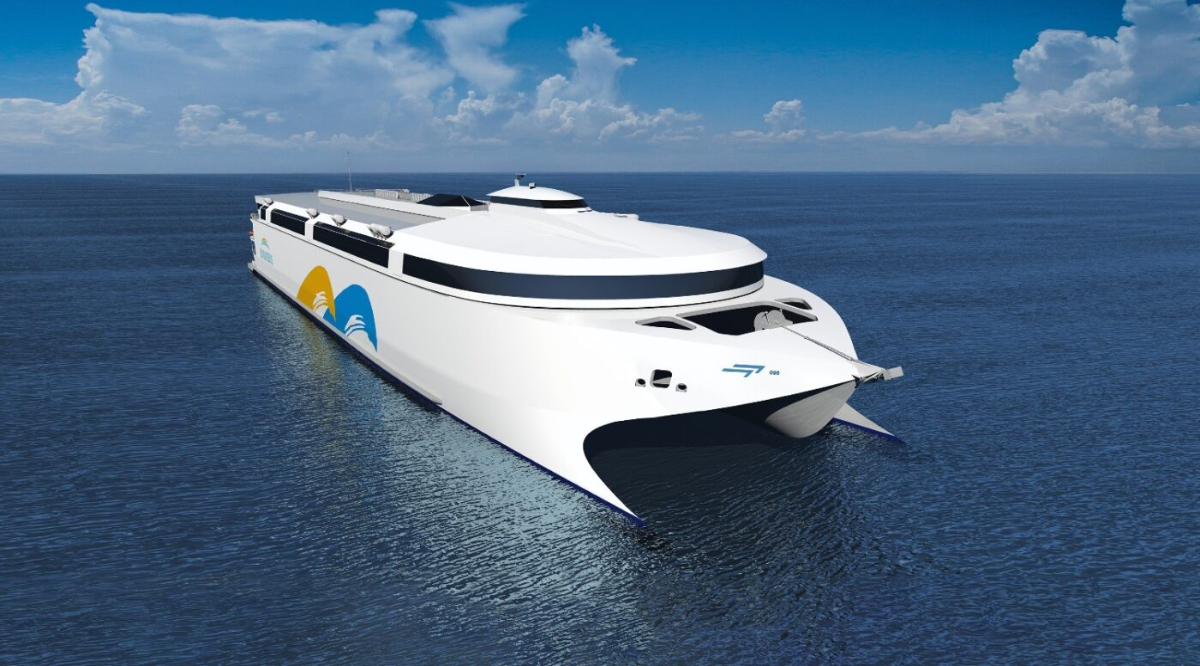
In May 2025, it launched Hull 096, a 130 meter (426 foot) twin hull fast ferry it claims is the largest all-electric ferry in the world. It has successfully passed its initial round of sea trials and will begin its journey to South America early next year after final checks in Hobart are completed.
Robert Clifford, the chairman of Incat, described the completion of Hull 096 as a significant milestone: “This is the first time a ship of this size, anywhere in the world, has been trialed under 100 percent battery-electric propulsion. It’s a remarkable achievement by our workforce and a turning point for shipbuilding.”
Many think of ferries as slow, smelly, and uncomfortable, but this latest vessel is none of those things. It has room for 2,100 passengers and crew plus 225 cars. It also features an enormous 2000 square meter (21,500 square foot) duty-free shop. The ferry will operate on the Rio de la Plata and is equipped with a catamaran-like hull featuring two pontoons.
Hull 096 is what is called a RoPax ferry, meaning it has a roll-on, roll-off configuration for vehicles and freight, while having separate entrances and exits for passengers. It is being built in Australia for use in South America, but several European companies are responsible for its operating systems.
Wärtsilä will supply many of the components that power the all-electric ferry. Among those components are its in-house energy management system, eight electric motors, and the associated eight Wärtsilä WXJ1100 axial flow water jets, complete with ProTouch propulsion control.
“The water jet propulsion configuration with eight electric motors is the most efficient available on the market today for this speed range and type of application, while also offering all the benefits of Wärtsilä’s axial-flow water jet technology — lightweight, shallow draft, excellent maneuverability, and low maintenance,” said Roger Holm, president for marine power at Wärtsilä. The ferry will have an operating speed of 25 knots — double or triple the speed of conventional ferries.
Onboard, the ferry will have 40 MWh of batteries weighing 250 tons supplied by Norwegian energy storage specialist Corvus Energy. Incat says that the energy storage system is “four times larger than any battery system ever built and installed for maritime transport anywhere in the world.”
In addition to its high storage capacity, the vessel will “be charged using the world’s highest-capacity chargers,” Corvus Energy said in a statement. The charging infrastructure is expected to be installed onshore in South America.
The launch comes at a time when Incat is expanding its production of electric vessels, partly supported by a $60 million (AUS) loan from the Tasmanian government. The company has also announced plans to develop a second facility upstream in Boyer, which will double its capacity and support future electric vessel projects.
“Tasmania has been at the forefront of international aluminium shipbuilding for decades, and today’s milestone shows we are now leading the world in the next era — sustainable, high performance vessels at scale,” said Clifford. “This ship will stand as a flagship for what’s possible when industry, design, and clean energy technology come together.”
My colleague Michael Barnard wrote recently, “Seventy percent of ferries currently on order globally now feature electric drivetrains, a remarkable shift underscoring just how rapidly maritime transportation is decarbonizing. Norway has about 70 electric ferries running already, and there are likely north of 200 globally.
“There are about 15,400 ferries in operation around the world, new ones are overwhelmingly being purchased with electric drivetrains, and most operators have electric retrofit plans for existing vessels.
“This transition, which seemed speculative just a decade ago, has moved swiftly from niche experiments in sustainability to mainstream procurement decisions, and the industry is now firmly on a trajectory toward large scale electrification.”
Why the shift? Electric propulsion undoubtedly costs more initially, but as many owners of electric cars and trucks have discovered, electric vehicles cost much less to operate. Not only are fuel cost considerably lower than the cost for diesel fuel, the motors are much more reliable than diesel engines, which further lowers operating costs for commercial transportation operators.
Barnard pointed out that ferries tend to operate close to shore and near population centers. As regulators tighten emission standards, operators face mounting pressure to rapidly decarbonize their fleets or risk penalties that can translate into higher operating costs.
Corvus Energy has supplied batteries for dozens of ferries in Norway and expanded its services to commercial ships as well. It was selected to provide an energy storage system to Kawasaki Heavy Industries for its zero-emissions electric e5 tanker, which is the world’s first zero-emissions tanker. The battery-powered vessel was designed by e5 Lab Inc., which is a consortium of leading Japanese shipping and maritime services companies. One of those companies is Asahi Tanker Co, which focuses on building infrastructure services for battery-powered vessels.
An electric ferry will be welcome news to the government of Uruguay. In 2007, it had to rely on electricity imported from Brazil and Argentina. That’s when it decided to invest heavily in wind turbines. Within 10 years, it had 4,000 MW of installed capacity. Today, 98 percent of the electricity for its 3.4 million inhabitants comes from renewables, including hydro.
Since the Kyoto Protocol was signed in 1997, Uruguay has surprised its South American neighbors with its growing list of environmental successes, including conserving native forests, protecting bio-diverse areas, and showing remarkable progress toward a promise to be carbon neutral by 2030.
That philosophy fits right in with that of Wärtsilä. Its CEO, Håkan Agnevall, has said, “Our modeling shows that it is viable for energy systems to be fully decarbonized before 2050 and that accelerating the shift to renewable power coupled with flexibility will help economies to thrive. We have all the technologies that we need to rapidly shift to net zero energy. The benefits of renewable-led systems are cumulative and self-reinforcing — the more we have, the greater the benefits — so it is vital that leaders and power producers come together now to front load net zero this decade.”
Those words resonate more than ever at a time when governments around the world are backing away from clean energy and transportation goals in the wake of chaotic policy shifts imposed by The Mouth That Roared in Washington. The increase in electric ferries worldwide is proof that the technology is mature, reliable, and affordable. It’s time to stay the course, for the benefit of all living things.
CleanTechnica’s Comment Policy
Steve writes about the interface between technology and sustainability from his home in Florida or anywhere else The Force may lead him. He is proud to be “woke” and believes weak leaders push others down while strong leaders lift others up. You can follow him on Substack at https://stevehanley.substack.com/ but not on Fakebook or any social media platforms controlled by narcissistic yahoos.
Steve Hanley has 6500 posts and counting. See all posts by Steve Hanley
Related Article