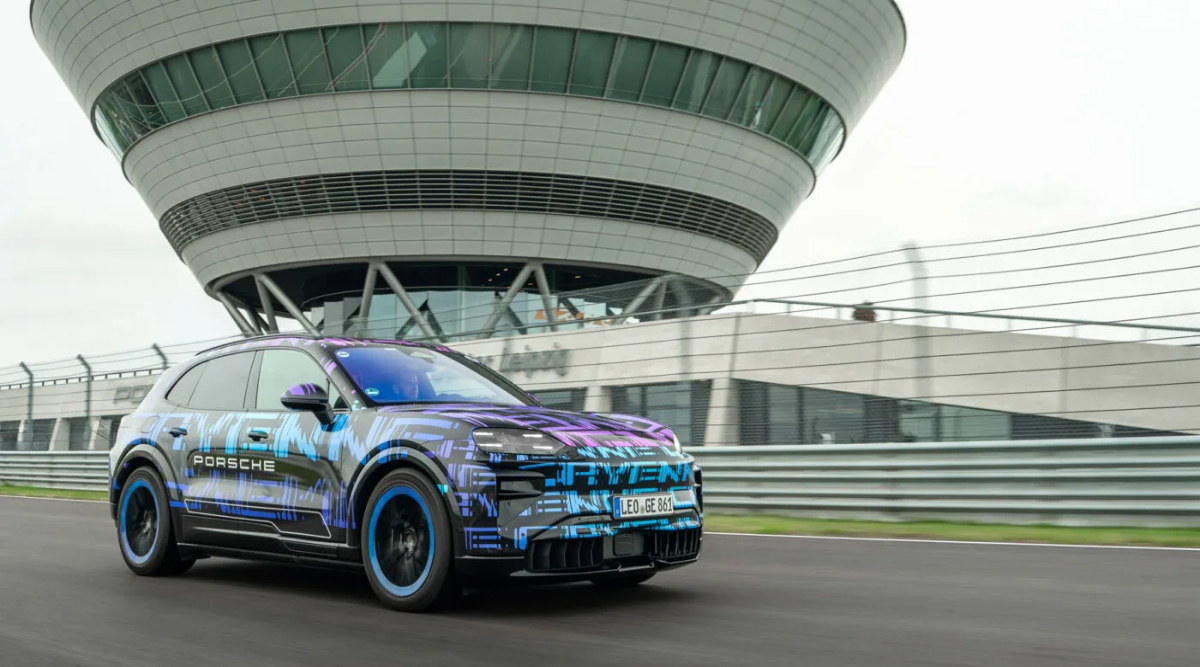
Production of the Porsche Cayenne Electric, which is based on the PPE battery-electric platform, has begun at the factory in Bratislavia just a few months after its global premiere. For several years, that factory has produced the gasoline-powered and hybrid versions of the Cayenne along with similar models from Audi and Volkswagen. According to Porsche, such a flexible production line enables the company to “respond quickly to changes in demand.”
One limiting factor on flexibility concerns the battery assembly. For the Taycan and Macan Electric, Porsche relied on supplier Dräxlmaier to assemble the battery packs and deliver them to the factory. With the electric Cayenne, the automaker has brought battery assembly in-house. In collaboration with Porsche tool making, Porsche has established the Porsche Smart Battery Shop in Horná Streda.
“The close integration with Porsche tool making was a key success factor. Competencies from prototype production could be seamlessly transferred to series production,” Porsche said in a press statement. “In a precisely controlled process consisting of cell preparation, stacking, laser welding, foaming, cold plate integration and end-of-line testing, the modules are created under complete quality control.”
According to Germany’s Automobilwoche, 150 employees in Horná Streda assemble 132 modules per hour in two shifts using pouch cells supplied by LG Energy Solution. Each vehicle requires six of these modules for its 113 kWh battery (108 kWh net) — enough to build 352 Cayenne Electric vehicles a day. From Horná Streda, the modules are sent to supplier Webasto, which integrates the modules and power electronics into the battery frame before delivering them to the assembly plant.
Unlike the Macan Electric, the first Porsche to use the PPE platform, which still uses conventional battery modules and a traditional battery pack with prismatic cells, the Cayenne’s battery is designed as a structural component. With 108 kWh of usable energy, it eneables a range of over 600 kilometers (WLTP) and supports 800 volt fast charging. According to Electrive, the Porsche is able to charge from 10 to 80% in 16 minutes — 5 minutes faster than the BWW iX3 50 xDrive. A unique cooling concept which features two cooling plates allows the battery to stay within the optimal temperature range during charging sessions.
Not only the battery supply chain, but also the vehicle plant in the factory has been extensively adapted for the Cayenne Electric. In a new “platform hall,” the skateboard-like chassis is assembled and subsequently fitted with side panels, roof, doors, bonnet, and tailgate, according to Porsche. These components are produced at a local stamping plant.
“With the Cayenne Electric, we are consistently transferring Porsche’s DNA into the future with in-house developed battery modules, maximum manufacturing quality, and a production line that seamlessly integrates combustion, hybrid, and electric vehicles,” said Albrecht Reimold, board member in charge of production and logistics at Porsche. “This gives us the flexibility we need to reliably meet the highest quality standards, cutting-edge technology, and individual customer requirements in every market worldwide.”
When the Porsche Cayenne was first introduced, purists were horrified that the company had been reduced to selling “trucks.” But the Cayenne and its slightly smaller sibling, the Macan, have been huge successes for the company. Now the question is whether the electric versions will be able to carry the company into the future as the headwinds for electric cars seem to be gathering strength.
The good news is that orders for the new BMW iX3 are stronger than anticipated, forcing BMW to increase its production plans almost immediately after the assembly line started. Reports of the death of the electric car may be premature — hopefully.
The Macan Electric and Cayenne Electric are both now in production, but the future of the battery-powered Boxster and Cayman — designated 718 models by the company — is cloudy, due to development delays and rising cost. According to Bloomberg, the Porsche board is considering the abandonment of both EV models. Part of the problem in bringing them to market is fitting battery packs to the sports cars, which have a relatively short wheelbase, while retaining the performance characteristics.
Battery cells with high energy density supplied by Northvolt were crucial to the design of both cars, but now that Northvolt has gone bankrupt, there is no other supplier at a price that is acceptable to Porsche. No final decision has been reached on the battery-electric 718 models, but the prospect of these cars ever starting production is looking less and less likely.
Careful CleanTechnica readers — that may be redundant — will notice the above photo shows a PPE platform on the assembly line, but the chassis just behind it clearly has all the external pulleys associated with an internal combustion engine. Building cars for a living is not for the faint of heart. Witness the sales debacle that unfolded in Norway in January. Oh, sure, cars with plugs still dominated new car sales there, but overall, the number of new cars sold tumbled by 77 percent.
Only 2,218 new passenger car were sold in Norway in January — a 76.7% decline compared to the same month last year. In December, 35,000 new cars were registered. Normally somewhere between 10,000 and 15,000 new cars are sold in Norway each month. The market typically ranges between 10,000 and 15,000 vehicles.
The difference is that new VAT regulations came into force on January 1, 2026. As a result, many dealers and customers rushed to register vehicles in December before the new tax rates took effect, leading to a surge in advance purchases. Something similar happened in the US in September as the EV incentives provided by the Inflation Reduction Act expired. Government policies giveth and government policies taketh away.
“Tax changes just before the turn of the year create artificial sales peaks and sharp declines, resulting in an unnecessary stop-and-go market. Therefore, the January figures are not a sign that demand has stalled, but rather a result of the extraordinary final spurt before the New Year,” the Norwegian government said in an announcement thus week. “We expect registrations to pick up again as the market stabilizes,” OFV Director Geir Inge Stokke added.
Battery-electric vehicles, which dominate the Norwegian market, accounted for 2,084 new registrations in January, representing a 94% share. In January 2025, this figure stood at 95.8%. Thus, even with the heavily distorted market, battery-electric vehicles remain far ahead of any other powertrain, according to Electrive.
In second place for January were diesel cars, with 98 new registrations and a 4.4% market share. Gasoline-powered vehicles and hybrids each accounted for less than one percent of the market. Only 7 sales of gasoline powered cars were recorded in January — the lowest number ever reported since the country started keeping track of such things.
The Volkswagen ID.3 was the bestselling electric car in Norway in January with 299 sold. The Toyota bZ4X was second in sales with 184 registrations, while the Skoda Elroq (78), Changan Deepal S05 (75), VW ID.4 (69), and Tesla Model Y (62) filled out the remaining top sales slots. Tesla should be more than a little concerned that the venerable Model Y was outsold by the Changan Deepal!
CleanTechnica’s Comment Policy
Steve writes about the interface between technology and sustainability from his home in Florida or anywhere else The Force may lead him. He is proud to be “woke” and believes weak leaders push others down while strong leaders lift others up. You can follow him on Substack at https://stevehanley.substack.com/ but not on Fakebook or any social media platforms controlled by narcissistic yahoos.
Steve Hanley has 6553 posts and counting. See all posts by Steve Hanley
Related Article