Ranked: The Jobs Most Exposed to Generative AI, According to Microsoft
Mapped: AI Adoption Rates by Country
Charted: The Battle for AI Data Center Revenue (2021–2025)
Charted: The Explosive Growth of Gen AI Apps
Visualized: AI Safety Report Card of Leading Companies
The Pyramid of S&P 500 Returns: 152 Years of Market Performance
Charted: The Battle for AI Data Center Revenue (2021–2025)
How Nvidia’s Market Cap Stacks Up Against Entire Countries
Charted: The Rise of Major Currencies Against the U.S. Dollar in 2025
Charted: Asset Class Returns Across Eras (1990–2025)
Ranked: The World’s Biggest Risks Today vs. in 10 Years
Mapped: Which European Countries Pay the Highest Salaries
Mapped: Which Countries Rely Most on Imports
The World’s Most Import-Dependent Countries, Ranked
Ranked: The World’s Top Economies in 1980 vs. 2025
Ranked: The Jobs Most Exposed to Generative AI, According to Microsoft
Ranked: Countries Spending the Most on Research and Development
Charted: Amazon Is Hiring Robots While Cutting Human Jobs
Mapped: U.S. Cities With the Most Remote Workers
Ranked: How Global R&D Spending Growth Has Shifted Since 2000
Mapped: Which European Countries Pay the Highest Salaries
Charted: Silver Price Rallies Over Time (1965–2026)
All of the World’s Billionaires by Country
Who’s Powering Global Economic Growth in 2026?
Ranked: Central Banks by the Value of Their Gold at $5,500 an Ounce
Mapped: Health Insurance Costs by U.S. State in 2026
Mapped: America’s Healthiest States, Ranked
Ranked: America’s Most Expensive Drugs
Ranked: America’s Most Common Drugs by Medicare Spending
Ranked: Countries With the Most Years in Poor Health
Ranked: Countries by the Share of Babies Born Outside of Marriage
Mapped: Where Birth Rates Are Highest in the U.S.
Mapped: U.S. Population Growth by State (2020-2025)
The Entirety of the World’s 8.2 Billion Population in One Chart
Greenland vs. Iceland: What’s the Difference?
Ranked: Countries Leading in EV Charger Density
Ranked: Natural Gas Reserves by Country
Mapped: Venezuela’s Abundant Natural Resources
Visualized: Venezuela’s Crude Oil Exports by Country
Oil Benchmarks Around the World: How Venezuela Compares
Mapped: Where Birth Rates Are Highest in the U.S.
Mapped: Which European Countries Pay the Highest Salaries
Mapped: Which Countries Rely Most on Imports
Mapped: U.S. Population Growth by State (2020-2025)
Mapped: How Arctic Ice Loss Is Reshaping Global Shipping
Charted: Silver Price Rallies Over Time (1965–2026)
How Greenland’s Rare Earth Reserves Compare to the Rest of the World
Charted: Silver Supply–Demand Imbalance (2015-2025)
Mapped: Venezuela’s Abundant Natural Resources
Ranked: The World’s Top Silver Producers
Charted: $2.4 Trillion in Energy Transition Spending, by Category
Charted: Carbon Emissions by Global Region (2010-2050P)
Mapped: The World’s Largest Regional Seas
Ranked: G20 Greenhouse Gas Emissions per Capita (1990-2024)
Mapped: The Four Major Types of Forests Around the World
Published
on
By See more visualizations like this on the Voronoi app.
Use This Visualization
See visuals like this from many other data creators on our Voronoi app. Download it for free on iOS or Android and discover incredible data-driven charts from a variety of trusted sources.
The reliability of car brands can vary widely, and those differences—especially between new and used models—can cost owners thousands in repairs and upgrades over a vehicle’s lifetime.
Reliability can also change significantly over time. Several EV brands, for instance, have shown improving reliability in newer models as battery and powertrain technology matures and earlier issues are resolved. At the same time, some traditional automakers, such as Mazda, have seen reliability decline in recent model years.
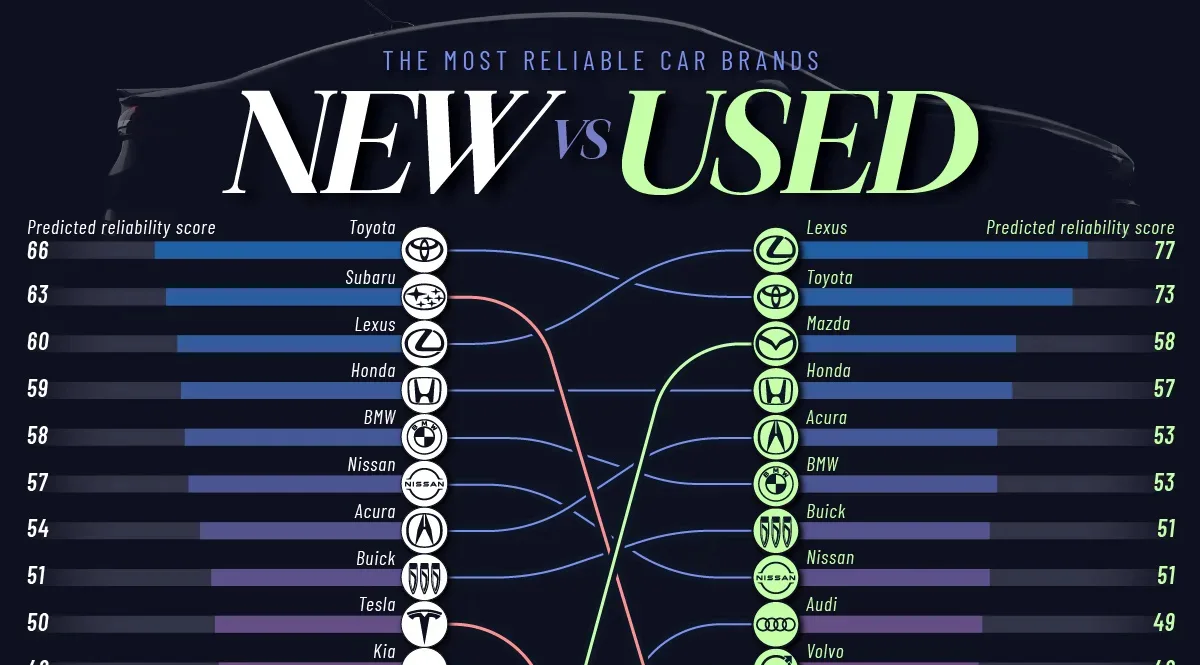
This graphic shows the most reliable new and used car brands in 2026, based on Consumer Reports data.
For the 2026 rankings, 380,000 reports were analyzed from consumers factoring in vehicle problems.
Each brand was scored on a scale of 1 to 100 based on 20 key trouble areas to arrive at the predicted reliability score. Used cars were based on problem rates on currently owned 5- to 10-year-old vehicles.
In 2026, Lexus is the most reliable brand for used cars, seeing a higher score across older vehicles than newer ones.
As a luxury brand owned by Toyota, it also ranked in the top three most reliable new cars, highlighting its performance consistency. Toyota, meanwhile, follows closely behind, also ranking highly in both categories.
Coming in at a distant third is Mazda, which ranks better for its old vehicles than its newer ones because of process changes.
In contrast, the least reliable brands for used cars were Tesla, Jeep, and Ram.
While new Teslas rank ninth across new cars, reliability plummets meaningfully given several issues with older models. Yet more promisingly, newer Model 3 and Model Ys, show above-average reliability as problem rates have declined.
Below are the most reliable new car brands:
For a deeper breakdown on this section of the ranking, check out our full ranking of new car brands also leveraging Consumer Reports data.
To learn more about this topic, check out this graphic on America’s slowest depreciating cars.
Ranked: The Most Reliable Car Brands in 2026
Ranked: The World’s Best Selling Car Brands
Ranked: Cars With the Best Resale Value in 2025
Ranked: Europe’s Best-Selling Car Brands in 2025 So Far
Ranked: The Best-Selling Cars in the U.S. So Far in 2025
Ranked: The 50 Largest Companies Outside the U.S., in 2025
Mapped: The Most Stolen Car in Every U.S. State
Japanese brands top the list.
Published
on
By
See visuals like this from many other data creators on our Voronoi app. Download it for free on iOS or Android and discover incredible data-driven charts from a variety of trusted sources.
Who makes the most reliable cars?
This visualization ranks the most reliable car brands in 2026 based on predicted reliability scores by Consumer Reports.
Consumer Reports calculated predicted reliability scores for nearly every new car, truck, and SUV by analyzing data from its annual member reliability surveys. These surveys collect detailed, self-reported information about problems owners have experienced with their vehicles.
For the most recent analysis, CR used responses covering roughly 380,000 vehicles, allowing them to identify patterns in reliability across brands, models, and powertrains. The aggregated results are then used to score and compare vehicles, highlighting trends such as differences between gas, hybrid, plug-in hybrid, and fully electric models.
Japanese brands claim six of the top seven spots in 2026. Toyota leads the list with a score of 66, followed closely by Subaru and Lexus. These manufacturers are known for conservative engineering, long model cycles, and a focus on proven technology.
Toyota vehicles are engineered to last well beyond 200,000 miles with proper maintenance, thanks to rigorous quality control at every stage of production and simplified powertrain designs that reduce potential failure points.
In addition to long-term mechanical durability, Toyota’s strong anti-theft reputation places several of its models among vehicles with the lowest theft risk.
Honda and Nissan also perform strongly, reinforcing Japan’s dominance in long-term vehicle dependability.
European automakers cluster in the middle of the rankings. BMW stands out as the top European brand, ranking fifth overall and outperforming several Japanese competitors.
In contrast, Volkswagen, Audi, Mercedes-Benz, and Volvo score in the low-to-mid 40s.
Tesla recorded the largest improvement in the rankings compared to the previous survey, moving up eight spots to ninth place. This gain is driven by strong reliability scores for the Model 3 and Model Y, which now benefit from years of incremental design refinements.
Lower-ranked brands such as Jeep, Ram, and Rivian highlight how newer platforms and performance-focused designs can face early reliability hurdles.
If you enjoyed today’s post, check out EV Global Market Share by Country on Voronoi, the new app from Visual Capitalist.
The Netherlands leads globally, with just five EVs per public charger.
Published
on
By
See visuals like this from many other data creators on our Voronoi app. Download it for free on iOS or Android and discover incredible data-driven charts from a variety of trusted sources.
As electric vehicle adoption accelerates, charging infrastructure is becoming a critical bottleneck. Countries that scale public chargers efficiently can reduce range anxiety, support faster EV adoption, and ease pressure on urban transport systems.
This visualization ranks major countries by EV charger density, measured as the number of electric vehicles per public charger as of Q3 2025. The data for this visualization comes from Benchmark Mineral Intelligence.
The Netherlands ranks first by a wide margin, with just five EVs per public charger. This reflects a highly coordinated infrastructure strategy, where chargers are often installed based on direct user requests. The result is an efficient, demand-driven network that minimizes congestion and maximizes charger utilization.
Despite having a low share of fast chargers today, the country is steadily expanding capacity. By 2030, fast chargers are expected to play a larger role as EV adoption continues to rise.
China ranks second in charger density, with nine EVs per public charger, but leads decisively in fast-charging deployment. Nearly half of China’s public chargers are already direct current fast chargers, a figure projected to exceed 50% by 2030.
Fast chargers help support dense urban populations and long-distance travel across regions, reinforcing China’s dominance in the global EV adoption.
Several European countries cluster in the middle of the rankings, with roughly 10–13 EVs per public charger.
These countries are also rapidly expanding fast-charging infrastructure, with fast chargers projected to account for around one-third of networks by 2030.
By contrast, the U.S. trails the group, with 31 EVs per public charger.
If you enjoyed today’s post, check out Top 20 Countries by Battery Storage Capacity on Voronoi, the new app from Visual Capitalist.
Ranked: The Most Reliable Car Brands in 2026
Mapped: The Maximum Extent of the Roman Empire in 117 AD
Ranked: The 35 Countries with the Highest Household Debt
How Greenland’s Rare Earth Reserves Compare to the Rest of the World
Mapped: The True Size of Greenland, Compared to Most World Maps
Charted: Life Expectancy in the World’s Largest Economies
Mapped: America’s Healthiest States, Ranked
How Billionaires Plan to Invest in 2026
Copyright © 2026 Visual Capitalist | Privacy Policy
Related Article