At Governor Maura Healey’s State of the Commonwealth address on January 22, the MBTA and her administration’s pick for General Manager, Phillip Eng, won a standing ovation. Less than a week later, in the frigid aftermath of a two-day snowstorm, the MBTA’s Red Line service–despite almost three years of recovery–was rated at its worst level in eight years, and a former state transportation official was calling for emergency steps to break the impasse on long-awaited replacements for the line’s aging trains.
After almost two decades of periodic campaigns for recovery and improvement, the MBTA in 2026 is still vulnerable to weather, and increasingly buffeted by stiffening headwinds in global trade.
The storm on Jan. 25-26 dropped two feet of snow on Dorchester, with the worst service disruptions on the Red Line, and more limited problems on the Mattapan-Ashmont trolley line. Though many US transit systems were hampered by the Covid-19 pandemic and its aftermath, the Red Line has been plagued by winter service troubles that even predate the MBTA’s near system-wide shutdown in 2015, which was triggered by a barrage of storms that hit Boston with a record snowfall of more than 100 inches.
According to the advocacy group TransitMatters, service on the Red Line, normally at 80-95 percent of scheduled levels, plunged dramatically after last weekend’s storm. On Jan. 26-28, service levels were between 29 and 38 percent, climbing to 67 percent by Jan. 30, before regaining normal levels over the past weekend.
In Twitter posts for Jan. 27 and 28, the MBTA alerted riders to Red Line delays and “residual delays” of anywhere from 10 to 30 minutes. Most were caused by disabled trains, but one hold-up caused by a train near Ashmont Station on Jan. 28 was compounded by a frozen switch that prevented a bypass for other trains. By 8:26 p.m. that day, the MBTA’s estimated time spans reports were replaced by a more general Twitter advisory: “Riders will continue to experience longer wait times due to reduced service on the Red Line after the winter storm.”
A old Red Line train as seen in a snowy Fields Corner MBTA station platform on Jan. 29, 2022 The Red Line fleet largely comprises older rolling stock that performs poorly in cold temps. Chris Lovett photo
Seth Kaplan, the co-lead for the TransitMatters labs, ranked last week’s 52 percent of scheduled service on the Red Line as the lowest since the 43 percent in February 2017, after 15 inches of snow. On Jan. 28 of this year, after the city’s eighth-highest recorded snowfall, the line had only six sets of trains in operation.
One factor in the breakdowns singled out by Kaplan was the US government’s halt in the shipment of parts for new Red Line cars that were being assembled in Springfield, Massachusetts by a subsidiary of the Chinese state-owned China Railway Roling Stock Corp. (CRRC), the world’s largest producer of passenger rail cars. Most leading global producers of railcars are based in Asia or Europe.
“Last week’s 29 percent service low is a direct symptom of a stalled fleet replacement,” Kaplan observed in an email response. “We are trying to run a major transit line using 30- to 50-year-old trains that are physically incapable of handling a Boston winter. Every day the CRRC contract remains stalled is a day we gamble with the commute of thousands. Until those new cars arrive, the Red Line will remain at the mercy of the thermometer.”
The MBTA’s deputy chief operating officer, Deirdre Habershaw, said this week that steps are already underway to prevent hold-ups caused by frozen switches and rail ties. “We are working through with vehicle maintenance if there’s anything that we can do on the older fleet in terms of components that we might be able to upgrade,” Habershaw added. “But we’re really in early days of that as we continue to look at the likelihood of receiving new cars.”
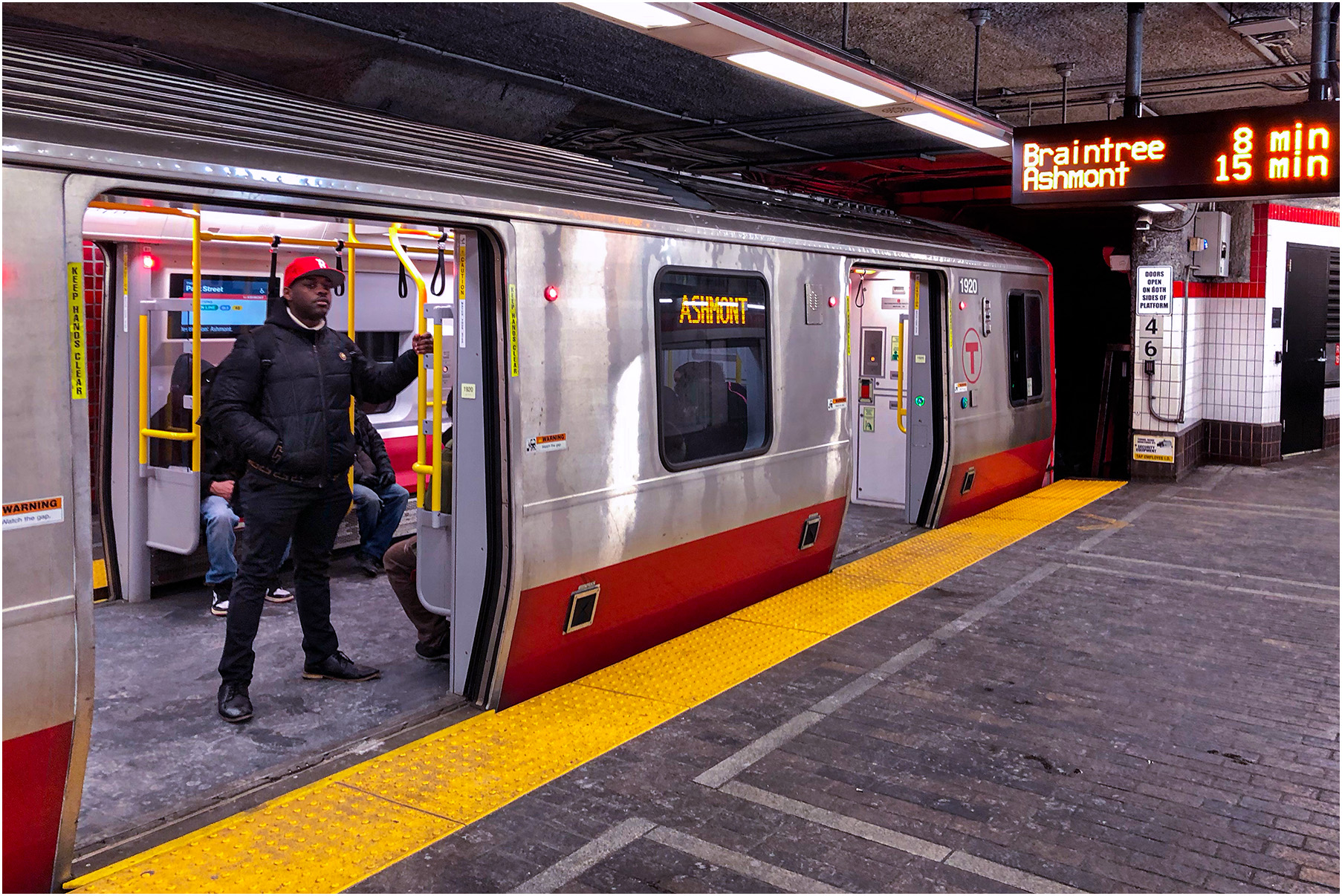
Habershaw also noted that new CRRC cars on the Red and Orange Line performed well after the storm, despite earlier problems. “They’re outperforming their contract or the requirements in their contract in terms of mean miles between failure,” she reported. “And when our car count was extremely low last week on the Red Line, we were predominantly running the [new] Red Line cars.”
A Red Line train made the crossing over the Neponset River on an icy winter day. Chris Lovett/File photo
The MBTA’s deputy press secretary, Lisa Battiston, said the agency is “really committed to working with CRRC on getting more of the new Red Line cars,” but only 60 of the 252 cars on order had been put into service as of January.
According to initial reporting in Contrarian Boston, the shipments of parts for the new trains were confiscated last year by Customs and Border Protection on grounds that they violated a US law meant to protect China’s ethnic minorities from being placed into forced labor. According to WGBH, CRRC’s subsidiary in the US maintained that it was in compliance with the law.
According to the Wall Street Journal, concerns were raised in 2019 about cybersecurity vulnerabilities of CRRC trains when the firm was trying to secure a contract with the subway system in New York City. Among those expressing concerns were members of Congress, including a high-ranking Democrat and current Senate Minority Leader, Chuck Schumer.
CRRC had secured contracts to build trains for systems in Philadelphia, Chicago, and Los Angeles in the five years or so before 2019, with the MBTA awarding the contract for new Red and Orange Line cars in 2014. But CRRC’s claims of compliance with US law have been disputed by the Rail Security Alliance (RSA), a trade group representing the manufacturing segment of the North American rail industry for freight cars and railcar components.
Last March, in a letter to the US Trade Representative, RSA reiterated its call for including rail in Trump administration tariffs on Chinese goods. “We deeply appreciated President Trump’s focus on Chinese bad actors during his first term,” the group wrote, “and were proud to work alongside his administration to start the process of blocking CRRC from further entering the North American market.”
Last October, the RSA hailed a Trump administration investigation of a 2019 trade agreement with China. In a Feb. 2 letter, the RSA also opposed CRRC contracts in Europe, accusing the company and a subsidiary of benefitting from “massive Chinese state subsidies, below-market pricing, and anti-competitive tactics.”
According to the Commonwealth Beacon, concerns about human rights violations by the CRRC’s forerunner were raised by former state Rep. Byron Rushing (D-South End) as early as 2014, when the state’s contract was announced by former governor Deval Patrick and his transportation secretary, former MBTA general manager Richard Davey.
Within weeks of succeeding Patrick as governor, Charlie Baker was faced with a collapse in MBTA service triggered by the record snowfall of 2015. According to The Boston Globe, a leading factor in the breakdowns was that train motors were still running on direct current, an older technology more vulnerable to moisture from snow that had already been phased out by many other US transit systems.
Baker formed a commission that later called for reforms and new investment in the MBTA for repairs, upgrades, and expansion. But serious problems in the system had already been cited during Patrick’s first term, in the 2009 “MBTA Review,” whose lead author was David F. D’Alessandro, the former chairman and CEO of John Hancock.
When D’Alessando’s report was released, one-third of the Red Line fleet was already 40 years old, having outrun its “useful life” by 15 years. By 2015, another 27 percent had outrun its span, as had the entire fleet by 2019.
One of the new CRRC trains in service last week on the Red Line in North Quincy. Chris Lovett photo
Jim Aloisi, a consultant, author, MIT professor, and transportation secretary under Patrick, reflected in an email on Monday about setbacks in the subway car procurement process under the current governor and her predecessor. As reported in recent years, the process had also been slowed by production problems and supply chain gaps resulting from the pandemic.
“Despite best and good faith efforts, there seems no end to barriers to the timely delivery of new subway cars. At some point, the state needs to assess the heavy cost of further delay,” Aloisi wrote, arguing for possible legal action to break the impasse, as well as emergency legislation.
“Sometimes you have to cut your losses and move on – and we may well be there with this procurement,” he concluded. “I am thinking of a two-pronged effort: Have the legislature enact into law emergency legislation that makes a new Red Line train procurement fast and efficient, exempting it from the usual procurement rules that tend to take too much time. Put money from the Millionaire Tax on the table and fast-track a new procurement with a new provider. Treat this like the emergency situation it is.”
Habershaw acknowledged that the MBTA was contending with a “complex global situation” that “extends beyond the current administration,” she said, “and I think we are trying at the ‘T’ to work the best we can through our legislative channels to advocate for what we need, but there is no simple solution.”
A Red Line commuter who lives in Dorchester, Habershaw also compared the current state of the MBTA to its year-round struggles three years ago, with more slow zones for trains and longer waits for riders.
“It has been life changing for me personally and for my family in terms of getting home earlier, a shorter commute, more reliable,” she said. “Even in the storm, we did preemptively shut down Mattapan because of how the trolley has challenges in the adverse weather, but our track department managed very well to remove that snow and get the trolley back into service pretty quickly.”
share this article:
Recent News
Donate
Newsletter
Podcast
Forry Foundation
Boston Irish
Boston Haitian
About Us
Advertising
Print Issues
Legal Notices
News
Art
Business
Opinion
School
Sports
Donate
Newsletter
Podcast
Forry Foundation
Boston Irish
Boston Haitian
About Us
Advertising
Print Issues
Legal Notices
News
Art
Business
Opinion
School
Sports
Copyright © 2025 Boston Neighborhood News, Inc. All Right Reserved. Designed by WashTone Media.