U.S. automakers are dealing with a new reality this year.
The American auto industry is coming off one of its most tumultuous years.
From new tariffs aimed at promoting American manufacturing to the end of federal electric vehicle subsidies and the efficiency credits earned by selling EVs, automakers have been rushing to reshape their lineups to align with the new market reality. One that remains very much in flux.
Will electric cars still sell? Is it time for hybrids to shine? Does everyone want a V8 truck?
With government pressure mostly relieved, it’s up to consumers to answer those questions, and there is an interesting batch of new American cars, trucks and SUVs on the way whose tires await kicking.
CHEVROLET BOLT
The Chevrolet Bolt got caught in the middle of the transition from Biden’s to Trump’s environmental policies. The subcompact electric SUV was initially scheduled to be discontinued at the end of 2023, but ended up taking a sabbatical. Chevrolet decided at the last minute to keep selling it, but only after moving production from Michigan to Kansas, which would take a couple of years.
The reborn Bolt has been updated with refreshed styling, a longer 255-mile range and lists for $28,995, which would have made it an excellent bargain if the $7,500 federal tax credit were still available. Instead, Chevrolet calls it a limited-run model without confirming exactly how long that run will be.
DODGE CHARGER
Dodge tried so hard to convince its muscle car customers to buy an electric vehicle that it put a fake V8 engine in one. The Charger Daytona was equipped with a feature that vibrated the car and blasted digital exhaust sounds out of the rear bumper. They weren’t buying it, but now there is a model that makes noise the old-fashioned way.
The Charger drops the Daytona name and electric motors and adds a turbocharged inline-six-cylinder engine under the hood. The all-wheel-drive full-size car is offered in two-door and four-door versions starting at $51,990 with 420 horsepower and $57,990 with 550 horsepower. That’s very powerful, but you can expect to hear many people complaining that it still doesn’t have a V8.
FORD F-150 POWERBOOST
The big news at Ford isn’t a new model, but one that is no longer on sale. Ford pulled the plug on the revolutionary electric F-150 Lightning late last year amid low demand and will not replace it with another large all-electric pickup. However, it is expanding its lineup of F-150 PowerBoost hybrids, which have been strong sellers even without any subsidies to help prop them up. The new entry-level $55,930 F-150 PowerBoost STX is rated at 430 horsepower and can be used as a mobile generator for electrical equipment through various outlets built into the truck.
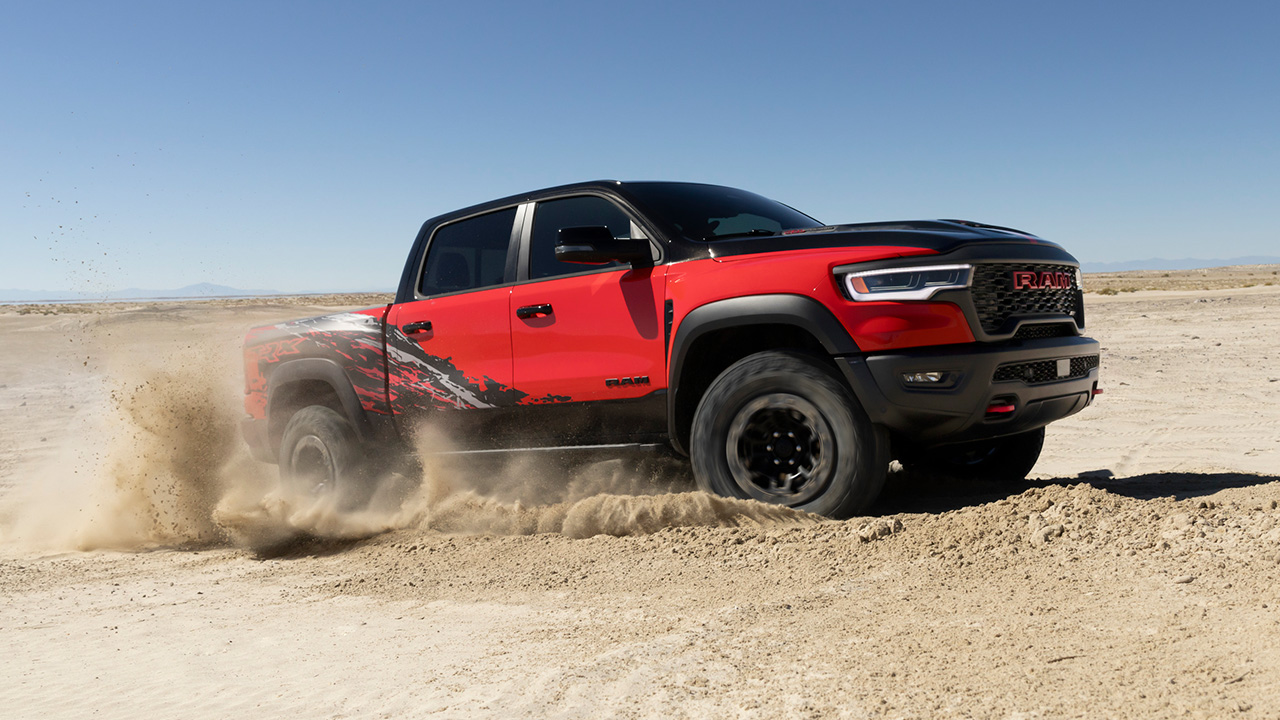
RAM 1500 REV and 1500 TRX
Ram is playing both sides of the coin with its full-size pickups. Heads is the 1500 REV, which is set to be the first extended-range electric truck sold in America. It features an electric drivetrain with a short 145-mile range, but also has a gas V6 engine on board that works as an electricity generator to stretch that to 690 miles between charges and fill-ups. Pricing hasn’t been announced, but it will cost less than the fully electric pickup Ram has decided not to build.
Tails is the 1500 TRX, a high-performance off-road model that Ram discontinued in 2024 in the face of increasingly stringent emissions rules, but has revived as the most powerful pickup with a gas engine. Its supercharged 6.2-liter V8 with 777 horsepower, and its price is a similarly high $102,590. Fuel economy? The last edition was rated at 12 mpg.
RIVIAN R2
Rivian has been following in Tesla’s footsteps since it launched five years ago. Like its electric rival, it started out selling pricey luxury vehicles, but is moving closer to the mainstream this year with the R2 that competes directly with the Model Y in the compact SUV segment that dominates the American market. The R2 features rugged off-road styling and looks just like Rivian’s larger $77,000 R1S from a distance. The R2 will have a starting price around $45,000 with a 270-mile driving range, but more expensive 300-mile and 330-mile versions will also be offered. The R2 is a make-or-break moment for Rivian, which plans to move its production to a new factory in Georgia in 2028 that will be capable of building hundreds of thousands of R2s each year if the customers show up.
TESLA CYBERCAB
Tesla’s next model is a car designed to end private car ownership. The Cybercab was optimized for use in Tesla’s Robotaxi service, which aims to provide fully autonomous ride-hailing across the country one day, but is still in the testing phase in Austin, Texas. The two-seat electric car will be the most efficient ever built when it officially debuts in April, but it is not destined to be used as a personal vehicle. Tesla will keep some for itself and sell them to people whom Tesla CEO Elon Musk has likened to shepherds tending to flocks of sheep. These stewards will see to their maintenance and send the cars off to work in the Robotaxi service each day for a cut of the fees.
Gary Gastelu is the Executive Editor of American Cars And Racing and host of the American Cars And Racing YouTube channel. He has been covering the U.S. automotive industry since 2007.
© 2026 The New York Sun Company, LLC. All rights reserved.
Use of this site constitutes acceptance of our Terms of Use and Privacy Policy. The material on this site is protected by copyright law and may not be reproduced, distributed, transmitted, cached or otherwise used.
Related Article