On the morning of Jan. 6, 2024, Detroit resident Paradise Warsaw experienced a brutal car accident alongside her daughters, Lyliah Williams and Payden Pinson.
The details remain fuzzy even a year later, but Warsaw, 30, recalls spinning out in her 2010 Ford Edge after hitting what she assumed to be a patch of black ice. The vehicle slammed into the wall of the highway on the passenger side.
All were buckled inside the vehicle when it came to a stop. Their injuries came after they exited the car.
“Just to sit there and wait ― seeing lights come, it didn’t sit right with me,” Warsaw told the Detroit Free Press recently, part of the USA TODAY Network. “You hear about people not making it inside the car. … I just couldn’t sit there and be helpless.”
Moments after vacating the Ford Edge and moving farther down the shoulder of the highway away from their vehicle, all three were struck by another vehicle.
She doesn’t remember much after that. Over the past year, Warsaw and her children have undergone numerous surgeries and months of physical therapy. Warsaw lost her job in security. Lyliah, 11, was forced to quit majorette and cheer. Payden, 7, recovered faster than her mother and sister.
Warsaw said her only health goal is to walk without a limp one day.
And after the accident, she cannot understand people who take vehicle safety for granted — in particular, not wearing a seat belt.
“I don’t get how a person can get in the car and not wear it,” Warsaw said. “People think it’s never going to happen. But life is life. What I thought would never happen to me and my kids, it happened.”
According to the National Highway Traffic Safety Administration (NHTSA), of the 23,969 passenger vehicle occupants killed in 2023 on U.S. roads, nearly half were unbuckled.
Also, passengers are less likely to buckle up when seated in the back seat.
But the main reason not to buckle up? Because you don’t have to.
Michigan law states that everyone except adults in the back seat of a vehicle must be buckled.
According to research by Dr. Matthew Seeger, professor of communication who is co-director of the Center for Emerging Diseases at Wayne State University and an expert in emergency risk communication, young men are least likely to take steps to mitigate health risks because they do not believe they are at risk.
“We saw that in COVID-19 with the mask phenomena, ‘I’m not going to wear a mask because it’s a hoax.’ If we do not believe something is risky, you won’t act,” Seeger said. “People who choose not to wear seat belts aren’t making those choices on empirical data. They came to those conclusions based on stories, or advice from Uncle Jim during Thanksgiving. Data is necessary, but not sufficient, to change behaviors.”
More traffic safety: AAA pushes drivers to obey ‘Slow Down, Move Over’ laws. What are they?
Kendra Blocker, General Motors’ lead seat belt engineer and technical specialist, is working to increase seat belt usage in vehicles. She works on seat belt reminders, which are becoming more prominent among GM’s product lines. A new NHTSA seat belt reminder rule requires the tech to be rolled out to every vehicle by September 2027, Blocker said, adding that the company was already on track to meet that goal ahead of the mandate.
“The screen on the dashboard tells me with red Xs or green check marks who is buckled up. My kids know my car doesn’t move unless they’re buckled up, but when their friends get in the car, they’re not buckling.”
The seat belt buckle reminder now comes standard for back seats as well. GM began transitioning vehicles in the 2024 model year to include the chimes and lights across the vehicle.
“Currently, the dinging seat belt reminder goes off for 90 seconds, but under NHTSA’s new rule, we have to have the chimes going off continuously until you buckle up in the front row.”
According to Michigan State Police 1st Lt. Mike Shaw, drivers are not wearing their seat belts like they used to.
In 1984, seat belt usage in Michigan was below 20%, according to the state police. It rose to 60% shortly after the law went into effect in July 1985. It then dropped to 45% before going up again, hitting an all-time high in 2009.
“These are not accidents, they’re crashes. Somebody did something they weren’t supposed to do and caused a crash. We need to get away from the idea that these crashes are not preventable,” he said. “People aren’t paying attention. We see fully marked State Police cars get broadsided. People hit fire trucks. You never realize how fast 75 miles per hour is until your butt is hanging out in traffic while you’re writing a ticket.”
According to a NHTSA survey in 2022 that looked at data from 2013-2022, seat belt compliance across the United States was approximately 91% in the front seat but only 80% for the row behind. For vehicles with third rows, compliance further fell to about 60%, according to GM.
The lack of requirements for rear passengers may be part of what fuels the myth that sitting in the back seat is safer for passengers than it actually is, Shaw noted.
“If the car is going 70 miles an hour and you crash, you’re going to continue to do 70 miles per hour until you hit something, which is usually the seat in front of you,” he said.
Even if the belt is technically “on,” it doesn’t mean it’s going to work as designed. During long car rides, some people might be tempted to slip the shoulder harness behind them or under their arm.
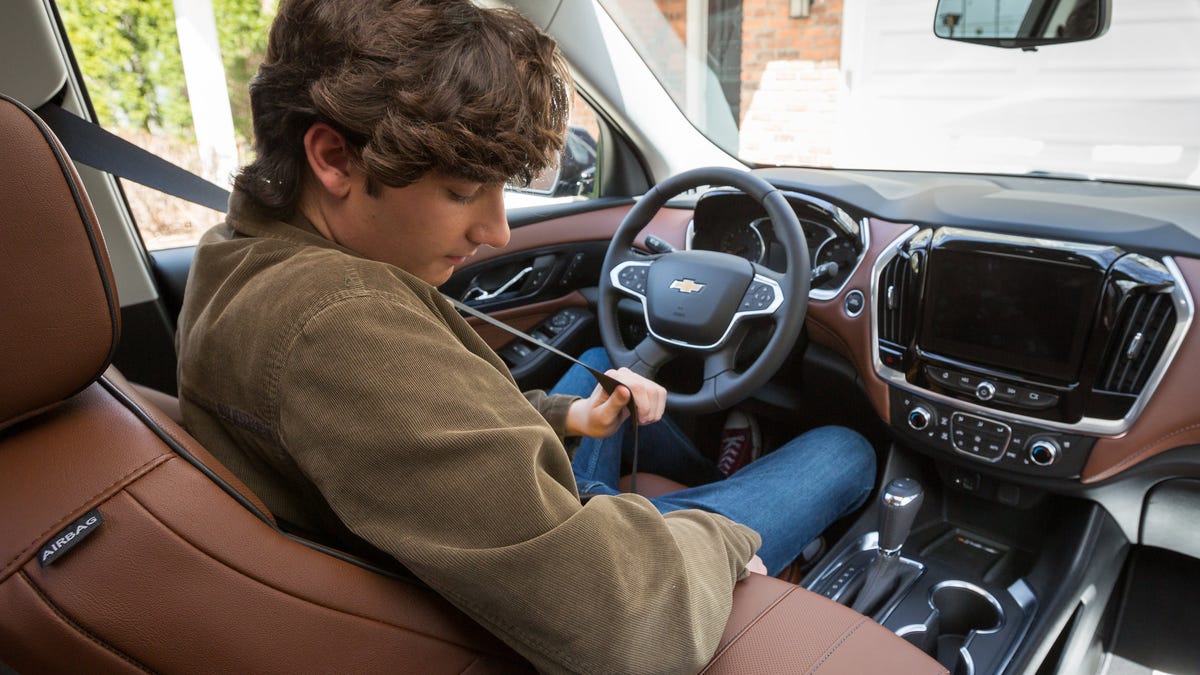
“What we use today ― the three-point harnesses ― are the best belts,” GM’s Blocker said. “You want your seat belt on your shoulder coming across your sternum, going down to your hip, and your lap belt is supposed to be on your hips so that you’re hitting the major bone joints.”
Properly worn seat belts can reduce fatalities by 45% among front-seat passengers and cut serious injuries by 50%, Blocker added, because when the belt doesn’t cover more durable points of the body during a collision, “you’re squishing organs.”
GM sells clips at the dealership that redistribute the pressure of seat belts for younger children or adults who find belts uncomfortable.
Another optional feature on GM vehicles is Buckle to Drive. When activated, the feature prevents the driver from shifting out of park for 20 seconds or until their seat belt is buckled; on many models, that applies to a front seat passenger as well, whose belt must also be buckled before the driver can shift out of park.
For the better part of 2025, Warsaw and her family have worked with physical therapists in the outpatient program of DMC Rehabilitation Institute of Michigan (RIM).
They are among approximately 1,000 RIM outpatients this year recovering from injuries sustained in vehicle crashes.
RIM, metro Detroit’s only freestanding rehabilitation hospital, accepts referrals from hospital systems across southeast Michigan and provides intensive, specialized care for a range of issues, especially those recovering from critical injuries. A majority of patients then transition to one of RIM’s 22 outpatient physical therapy centers across southeast Michigan to continue their recovery.
Kayla Zelle, a staff physical therapist at RIM working with Warsaw and her daughters, said that most injuries her facility sees when people are not restrained in a crash include head, spinal cord and neck pain from the force of striking dashboards or the roof of the vehicle. Each patient typically requires 10 to 12 outpatient physical therapy visits.
Since the accident, Warsaw said she struggles to trust other parents with transporting her kids. Even though her family always wears their seat belts, she doesn’t trust that all of her daughter’s friends and families will respond as cautiously as she now does with driving without having the same traumatic experience.
Cautionary tales and data aren’t enough without personal experience to change behavior, but Wayne State’s Seeger suggests establishing social norms in the vehicle. It’s more difficult for an individual to take a stand if most of the vehicle’s passengers support wearing the belt.
Another influential tool is humor.
One of the most effective seat belt campaigns was the crash test dummy commercials that NHTSA produced in the 1980s and 1990s. The dummies, Vince and Larry, were put through a series of circumstances designed to showcase the importance of wearing a seat belt, like one spot that showed they trusted front airbags but then got hit from the side, and because they weren’t buckled, they flew out a vehicle door.
“It’s funny, it’s memorable — we can latch onto it,” Seeger said of the TV spots. “It’s better than an argument. When you argue with people about why they aren’t wearing seat belts, they have to create an argument as to why it’s OK for them not to wear a seat belt. You’re forcing them to double down on that belief system through a narrative of defense.”
Shaw said he has seen fatalities from what his department considers minor collisions simply because passengers in the back weren’t buckled up. Ultimately, he said, the fault lies with the driver.
“It’s your car, you have to take responsibility for what’s happening inside that car. If you’re the designated driver, you shouldn’t drink at all. It’s the same thing with seat belts. If (your passengers) are bouncing around the interior of that vehicle, one thing they may strike is you.”
His advice to drivers if someone doesn’t want to wear a seat belt?
“Tell them to take an Uber.”
Jackie Charniga covers General Motors for the Free Press. Reach her at jcharniga@freepress.com.
Related Article