Rahul Kapoor has been chasing cars on track, on the road, and occasionally on foot since 2014. His work has appeared in autoX, Motown India, and The Financial Express, covering everything from the latest EV tech to 1960s endurance racers. He’s not just a writer; he’s a photographer, videographer, and someone who’s actually lived inside the industry’s moving parts; attending launches, test-driving on race circuits, and talking shop with engineers, designers, and team principals. That mix of access and curiosity means his readers don’t just get the news; they get the story behind the story.
Performance cars now lean heavily on turbochargers, superchargers, and electrification to meet power, efficiency, and emissions targets. Naturally aspirated engines still exist, but they no longer define the segment. They sit on the margins, reserved for specific platforms where response, sound, and mechanical simplicity remain priorities. That shift has narrowed the field, especially for buyers looking at new cars sold in the United States.
This list follows a strict methodology. Every vehicle qualifies as a performance car based on output, chassis dynamics, and driving focus. None use turbocharging, supercharging, or hybrid assistance. All are available new in the US market. What follows is a factual inventory of what remains, grounded in specifications and current production reality, without nostalgia or speculation. Intro
The Porsche 911 is still the go-to sports car for captains of industry and motoring enthusiasts alike, but there are other great options too.
Engine
Transmission
Power
Torque
2.0L inline-4
6-speed manual/automatic
181 hp
151 lb-ft
The Mazda MX-5 Miata qualifies because performance is not defined by horsepower alone. Its 2.0-liter naturally aspirated inline-4 produces 181 hp, but curb weight sits just over 2,300 lbs, depending on trim. That power-to-weight ratio, combined with rear-wheel drive and a longitudinal engine layout, gives the Miata a level of responsiveness many heavier, more powerful cars cannot match.
Mazda offers the Miata with a 6-speed manual or a 6-speed automatic, keeping the mechanical layout simple and driver-focused. Throttle response remains immediate because there is no turbocharger masking pedal inputs. Steering feedback and chassis balance do the rest.
The MX-5 platform continues to dominate grassroots racing and frequent track-day grids sanctioned by organizations like the SCCA. The Miata’s continuity across generations reinforces its place here as a modern performance car built around efficiency rather than output. Its consistent success in amateur motorsports and spec racing underscores how effectively the chassis converts modest output into repeatable, measurable performance.
Engine
Transmission
Power
Torque
2.4L flat-four
6-speed manual / automatic
228 hp
184 lb-ft
The Toyota GR86 and Subaru BRZ represent one of the last affordable entries into naturally aspirated performance. Their shared 2.4-liter flat-four produces 228 hp and 184 lb-ft of torque, a clear improvement over the previous generation in both output and midrange response. The engine remains naturally aspirated, preserving linear power delivery and predictable throttle behavior.
Both cars offer a 6-speed manual, reinforcing their driver-first intent, while an automatic remains available for broader appeal. Although the platform is shared, suspension tuning and steering calibration differ slightly between the two, giving each a distinct feel. Compared to turbocharged hot hatches with similar acceleration figures, these coupes trade outright torque for balance, lower insurance costs, and mechanical simplicity.
The FA24 engine stands as a rare example of a modern naturally aspirated design optimized for reliability and consistency rather than peak numbers. By avoiding forced induction, the GR86 and BRZ maintain predictable heat management and power delivery during extended spirited driving or track use.
Engine
Transmission
Power
Torque
5.0L V8
6-speed manual / 10-speed automatic
480–500 hp
418 lb-ft
The Ford Mustang GT and Dark Horse sit at the opposite end of the spectrum as large-scale, naturally aspirated V8 performance cars. Both rely on the 5.0-liter Coyote V8, producing between 480 hp in the GT and tuned to 500 hp in the Dark Horse. In a market dominated by downsized turbo engines, this remains a rare commitment to displacement and airflow.
Ford pairs the Coyote V8 with rear-wheel drive and offers a 6-speed manual alongside a 10-speed automatic. Production volume separates the Mustang from niche sports cars, keeping pricing and parts availability realistic. Compared to the turbocharged Mustang EcoBoost, the naturally aspirated V8 delivers cleaner throttle response and avoids the thermal and long-term stress associated with forced induction.
The Coyote V8’s durability across street, track, and drag-strip use helps explain why Ford continues to refine the platform rather than replace it with smaller, boosted alternatives. On the Mustang S650 platform, the GT and Dark Horse continue to prove that mass-market performance can still rely on natural aspiration.
Engine
Transmission
Power
Torque
5.0L V8
10-speed automatic
471 hp
398 lb-ft
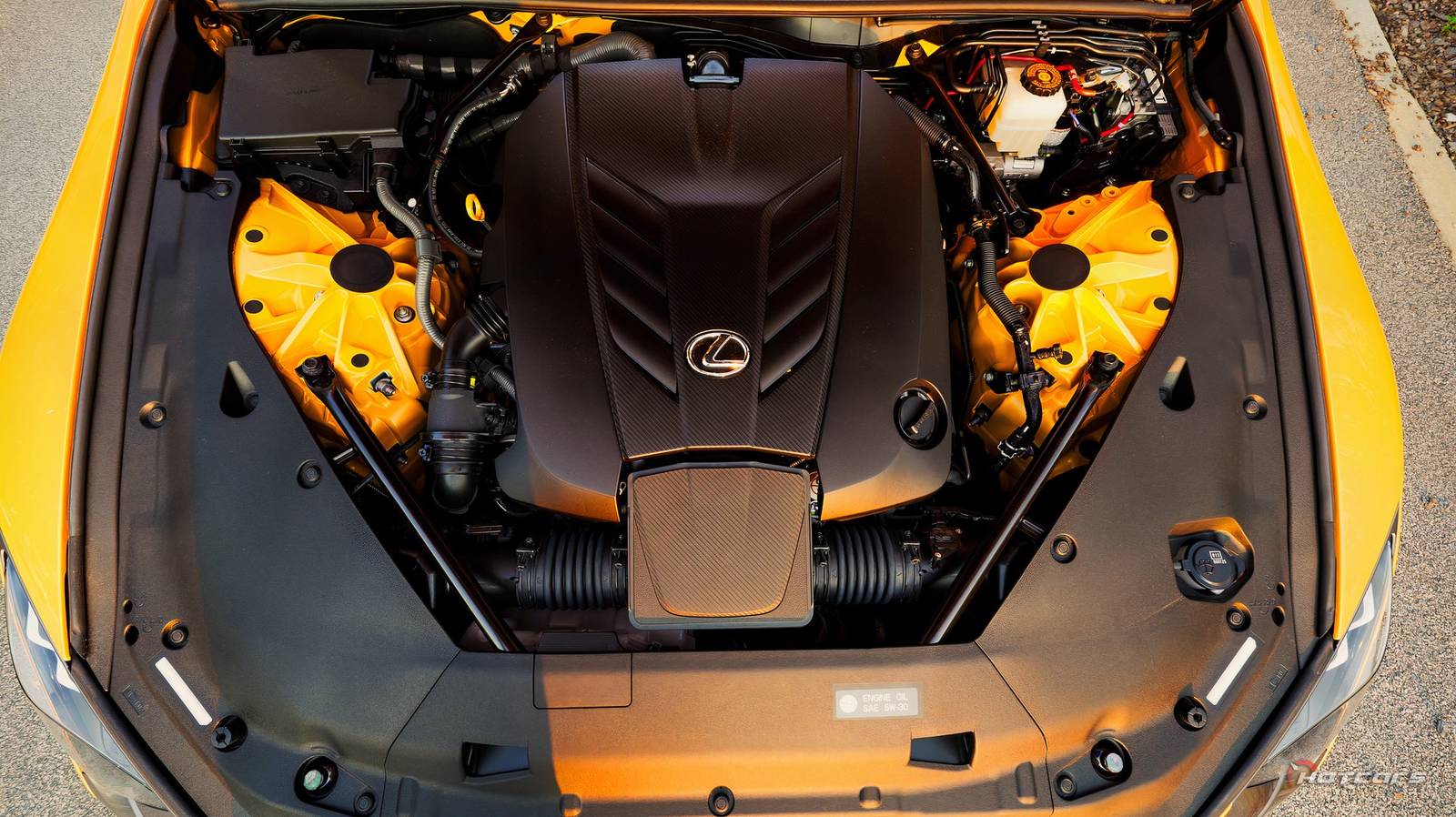
The Lexus LC 500 approaches performance from a different direction. Its 5.0-liter naturally aspirated V8 delivers 471 hp with a high redline and a linear power curve that prioritizes smoothness and consistency over outright aggression. This engine philosophy feels increasingly rare in the luxury GT space, where turbocharging has become the default solution for power and efficiency.
The LC 500 comes exclusively with a 10-speed automatic, reinforcing its role as a long-distance performance coupe rather than a track-focused car. The chassis favors stability at speed, and the powertrain remains relaxed during extended highway use. Build quality and long-term reliability continue to distinguish the LC from turbocharged German rivals, which often trade complexity for peak output.
The LC 500 stands as a deliberate commitment to an old-school naturally aspirated formula within a modern luxury platform. Unlike many modern GT cars, the LC 500 emphasizes sustained refinement and engine character over short bursts of boosted acceleration.
Engine
Transmission
Power
Torque
6.2L V8
8-speed DCT
495 hp
470 lb-ft
The Chevrolet Corvette Stingray proves that naturally aspirated engines still scale to serious performance. Its 6.2-liter LT2 V8 produces 495 hp and 470 lb-ft of torque, mounted behind the driver in the C8’s mid-engine layout. The result is sub-3-second 0–60 acceleration without turbochargers or hybrid assistance.
Chevrolet pairs the LT2 exclusively with an 8-speed dual-clutch transmission, prioritizing shift speed and consistency. The mid-engined C8 platform benefits from increased rigidity and improved cooling compared to previous generations, allowing sustained performance without thermal compromises. The LT2’s broad torque curve allows the Stingray to deliver supercar-level acceleration without relying on aggressive gearing or artificial torque fill.
When priced against European mid-engine rivals with similar acceleration figures, the Stingray undercuts them significantly while maintaining comparable real-world pace. Strong sales volume reinforces its relevance as a mass-produced performance car that still relies entirely on natural aspiration.
America makes the world’s most powerful naturally aspirated V8, and it makes its peak power at a stratospheric 8,400 RPM.
Engine
Transmission
Power
Torque
5.5L V8
8-speed DCT
670 hp
460 lb-ft
The Chevrolet Corvette Z06 represents the technical ceiling of naturally aspirated road cars still sold new. Its 5.5-liter LT6 V8 uses a flat-plane crankshaft, revs to 8,600 rpm, and produces 670 hp without forced induction. These figures place it firmly in supercar territory through airflow and engine speed alone. Achieving this output without turbochargers places unusual demands on materials, valvetrain design, and airflow efficiency, highlighting the LT6’s engineering focus. Today, the Corvette Z06 is the most powerful naturally aspirated V8 ever made.
An 8-speed dual-clutch transmission manages the power, while the chassis integrates racing-derived aerodynamics and cooling solutions influenced by programs like IMSA GTD. Compared to turbocharged European supercars that achieve similar outputs through boost, the Z06 maintains immediate throttle response and mechanical simplicity. That combination strengthens the headline claim by demonstrating that natural aspiration can still deliver extreme performance when engineering priorities focus on efficiency, materials, and precision rather than forced airflow.
Engine
Transmission
Power
Torque
6.5L V12
8-speed DCT
715 hp
528 lb-ft
The Ferrari Purosangue stands apart as the only naturally aspirated V12 performance vehicle sold new that also seats four adults. Its 6.5-liter V12 delivers 715 hp and a high redline typically reserved for Ferrari’s two-door models, paired with an 8-speed dual-clutch transmission and rear-biased all-wheel drive. Despite its unconventional body style, the powertrain remains uncompromised.
Ferrari engineered the Purosangue around chassis balance, suspension control, and engine placement rather than utility-first priorities. Compared to turbocharged luxury performance SUVs that depend on boost for low-end torque, the Purosangue delivers linear response and sustained high-rpm performance. That approach reinforces the headline claim by proving that natural aspiration still survives even in segments where forced induction has become nearly universal, provided the manufacturer commits fully to the engineering tradeoffs.
Engine
Transmission
Power
Torque
6.5L V12
8-speed DCT
819 hp
500 lb-ft
The Ferrari 12Cilindri exists almost as a defiant statement. Its 6.5-liter naturally aspirated V12 produces 819 hp and revs beyond 9,000 rpm without turbochargers, superchargers, or hybrid assistance. Ferrari designed this engine around airflow, rotational speed, and internal efficiency rather than boost, continuing a lineage that traces directly back to its front-engine V12 grand tourers.
Power goes to the rear wheels through an 8-speed dual-clutch transmission, emphasizing precision and stability at high speed rather than theatrical acceleration tricks. In a market where most rivals rely on turbocharged V8s or electrified assistance to reach similar numbers, Ferrari demonstrates that extreme performance remains achievable through natural aspiration alone, albeit at a scale and cost few manufacturers can justify.
Sources: Mazda, Ford, Chevrolet, Lexus, Toyota, Ferrari
We want to hear from you! Share your opinions in the thread below and remember to keep it respectful.
Your comment has not been saved
This thread is open for discussion.
Be the first to post your thoughts.