Rahul Kapoor has been chasing cars on track, on the road, and occasionally on foot since 2014. His work has appeared in autoX, Motown India, and The Financial Express, covering everything from the latest EV tech to 1960s endurance racers. He’s not just a writer; he’s a photographer, videographer, and someone who’s actually lived inside the industry’s moving parts; attending launches, test-driving on race circuits, and talking shop with engineers, designers, and team principals. That mix of access and curiosity means his readers don’t just get the news; they get the story behind the story.
Many expect the largest displacement V8 to sit under the hood of a pickup truck or a muscle car, but that isn’t the case in 2026. Large-displacement V8s have quietly disappeared from new-car showrooms. Emissions rules, downsized platforms, and turbocharged alternatives have pushed engine size down even as performance numbers climb. But some naturally aspirated engines are making a comeback.
Displacement shapes how an engine delivers torque, how it sounds under load, and how it behaves without forced induction doing the heavy lifting. The question is no longer which V8 makes the most power. It is whether any truly big V8s remain in production at all. Among the few survivors, one current model still stands apart on displacement alone under the hood of an SUV.
There has been no shortage of huge V8 engines over the years, but which lump takes the crown with the largest displacement ever?
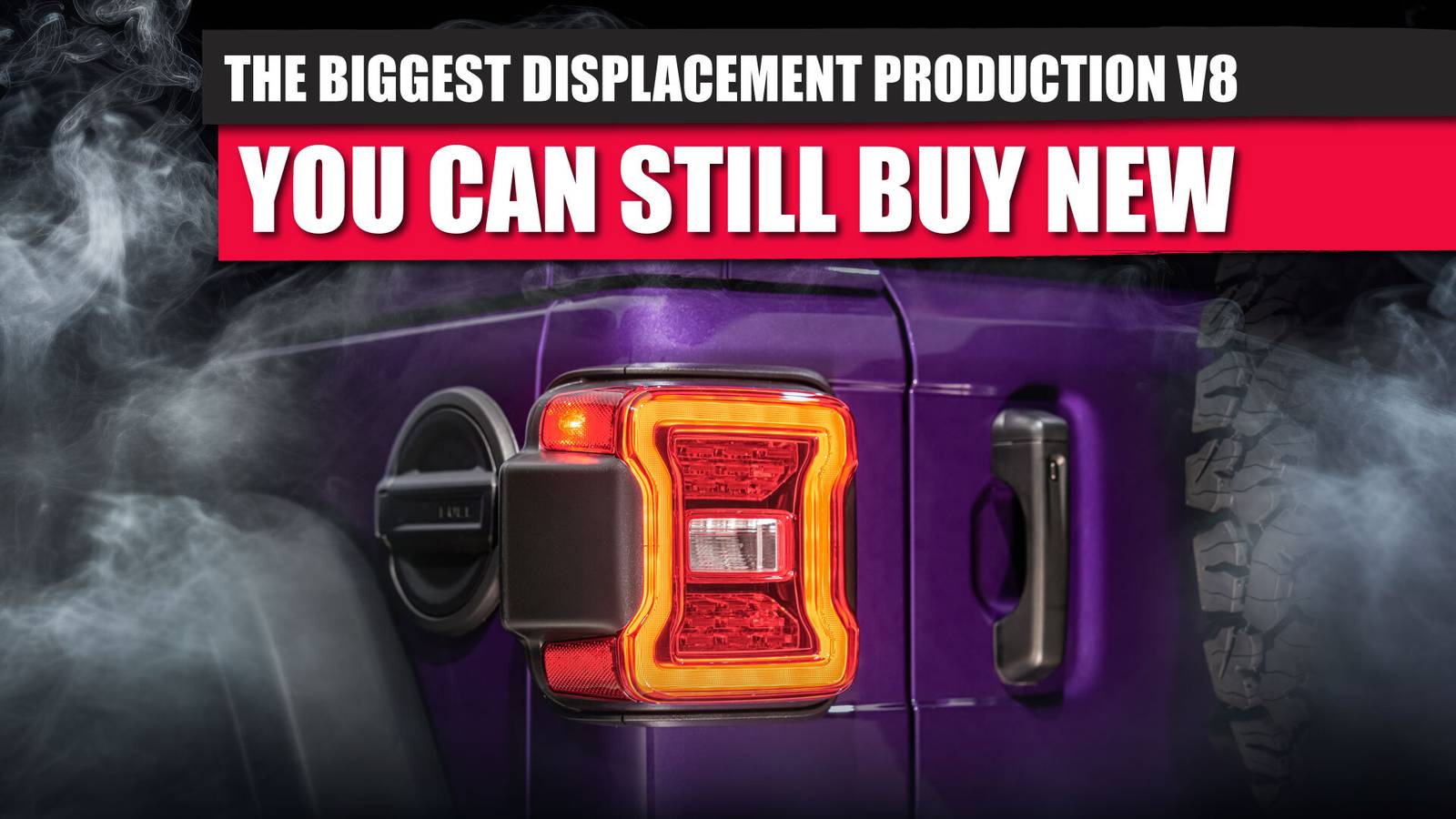
The largest displacement production V8 you can still buy new is a 6.4-liter naturally aspirated Hemi V8, and it comes in the 2026 Jeep Wrangler Moab 392.
No other new production vehicle on sale today offers a larger V8 by displacement. Everything above that number either disappeared years ago, exists only as a crate engine, or comes in a different engine configuration entirely. Modern supercharged and turbocharged V8s may produce more power, but they do so with smaller engine blocks and forced induction. On displacement alone, the 6.4-liter Hemi stands at the top.
Engine
Transmission
Power
Torque
6.4-liter HEMI V8
8-Speed Automatic
470 hp
470 lb-ft
This engine displaces 392 cubic inches and remains naturally aspirated, producing 470 hp and 470 lb-ft of torque. It is installed at the factory, sold through Jeep dealers, and available to order for the 2026 model year. Limited-run conversions, aftermarket builds, and discontinued halo cars do not qualify when the question is about what buyers can purchase new today.
The Wrangler Moab 392 qualifies because it meets every practical definition of a production vehicle. It is not a special-access model, not a homologation exercise, and not restricted to fleet or commercial buyers. It is a retail SUV built by Stellantis and sold nationwide.
Modern V8 availability has narrowed sharply across sedans, coupes, and sports cars as manufacturers chase efficiency targets and fleet averages. The fact that this engine survives at all reflects a specific market window and a platform willing to accommodate it, but that window is closing fast.
Engine
Manufacturer
Displacement
Induction
Vehicle Type
Hemi V8
Stellantis
6.4 liters
Naturally aspirated
SUV
Hellcat V8
Stellantis
6.2 liters
Supercharged
Coupe, sedan
LT2 V8
General Motors
6.2 liters
Naturally aspirated
Sports car
LT6 V8
General Motors
5.5 liters
Naturally aspirated
Sports car
Voodoo V8
Ford
5.2 liters
Naturally aspirated
Sports car
The continued availability of the 6.4-liter 392 Hemi V8 has less to do with nostalgia and more to do with packaging, regulation, and platform choice. Most modern cars cannot physically or legally support an engine of this size without major compromises. But the Wrangler Moab definitely can.
The Wrangler’s body-on-frame layout, generous engine bay, and higher ride height allow Jeep to package a large-displacement V8 without the cooling, crash, and emissions penalties that would sink the same engine in a low-slung car. SUVs and trucks also operate under different regulatory assumptions than passenger cars, which gives manufacturers more flexibility at low volumes.
Naturally aspirated engines generate less heat than boosted alternatives, reduce sustained thermal stress, and avoid the added complexity of intercoolers and pressurized intake systems. In off-road and low-speed applications, consistent torque delivery and predictable heat management matter more than peak output.
Low-volume performance trims create a survival path. By limiting production and pricing the vehicle accordingly, manufacturers can justify continued development and certification without reshaping the entire lineup. The Moab 392 fits that role, blending luxury and off-road capability while serving as a halo for Jeep’s V8 heritage.
This strategy sits within a broader approach from Stellantis, which has shown a willingness to keep legacy powertrains alive in select applications rather than replace them outright. Jeep buyers still expect mechanical authenticity, and the Wrangler remains one of the few platforms where that expectation aligns with regulations.
The 6.4-liter 392 Hemi is the largest-displacement V8 still available in a new production vehicle in 2026. But modern performance V8s are split into two camps. One side leans on forced induction to make power from a smaller displacement. The other relies on high-revving, tightly engineered naturally aspirated designs. The Hemi plays a different game, prioritizing engine size and low-rpm torque over boost or high revs.
The Dodge Challenger SRT Hellcat uses a 6.2-liter supercharged V8. It makes far more power, but it gives up displacement and depends on boost to do it. The base Corvette C8 Stingray is powered by the 6.2-liter LT2 V8, which is still smaller than the 392 in the Wrangler Moab. The Ford Mustang Shelby GT350 runs a 5.2-liter flat-plane Voodoo V8 designed to spin past 8,000 rpm. The Chevrolet Corvette Z06 goes smaller still with a 5.5-liter LT6, chasing power density and response through airflow and revs.
These engines are designed to be efficient, high-performance, and compliant with modern emissions targets. The Hemi’s advantage is simpler. More displacement means more air and fuel per revolution without relying on boost or extreme engine speeds. That matters for durability, thermal control, and consistent torque delivery, especially in a heavy four-wheel-drive platform.
Mopar V8s have powered the coolest and fastest muscle cars since before there were muscle cars. Here’s how they rank.
Engine
10.3L Naturally-Aspirated V8
Horsepower
1,004 hp
Torque
876 lb-ft
Price
$32,935
If production vehicles cap out at 6.4 liters, crate engines tell a very different story. Chevrolet Performance sells the ZZ632/1000, a naturally aspirated big-block V8 displacing 10.3 liters or 632 cubic inches. It produces 1,004 hp, 876 lb-ft, and carries a list price of $32,935. That makes this 10.3-liter V8 the largest crate V8 engine you can buy in 2026.
The 632 cu-in ZZ632/1000 uses a fully forged rotating assembly, anchored by a billet steel hydraulic roller camshaft. It features new high-flow spread-port cylinder heads adapted from Pro Stock racing technology. Supporting hardware includes roller-style forged aluminum rocker arms, forged 2618 aluminum pistons, and an aluminum high-rise single-plane intake manifold.
That engine proves that displacement alone no longer defines how cars are engineered. The crate market exists because modern production platforms cannot absorb engines this large while meeting emissions, packaging, and durability targets. The Hemi wins strictly on size only within the boundaries of street-legal, factory-backed vehicles you can still buy new.
This massive engine operates on sixteen cylinders and powers one of the most powerful production cars ever made.
The 6.4-liter Hemi exists because it fits into a shrinking window that most modern cars no longer allow. Emissions rules now prioritize fleet averages over individual halo models. Every large-displacement engine has to justify itself against hybrids, turbocharged six-cylinders, and electric drivetrains that lower the overall numbers.
As a result, SUVs and trucks remain the last safe harbor for big V8s. Their higher weight ratings, lower sales volumes in performance trims, and buyer expectations give manufacturers limited room to keep engines like this alive. That is why the largest production V8 you can still buy new lives in a Wrangler, not a coupe or sedan.
The pressure to electrify powertrains compounds this issue. Performance models increasingly use electric torque to replace displacement. Smaller engines paired with e-motors deliver quicker acceleration and cleaner certification numbers. From a regulatory standpoint, that solution scales better than a large naturally aspirated V8.
The likely future path is already clear. High-output turbocharged V8s will survive for a short time in limited, tightly controlled applications, while naturally aspirated large-displacement engines will be pushed into low-volume trims where they can still be justified. For buyers who care primarily about displacement, crate engines and restorations will increasingly become the only realistic outlet as production offerings continue to narrow.
General Motors, Ford, and Stellantis are no longer developing larger-displacement production V8s. That makes the 6.4-liter Hemi a closing chapter. It survives because the platform allows it, not because the industry still wants engines this big in abundance.
Sources: Stellantis, General Motors, Ford
We want to hear from you! Share your opinions in the thread below and remember to keep it respectful.
Your comment has not been saved
This thread is open for discussion.
Be the first to post your thoughts.
Related Article