“Innovation” is a tricky word to define in the automotive world. Does it mean constantly introducing state-of-the-art technology? Regularly producing fresh new models instead of continuing to build and sell old ones, even if they are still popular with consumers? Or simply staying on top of overall trends dominating the market, such as electrification or the rise of the subscription model?
The answer isn’t clear-cut, but luckily the automotive experts at J.D. Power have made an attempt at pinning down the definition. The J.D. Power 2025 U.S. Tech Experience Index (TXI) Study, released in the latter half of 2025, paints an overall picture of innovation in the automotive market, with a few core findings regarding the state of technology in today’s car world.
From the rise of AI (now pretty much ubiquitous in all aspects of technology and everyday life, even cars) to more mundane features like “car wash mode”, the J.D. Power study has captured the current state of automotive technological innovation. Let’s take a look at some of the study’s key findings, and the brand that the study has marked as the least innovative in America: Chrysler.
Impressive technology developments drive this young brand’s success
The J.D. Power study revealed a mixed bag of positives and negatives about the use of technology in the automotive world, with some features bringing a net benefit and others not quite capturing the public’s attention. Here are some of the study’s most important findings about technological innovation in today’s cars.
Smart technologies are a win: Some “smart” features, like intelligent climate control systems that automatically adjust the vehicle’s HVAC system to improve passenger comfort, are becoming more effective and useful. Customers are reporting fewer problems and more overall satisfaction as years go by, indicating the technology is going in the right direction.
Car wash mode is not quite there yet: Some modern cars (one notable example is the Tesla Cybertruck) are equipped with a new feature called “car wash mode”, which performs automatic functions such as closing windows and disabling wipers; however, this feature has not received good feedback from users, who have reported it can be complicated to find and difficult to use when needed. There is some more work to do for automakers wishing to implement this feature in their vehicle.
A recent Tesla customer’s issue with bringing their Cybertruck through a car wash has raised concerns about the vehicle’s Car Wash Mode feature.
In-vehicle payment technology may finally be having its moment: previous attempts to implement built-in payment tech in vehicles were hampered by technical imitations, however, today’s technology may finally be making seamless in-vehicle payments (for things like charging, fuel, or parking) possible.
Recognition and authentication tech is a problem area: one of the biggest issues faced by modern automotive tech features is the quality of recognition and authentication technology, such as biometric authentication.
Blind spot cameras are popular with drivers: 93% of drivers in the study reported using their blind spot camera most of the time. 74% say they wish to have one in their next vehicle. Cars equipped with this feature are also more likely to sell quickly compared to ones that don’t.
The J.D. Power study did not just analyze the evolution of automotive technology and innovation in 2025, but it also included a ranking of which automakers are considered the most and least innovative. This ranking was produced by assessing how effectively each automaker brings new forms of technology to the market. The level of adoption of new technologies is just one part of the equation; the score is also created by evaluating car owners’ feedback regarding these technologies and the number of issues they experienced while using them.
The brand that found itself at the very bottom of the ranking is an American company that has a long, illustrious history of producing stylish, innovative cars, but is now a shadow of its former self: Chrysler. The company’s placement at the bottom of the innovation table might put a dampener on what is currently a year of celebration for Chrysler; despite not being as much of a major player in the automotive world as it used to be, the brand is currently celebrating its 100th anniversary, with dedicated displays and past and present concept cars being showcased at automotive events.
Chrysler is currently a minivan-only brand, with just two models available in its lineup: the Voyager and the Pacifica, the latter also being offered in plug-in hybrid form. The Voyager has been on the market since 1988, with the current generation going on sale for the 2020 model year. The Pacifica is a more recent model, having been introduced in 2017 to replace another minivan, the Town & Country.
While Chrysler may have been branded as the least innovative automaker out there today, for a large portion of its history things were very different. Chrysler has stood out several times over the years for its approach to innovation and technology, right from its very beginning as a company.
How the Chrysler Airflow helped shape the automotive industry forever.
In the 1930s, a model called the Chrysler Airflow helped introduce the concept of aerodynamics to the mainstream car market. It was the first mass-produced car to be created using a wind tunnel as part of the design process; while a few one-off concept cars built around that time period, like the Rumpler Tropfenwagen or the Dymaxion Car, were built with aerodynamic principles in mind, the Airflow helped popularize aerodynamics in the mainstream. One of the people instrumental in the Airflow’s creation was Orville Wright, the legendary pioneer of aviation who built and flew the world’s first airplane.
Three decades later, with the Jet Age in full swing, Chrysler once again found itself at the forefront of engineering research with its attempt (or rather, several attempts) to build a turbine-powered car. While the first Chrysler prototype fitted with a turbine engine was built in 1954, it was in the ’60s that the fourth car in the series got the closest to an actual production run. A large public testing program was launched, with members of the public trying out the Turbine Car for themselves. The project never led to a production model, and eventually fizzled out by the early ’80s, but it is still testament to Chrysler’s willingness to explore new methods of propulsion.
The history of Chrysler’s one-of-a-kind Turbine Car, and why it didn’t work out.
In 2005, Chrysler also pioneered the Stow ‘n’ Go system, which allows the seats on the brand’s minivans to fold quickly and easily into the floor. This creates additional cargo space for items such as camping or sports gear. The seats are also equipped with in-floor bins, accessible even when the seats are not stowed.
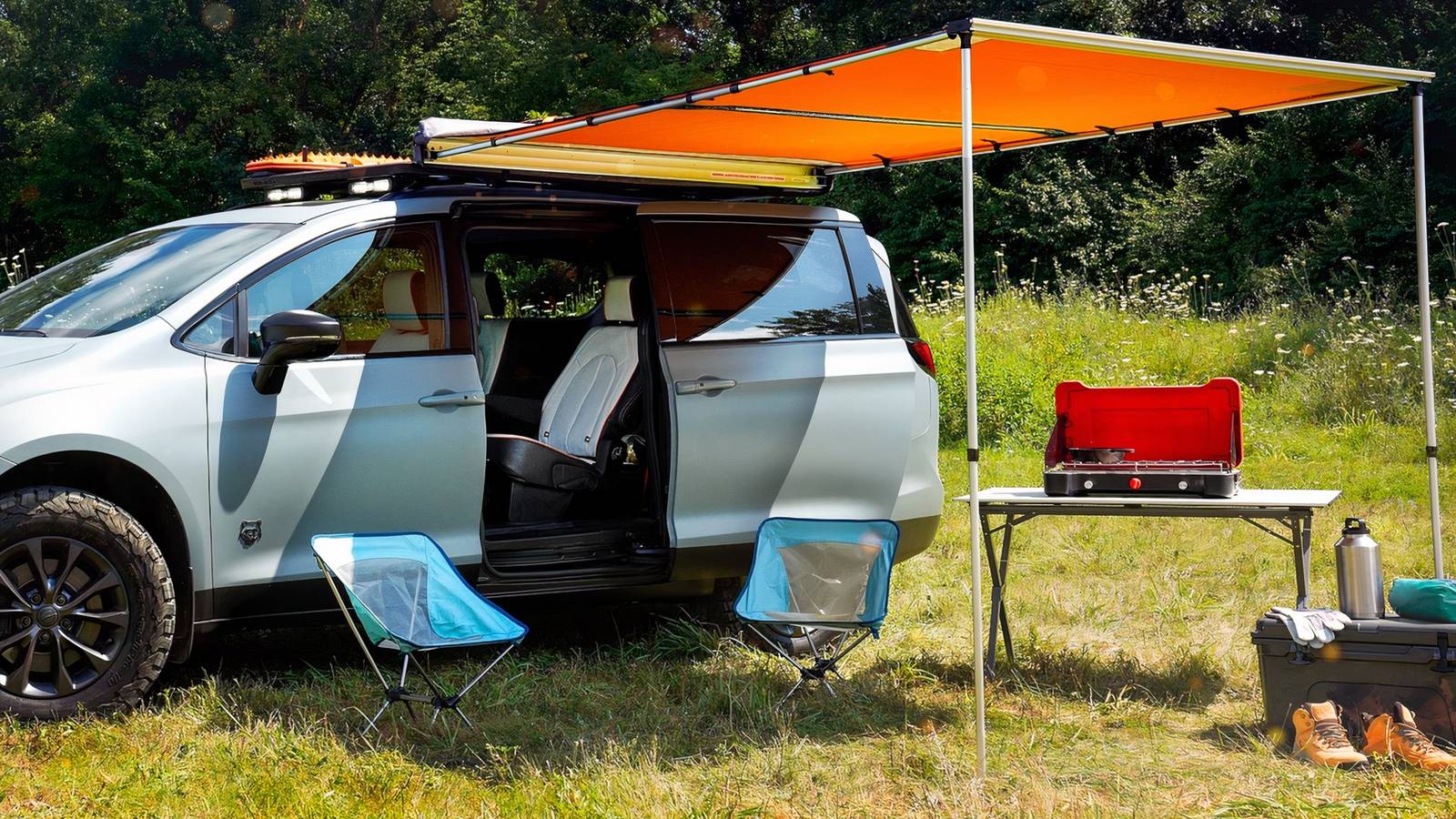
As Chrysler’s focus in the present day has shifted entirely on producing minivans, its attempts at innovation and looking towards the future are also confined to the world of minivans. The emphasis is squarely on the word “attempts”, since the latest Chrysler concept vehicle barely departs from the original model. The concept in question is the Pacifica Grizzly Peak, named after a mountain in California.
This vehicle attempts to fuse the world of minivans with the world of off-roaders, creating a vehicle supposedly capable of tackling rough terrain and offering space to sleep while on the move. The suspension is lifted by 2.75 inches at the front and 2.5 inches at the rear. The third row of seats was replaced with a cargo floor panel, and a roof rack was added for additional storage. A few additional touches, like a retractable awning, splash guards, and a protective wrap on the lower body panels, complete the package.
Other than the minivan above, all Chrysler has in the coming months is a facelift on the Pacifica. It appears as if Chrysler is at least making some big changes, which put it in a good position considering the way the minivan segment is heading.
Sources: J.D. Power, Chrysler
We want to hear from you! Share your opinions in the thread below and remember to keep it respectful.
Your comment has not been saved
Value for the mony: 10 out of 10. And I’m speechless.