Dan Mihalascu is an accomplished automotive journalist with over two decades of automotive media work both internationally and in his home country of Romania.
He holds a bachelor’s degree in journalism from Lucian Blaga University of Sibiu, and he has reviewed (sometimes even raced) cars for most of his professional life.
Prior to joining HotCars.com in July 2025, Dan worked as a news writer and editor for InsideEVs.com, CarScoops.com and Autoevolution.com. He also has bylines at DriveMag.com and ConsumerAffairs.com, among other international media outlets.
In Romania, he wrote for car magazines, sports newspapers and even a TV news station.
Writing and cars aside, he loves reading, cycling, hiking and spending quality time with his family.
While tech enhances car safety, infotainment, connectivity, efficiency, and performance, among other things, not all drivers are happy with how it affects the driving experience. Many car enthusiasts still like their cars analog, with as little digital tech as possible, especially in key areas the driver interacts with, such as the engine, steering, transmission, and user interface. But with naturally aspirated engines, manual transmissions, and physical buttons being “endangered species” in today’s automotive landscape, the pool of available analog performance cars is getting smaller by the year.
Thankfully, you can still buy one in the U.S. in 2026, with the most obvious picks being the Mazda MX-5 Miata and the Toyota GR86/Subaru BRZ twins, which start from around $30,000. But as fun as these affordable sports cars are to drive, they lack in the power department. The 400-hp Nissan Z and 382-hp Toyota GR Supra are a step above both in terms of performance and price, although they’re still reasonably priced from around $43,000 and $58,000, respectively.
If you’re willing to spend more than $100,000, you’ve got fast but very expensive options, like the Porsche 718 Cayman/Boxster GTS 4.0 or the Porsche 911 GT3 (the latter costs over $230,000), or the Lotus Emira V6, which starts from around $113,000. All these cars have manual transmissions and rear-wheel drive, although not all feature naturally aspirated engines. As you can see, Japan and Germany dominate the market for analog sports cars.
Things are a little different in the US, where the market is dominated by automatics and high-powered EVs. Old-school American analog performance cars are virtually extinct. The Cadillac CT5-V Blackwing carries the torch as America’s last manual-transmission sports sedan on the market, but it’s not a true two-door sports coupe and it’s not naturally aspirated, leaving just one American car as the country’s only truly analog sports car in 2025. And it’s surprisingly affordable.
These overachieving four-bangers might convince you that there is a replacement for displacement after all – turbos.
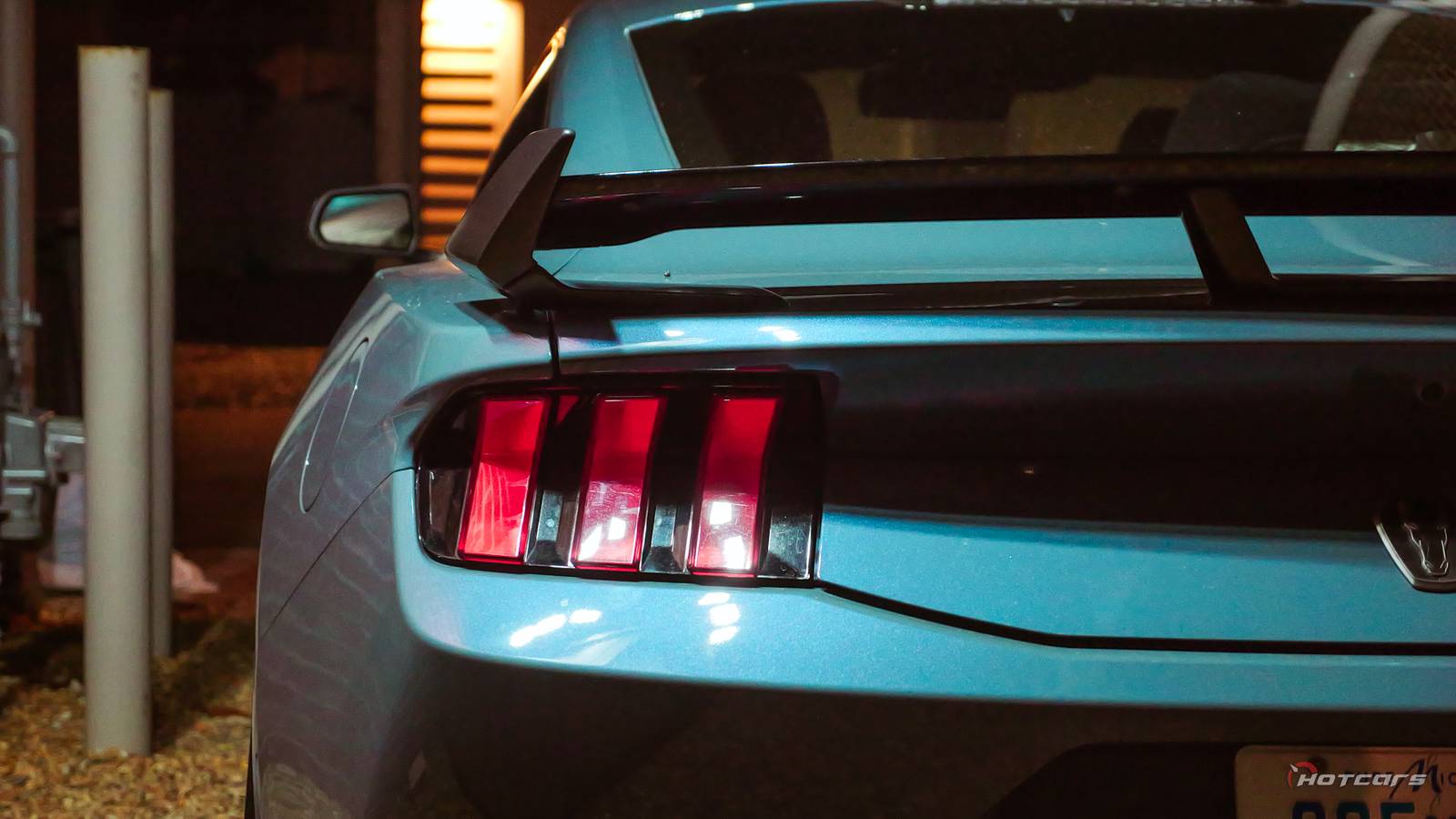
We’re talking about the Ford Mustang, and more specifically, the Dark Horse, the track-focused muscle car that combines a mighty naturally aspirated V8 engine with an available 6-speed manual transmission and rear-wheel drive. You can’t go wrong with a recipe like that, can you?
But wait, there’s more. The 2026 Dark Horse is the most track-focused, street-legal Mustang this side of a Mustang GTD, and it costs only a fraction of the GTD’s price, carrying a starting MSRP of $66,375 (including $1,995 destination).
The combination of the 500-hp naturally aspirated 5.0-liter Coyote V8 engine, the Tremec 6-speed manual gearbox (a no-cost option), and rear-wheel drive with a 3.73 rear axle makes the Dark Horse the Mustang to have for driving enthusiasts. There’s no other 2-door sports car on sale today in the U.S. that offers a normally aspirated V8 engine with a manual gearbox and rear-wheel drive, and that makes the Dark Horse not only the most analog American performance car, but also the only analog 2-door muscle car you can buy, period.
Engine
5.0-liter Ti-VCT ‘Coyote’ naturally aspirated V8
Bore x stroke
93.0 mm x 92.7 mm
Power
500 hp at 7,250 rpm
Torque
418 lb-ft of torque at 4,900 rpm
Drivetrain
Rear-wheel drive with a limited-slip differential
Transmission
Tremec TR-3160 6-speed manual
0-60 MPH
4.1 seconds
Top speed
168 mph
Now, let’s talk specs. The Mustang Dark Horse’s Coyote V8 puts out 500 hp at 7,250 rpm and 418 lb-ft of torque at 4,900 rpm. It also features a higher 7,500-rpm redline than the Mustang GT thanks to strengthened engine internals. When hooked to the 6-speed manual (a 10-speed auto is also available), the V8 enables the Mustang Dark Horse to do 0-60 mph in around 4.1 seconds and reach a top speed of 168 mph. As for the standing quarter-mile, it can be covered in the low to mid-12-second range.
Of course, when it comes to 0-60 and quarter-mile times, driver error is a big factor, as we’re talking about a manual transmission car. Speaking of the gearbox, the Tremec TR-3160 6-speed manual features shorter gears than those on the standard Mustang GT. That translates into more shifts, enhancing acceleration and track performance.
When ordered with the manual transmission, the Mustang Dark Horse also comes with a 3.73 rear axle instead of the automatic version’s 3.55 axle. The 3.73 axle ratio contributes to quicker acceleration and better low-end grunt for performance and towing, which is another thing the Dark Horse has going for it.
Now, if you want to compare the Mustang Dark Horse’s performance to other manual transmission performance cars, Ford’s muscle car is up there with some of the quickest ones, such as the Cadillac CT5-V Blackwing (3.6 seconds), BMW M3 (3.9 seconds), or Toyota GR Supra (3.9 seconds). It’s also almost as quick as the Porsche 911 Carrera T (4.0 seconds) despite costing less than half.
That said, performance figures don’t really do an analog sports car justice. Raw speed is nice to have, but it’s not that important; what matters more is that the driver feels a mechanical connection to the car, and that’s exactly what the Mustang Dark Horse offers.
While the Mustang Dark Horse offers most of the things enthusiasts want in an analog car, you should not mistake it for an old-school ride. This muscle car is as modern as it gets, featuring lots of tech that complements the analog part.
For example, some of the most high-tech features Ford offers on the Dark Horse include the fully digital cockpit, selectable drive modes that alter various parameters, including the MagneRide adaptive suspension, connectivity features like FordPass Connect, and driver assistance systems bundled in the Co-Pilot360 Assist+ package.
The Mustang Dark Horse is roughly five times cheaper than the new record-breaking GTD, but it’s still a better muscle car.
In addition, the muscle car also features a Track Apps menu in the infotainment system that allows users to activate several track-focused features, including launch control, lap timer, acceleration timer, line lock, brake performance, shift indicator, and active rev match. The good thing for purists is that the rev match function can be fully turned off if they prefer blipping the throttle themselves instead of letting a computer do it. Best of both worlds.
The sad truth is that analog cars are an endangered species as they are more expensive to build in the digital age, and demand for such vehicles is gradually shrinking. They are shifting toward a niche market for enthusiasts, with very high price tags. So what exactly makes a car analog?
There’s no precise definition, but generally it’s the direct mechanical connection to the driver consisting of raw feedback, minimal electronic driver aids (such as traction control or ABS), and the reliance on mechanical linkages like cables and hydraulics over drive-by-wire systems.
All these factors contribute to creating an unfiltered, engaging driving experience harking back to the era before computers took over the world. Key attributes of an analog car include manual transmissions, naturally aspirated engines (because they provide linear acceleration, progressive power delivery, and generally higher redline than turbo engines), hydraulic power steering instead of electric (although that has become very rare nowadays), and a focus on tactile feel.
An analog car can be front-wheel drive, rear-wheel drive, or all-wheel drive (we can certainly think of several off-roaders that fit the bill), but if we’re talking about a sports car for the road, rear-wheel drive is what you want to have. This setup allows for a pure driving experience where the front wheels are just steering the vehicle while the rear wheels are providing propulsion.
We want to hear from you! Share your opinions in the thread below and remember to keep it respectful.
Your comment has not been saved
This thread is open for discussion.
Be the first to post your thoughts.