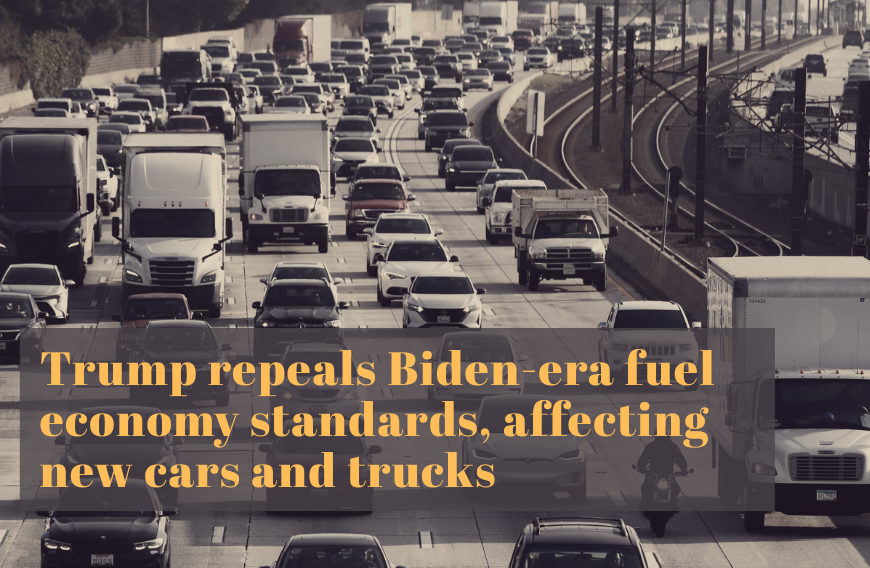
President Donald Trump looks to be on the war path against former President Joe Biden’s policies. Trump announced on Wednesday that he is repealing the Biden-era federal fuel economy standards, significantly weakening fuel efficiency requirements for tens of millions of new gasoline-powered cars and light trucks.
“We are officially terminating Joe Biden’s ridiculously burdensome, horrible actually, Cafe standards that imposed expensive restrictions,” Trump said in an Oval Office announcement, flanked by top auto executives including the CEOs of Ford and Stellantis. “It put tremendous upward pressure on car prices, combined with the insane electric vehicle mandate.”
It marks the president’s latest effort to dismantle pollution regulations and federal support for cleaner-running vehicles and renewable energy.
Joe Biden’s federal fuel-economy standards represented one of the administration’s central efforts to cut transportation-sector emissions, reduce fuel consumption, and accelerate the shift toward cleaner vehicle technologies. Implemented through the National Highway Traffic Safety Administration (NHTSA), the rules raised Corporate Average Fuel Economy (CAFE) requirements for automakers, affecting passenger cars, SUVs, and light- and heavy-duty trucks.
READ: Trump to undo Biden’s work against AI chip exports (
Early in Biden’s term, the administration reversed previous rollbacks and strengthened standards for model years 2024-2026, requiring annual increases in fleetwide efficiency. These rules aimed to push average fuel economy higher while giving automakers flexibility in how they met the targets, through improvements to gasoline engines, hybridization, or increased production of electric vehicles.
The long-term standards finalized in 2024 extended through model years 2027–2031. They called for steady efficiency gains in passenger cars and more moderate increases for light trucks, reflecting both technological expectations and consumer demand for larger vehicles.
The projected fleetwide average of roughly 50.4mpg by 2031, and the scheduled increases for trucks beginning in 2029, are now uncertain due to 2025 efforts to weaken or replace the rule. For heavy-duty pickups and vans, the standards targeted steep improvements into the mid-2030s, though these longer-term requirements may also be subject to revision.
Supporters argued that these rules would reduce gasoline consumption by billions of gallons, lower household fuel costs over a vehicle’s lifetime, cut climate-warming pollution, and strengthen energy security. Critics, particularly within the automotive industry, contended that rapid efficiency increases could raise vehicle prices and challenge manufacturers given the popularity of trucks and SUVs.
Wednesday’s announcement marks the latest action by the Trump administration to reverse Biden-era policies that encouraged cleaner energy vehicles, including relaxing auto tailpipe emissions rules, repealing fines for automakers that don’t meet federal mileage standards and terminating consumer credits of up to $7,500 for electric vehicle purchases.
READ: The myth of the ‘free market’ in fossil fuels (
Biden’s standards attempted to balance environmental goals with economic and market realities, though their long-term impact now depends on whether the 2025 rollback efforts succeed.
The clash over federal fuel-economy standards reflects a deeper national debate about the future of America’s transportation and energy systems. Biden’s rules sought to push the auto industry toward cleaner, more efficient technologies, framing higher fuel economy as essential to reducing emissions, cutting fuel costs, and strengthening long-term energy security.
Trump’s repeal, by contrast, signals a sharp return to prioritizing lower regulatory burdens, cheaper upfront vehicle prices, and expanded consumer choice, especially for gasoline-powered cars and trucks. These opposing approaches highlight the tension between environmental ambitions and economic or political considerations within the auto sector.
These policy shifts also have broader environmental and economic implications. While Biden-era standards were projected to reduce greenhouse gas emissions and encourage cleaner energy adoption, it is now uncertain how much of those benefits will be realized under the Trump rollback.
Vishnu Kaimal has over a decade of experience in both broadsheet and digital journalism. A graduate of the Asian College of Journalism Chennai, he has published stories for The Hindu, The New Indian Express and International Business Times, among other publications. He is an avid reader who spends his free time buried in books and when the mood strikes him he immersed himself in narrative driven videogames.
This site uses Akismet to reduce spam. Learn how your comment data is processed.
Let’s connect on any of these social networks!
The American Bazaar is a publication of American Bazaar, Inc., based in Germantown, MD.
Type above and press Enter to search. Press Esc to cancel.