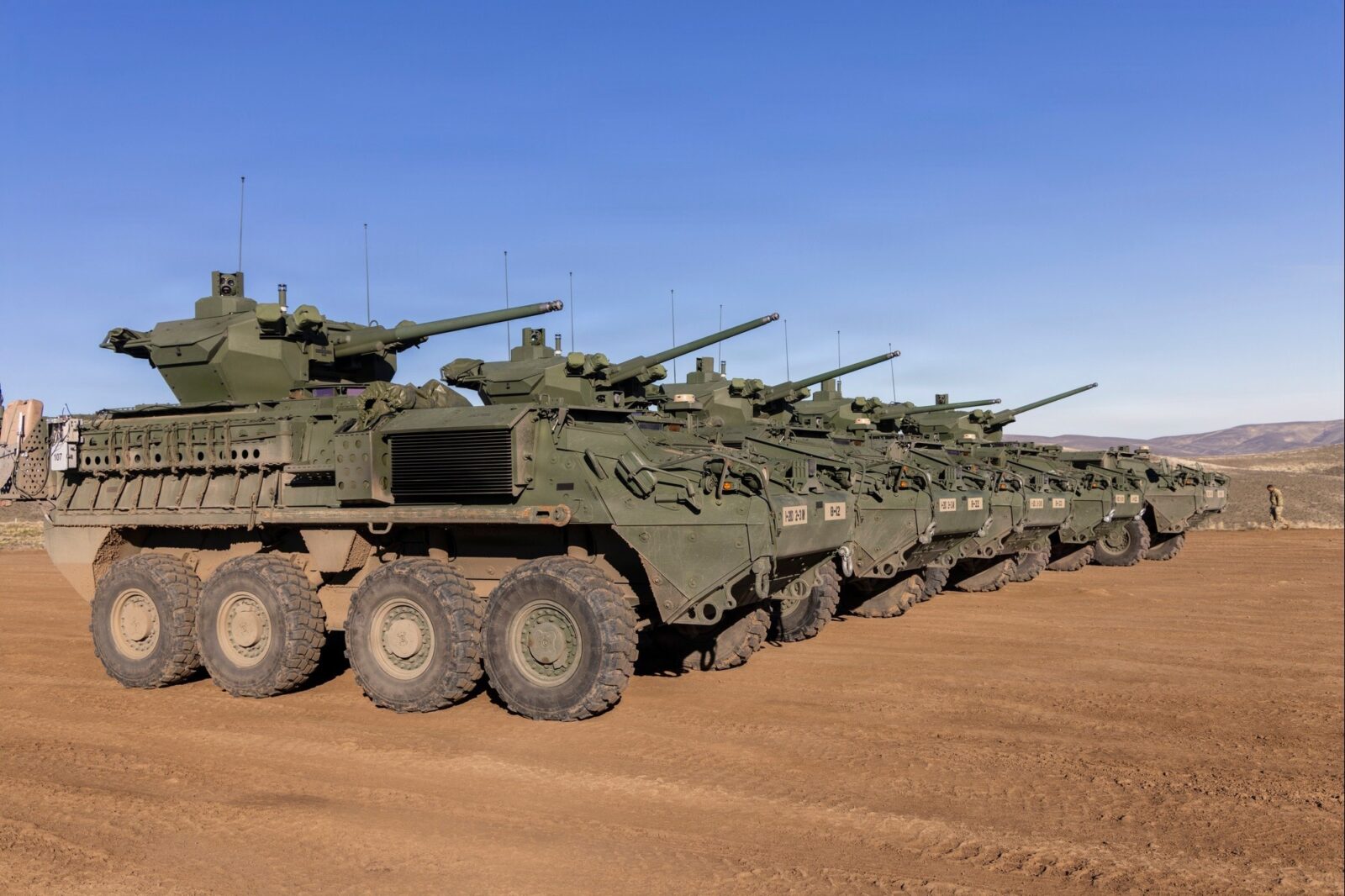
Soldiers from the 1st Battalion, 2nd Stryker Brigade Combat Team conducted a week of day and night live-fire gunnery at Yakima Training Center, Washington, using an experimental Stryker vehicle equipped with a 30mm autocannon, the U.S. Army confirmed.
The training event, held in a full operational environment, focused on live-fire qualification with the Stryker-mounted 30mm weapon system while integrating digital command-and-control tools. Crews employed Operational Network connectivity and the Digital Range Training System, using Instrumented Player Units inside their vehicles to track, record, and assess performance during offensive and defensive lane iterations.
“We’re only the second infantry brigade to train with the Stryker-mounted 30mm weapon system,” said U.S. Army Capt. Jarid Prahl, assistant operations officer for 2nd Battalion, 3rd Infantry Regiment. “So it’s also been unique to be on the cusp of the Army’s modernization initiatives, helping to advance the force and change the way we fight in the future.”
The gunnery was led by U.S. Army 1st Lt. Derrick Eng, who served as officer in charge for the range. Eng oversaw vehicle movement, digital system allocation, and communications to ensure crews fully utilized the experimental platform and its supporting technologies.
“It’s a complex system that requires tight synchronization,” Eng said. “Seeing crews qualify and adapt to a brand-new weapons platform while integrating digital tools shows how quickly Soldiers can learn and succeed when given the right resources.”
According to the Army, the 30mm system introduces additional demands compared with legacy Stryker armament. Crews were required to integrate sensors, advanced optics, and fire-control software while maintaining situational awareness inside the vehicle. During live-fire iterations, vehicle commanders and gunners relied on digital displays and real-time feedback to track target effects, adjust fire, and account for terrain and movement.
Operational Network connectivity allowed data to move between vehicles and the range infrastructure, providing crews with immediate access to performance information without disrupting execution. The Digital Range Training System recorded weapon engagements, vehicle positioning, and timing across each lane, allowing teams to review data between iterations rather than waiting until the conclusion of the exercise.
“This system brings a level of complexity and capability we haven’t had before,” said Spc. Nicolas Taylor, an infantryman assigned to 2nd Battalion, 3rd Infantry Regiment. “You feel a different kind of adrenaline when you’re operating it because you’re learning something entirely new. The 30mm gives you so much versatility—from airburst munitions to high-explosive rounds — and with the training we’re getting, you really see how efficient and effective the system can be.”
Taylor’s platoon leader, 1st Lt. Catherine Ortiz, observed the training and praised crew performance throughout the live-fire event. “They have been working on learning these new trucks and their time and dedication to learning paid off,” Ortiz said. “Watching our crews work through fatigue, adjust to a new Stryker, and still perform at a high level is exactly what we want to see from an Infantry formation. I’m proud of each of them and I know they will continue to excel.”
Readers who wish to follow our weekly coverage can subscribe to the Weekly Defense Roundup.
If you wish to report a grammatical or factual error in this article, please let us know by using the online form.
Support Independent Defense Reporting
© 2025 Defence Blog media group. All Rights Reserved.