By James Gent
The Insurance Institute for Highway Safety has released the first official findings from a brand-new form of crash testing, one that could significantly reduce the number of whiplash injuries recorded annually in the United States. Those among you that own a Toyota RAV4 can heave a sigh of relief, but those of you with a Ford Bronco Sport or Hyundai Tucson on the driveway may want to read on.
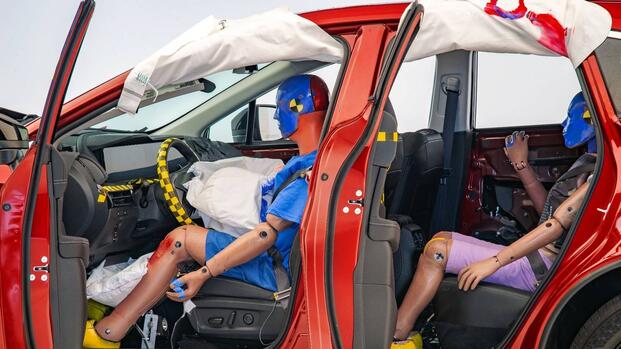
Like the head restraint evaluation it replaces, the IIHS’ new test determines the impact a rear-end collision can have on occupants in the driver’s seat. To test this, a midsize male dummy, with an articulating rather than rigid spine, is belted into a car seat loaned by the manufacturer being evaluated. The seat itself is then bolted to a sled on rails, and a rear-impact collision is simulated at 20 mph.
As was previously the case, the test measures head contact time – i.e. how long it takes for the head restraint to reach the back of the dummy’s skull – and the forces/speeds exerted on the upper spine, specifically the T1 vertebrae. The old test, however, was actually discontinued in 2022 when it was discovered that almost every seat being evaluated was receiving a ‘Good’ rating. Despite this, the number of whiplash cases being reported at accident sites were actually on the rise in North America.
The IIHS has since introduced a more rigid test, conducted with “greater severity,” to measure more metrics. While this new test will not eliminate false whiplash claims by defendants hoping for a quick pay-day, it is hoped the results will encourage automakers to continue developing their car seats to further improve cabin safety.
Alongside head contact time, for example, the new test more thoroughly evaluates head and spine support, and how much energy the seat absorbs under impact. Two different speeds are now being used as standard – 20 mph and 30 mph – given the significant differences 10-plus mph can make on the human body. The IIHS even measures how far the pelvis will move when impacted at 30 mph.
Moreover, the US organization also recommends that drivers, just as you would adjust your seatbelt before setting off, should ensure the headrest helps hold your neck in a natural upright position. Also, don’t put your feet on the dashboard. It may not be illegal, but it’s monumentally stupid.
IIHS used 36 late-model vehicles to fine-tune the new test, though the specific models weren’t revealed. With a baseline established, 18 small SUVs were chosen for the first official round of testing, all being 2025 models save for the 2024 Honda CR-V.
Interestingly, just four models – the Audi Q3, the Hyundai Ioniq 5, the Subaru Forester, and the Toyota RAV4 – passed the test with a top-tier ‘Good’ rating. Nine models received a mild slap on the wrist but were nevertheless ‘Acceptable.’ Two further vehicles – the BMW X1 and the Nissan Rogue – got a stern telling off, as their results were deemed ‘Marginal.’
Source: IIHS
Read the full article on CarBuzz
This article originally appeared on CarBuzz and is republished here with permission.
From its understated design to its powerful five-cylinder engines, Volvo's C70 convertible – discontinued in 2013 – left a…
The unique story of the Chevrolet K5 Blazer M1009, a military 4WD that served in the US armed forces, including the Gulf War.
Grand Cherokee SUVs from 2021 to 2023 are part of the recall, owing to improperly seated suspension components.
The most over-engineered American cars ever made, from the Duesenberg Model SJ to the Hennessey Venom F5 Revolution.
One of the keys to maintaining and repairing your car's engine is knowing all of its components and how they interact.
Maintenance is imperative if you want a diesel engine to last, and every diesel owner will probably encounter some pitfalls.
If your car's electronics go dead, it's probably due to a blown fuse. You can change fuses yourself easily and cheaply.
Since diesel fuel is sometimes called diesel oil, know that the oil to change is not the fuel but what lubricates the engine.
Replacing hoses is usually pretty easy and inexpensive, with two caveats.
Visit our Customer Support center for solutions or to contact us.
Related Article